
United States · District of Columbia
Washington, built for walking
Nearly every headline museum here is free, the whole spine of the city runs along one flat green mall, and the parts worth remembering are a fifteen-minute walk from the ones on the postcard.
A capital built to be walked, and free almost everywhere you look · 38.91° N · 77.04° W
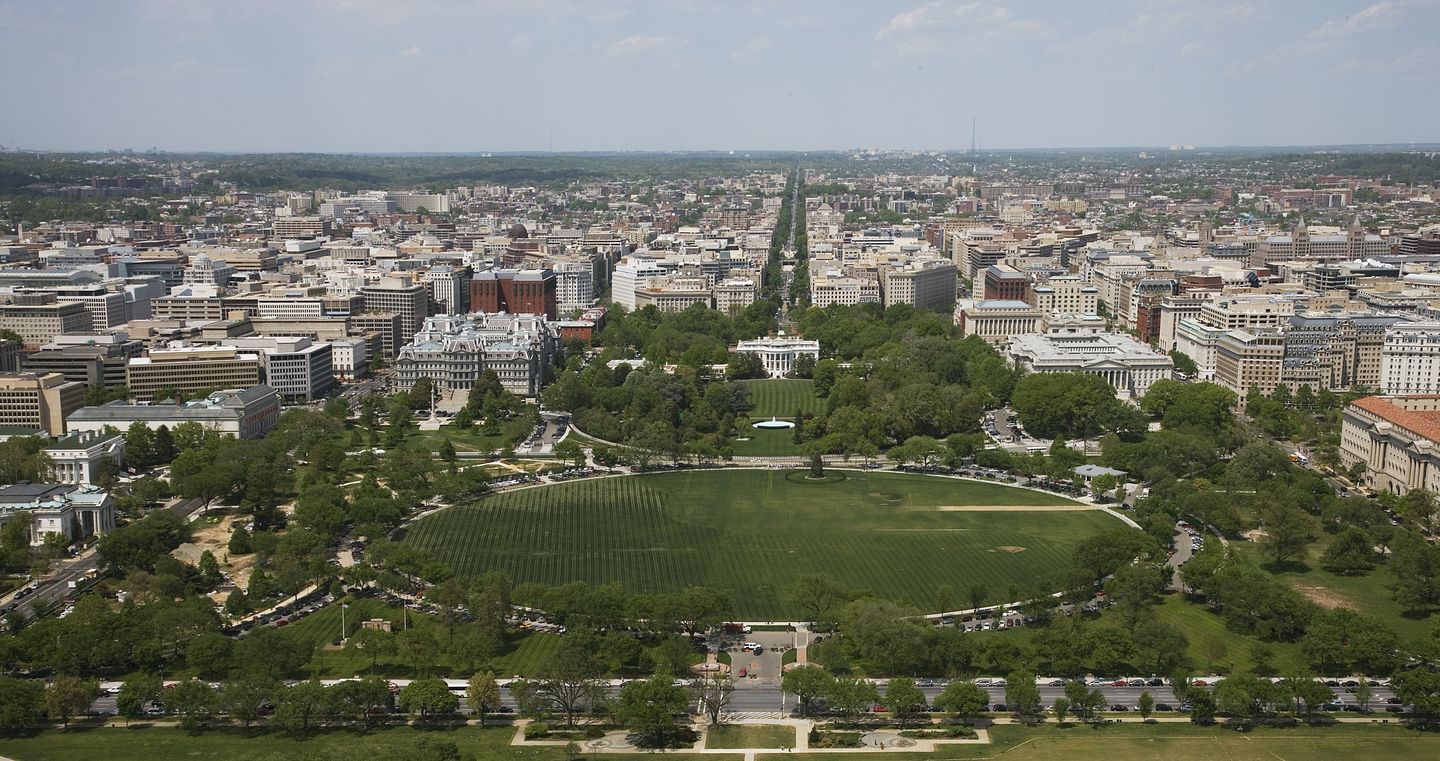
Washington is the rare capital that was designed rather than accumulated. Pierre L'Enfant laid a grid of broad avenues over a swampy stretch of the Potomac in 1791 and drew a two-mile green spine through the middle of it, and two centuries later that spine is still the organising fact of the city: the National Mall, flanked by more free world-class museums than any other stretch of ground on earth, bookended by a obelisk at one end and a Greek temple to a dead president at the other. Almost everyone who visits spends their first day on that spine, and they are right to, but treating it as the whole trip is the single most common way to leave disappointed.
The city that exists around the monuments is smaller, denser and considerably more interesting than its reputation as a town of suits and motorcades suggests. Washington has the largest Ethiopian population of any city outside Ethiopia, a go-go music scene it invented and still guards jealously, rowhouse neighbourhoods that shift character block by block, and a restaurant scene that quietly stopped being a punchline sometime in the last fifteen years. None of that shows up if you fly in, do the Mall in a day, and fly out. It shows up if you give the place a few evenings away from the marble.
It also happens to be one of the easiest major world capitals to visit on a budget, because the single biggest expense line on most city trips — museum admission — simply does not exist here for the Smithsonian institutions, which cover art, natural history, air and space, American history and a dozen other subjects without charging a cent. What follows is how to spend that saved money and time well: when to come, how to get around a city that is flatter and more walkable than it looks on a map, and which neighbourhood to actually sleep in.
The caseWhy Washington earns more than a day trip
The obvious case is the free museums, and it undersells the point to call it obvious: the Smithsonian's DC museums alone would anchor most other cities' entire cultural tourism industry, and here they are stacked one after another along a single walkable mall, no ticket required. The National Gallery of Art holds the only Leonardo da Vinci painting in the Americas. The National Air and Space Museum holds the actual 1903 Wright Flyer and the command module from Apollo 11. The National Museum of African American History and Culture, opened in 2016, is as serious and as sobering a museum as exists in the country, and it is also free, and it also requires a timed pass because of how many people already know that.
The less obvious case is that Washington is a genuinely liveable, human-scaled city underneath the monumental core, something its own tourist marketing undersells because monuments photograph better than rowhouses. The height limit imposed on buildings in 1910 means downtown never grew a Manhattan skyline, and the result is a capital where you can usually see the sky and the tree line from most intersections, where neighbourhoods like Capitol Hill and Georgetown read as villages rather than districts, and where a fifteen-minute Metro ride swaps federal Washington for a completely different register of city almost entirely.
The third case is timing-dependent but worth building a trip around if you can: late March into early April, when roughly 3,700 cherry trees around the Tidal Basin bloom in a two-week window that the whole city organises itself around, drawing well over a million visitors to a stretch of water that is empty and unremarkable the other fifty weeks of the year.
The calendarWhen to go
Spring is the headline season and for good reason. The National Cherry Blossom Festival runs roughly late March through mid-April, timed around the trees' actual bloom, which the National Park Service forecasts a few weeks out rather than fixes to a calendar date — check the current-year prediction before booking, because a warm February can pull peak bloom a full week earlier than the festival's own printed dates. April and May more broadly bring mild, comfortable weather and the Mall at its most photogenic, but also its most crowded and most expensive for hotels; book well ahead if your dates fall anywhere near peak bloom.
Fall, specifically late September through October, is the connoisseur's answer and arguably the better trip: comparable mild weather, real autumn colour along the Mall's elms and in Rock Creek Park, and none of the cherry-blossom crush. Washington's summer is genuinely rough — high heat, matching humidity, and the kind of thick air that makes an afternoon of monument-walking miserable — and it is also, unhelpfully, when Congress is out of session and the tourist crowds are near their annual peak regardless, mostly families travelling on the school calendar. Winter is the true off-season: cold, occasionally snowy, hotel rates drop noticeably, and the free museums are at their emptiest, which is a legitimate trade if you don't need cherry blossoms or garden weather to enjoy the trip.
One more calendar fact worth building around: Smithsonian museums are closed only on December 25th, and most run reliably from around 10am to 5:30pm the rest of the year, with select museums keeping extended summer evening hours — check the current schedule for whichever museum tops your list, since hours do shift museum to museum and season to season.
LogisticsGetting around
The Mall itself is flat and entirely walkable, but it is also considerably longer than it looks on a map — end to end, from the Capitol to the Lincoln Memorial, is closer to two and a half miles, and that is before you factor in the distance from any museum entrance to the actual exhibits inside it. Budget more walking time than instinct suggests, wear shoes you trust, and do not try to do the Capitol, the whole Mall, and Arlington Cemetery in a single day on foot; pick a zone and let the rest wait.
The Metro (WMATA) is clean, reasonably fast, and the right tool for anything beyond the Mall itself — Georgetown notably has no Metro station, which is the one significant gap in the system and the reason a short bus ride or a ten-minute walk from Foggy Bottom is usually the practical answer for getting there. Buy a SmarTrip card (physical or, more simply, loaded straight onto a phone's contactless wallet) and tap in and out; fares are distance-based, so keep the card for the whole trip rather than buying single-ride tickets. Trains run less frequently than in denser transit cities, particularly on weekends and after evening rush, so check real-time arrivals rather than assuming a train every few minutes.
Capital Bikeshare stations are dense throughout the central city and genuinely useful for the Mall-to-neighbourhood hops the Metro handles awkwardly — a single ride unlocks with a phone in under a minute, and the flat, low-rise geography of central DC makes cycling comfortable in a way it isn't in hillier capitals. Ride-hailing apps work everywhere and are the sensible choice late at night or for the last mile to somewhere the Metro doesn't reach. Reagan National Airport (DCA) is the closest airport, directly on the Metro's Yellow and Blue lines and a genuine convenience; Dulles (IAD) is further out in Virginia and needs either the Silver Line Metro extension or a taxi/rideshare, both adding real time.
The tableHow Washington actually eats
Start with the half-smoke, the city's own contribution to American sandwich culture: a coarser, smokier, part-beef, part-pork cousin of the hot dog, split and grilled, piled with mustard and DC's obligatory half-smoke chili. Ben's Chili Bowl on U Street has served them since 1958, survived the 1968 riots as one of the few Black-owned businesses left standing on the block, and remains the correct place to eat one, ideally at an hour when the line has thinned.
Washington's more understated culinary claim is Ethiopian food, and it is not a minor claim: the DC area holds the largest Ethiopian population of any city outside Ethiopia itself, concentrated historically around the U Street corridor's stretch still nicknamed Little Ethiopia. Injera-based combination platters, torn and shared by hand, are the standard order, and the neighbourhood's density of genuinely excellent, unpretentious Ethiopian restaurants has no real equivalent in most other American cities.
The last fifteen years turned Washington into a legitimate national dining destination beyond either of those, driven partly by a wave of chefs who treated the city as underrated territory rather than a government-town backwater, and partly by the neighbourhood-scale renewal of areas like Shaw, the Wharf and Navy Yard, each of which now carries its own cluster of serious restaurants and a food hall or two. Union Market in NoMa is the model example — a converted wholesale food terminal turned indoor market of a few dozen stalls, useful for one meal that samples several cuisines rather than a single sit-down commitment. Congressional schedules also shape the scene in a small but real way: expense-account power-lunch spots near Capitol Hill and K Street are a genuine sub-genre of DC dining, worth people-watching even if you're not the one on the account.
The mapNeighbourhoods to know
Capitol Hill, east of the Capitol building itself, is Washington's grandest residential neighbourhood: tree-lined rows of Victorian townhouses, the Eastern Market food and crafts market anchoring its southern end, and a genuine village feel a short walk from the seat of Congress. It is central for the Mall's eastern half and one of the more atmospheric places to actually sleep.
Dupont Circle, a mile or so northwest of the White House, is the classic base for first-time visitors: dense with restaurants, embassies in converted mansions, a well-regarded Sunday farmers market, and excellent Metro connections in every direction. Adams Morgan, just north of it, carries the city's late-night bar and live-music energy and a long-standing immigrant food scene, loudest and best after dark.
Georgetown, the oldest part of the city and pre-dating the federal capital itself, holds the cobblestone-and-rowhouse postcard version of Washington, the C&O Canal towpath, the Georgetown University campus, and the M Street shopping strip — genuinely lovely to walk, notably lacking a Metro station, and worth factoring that gap into any stay-here decision. Shaw and the U Street Corridor, historically the heart of Black Washington and the 'Black Broadway' jazz scene that gave the city Duke Ellington, is now the sharpest edge of the restaurant and nightlife scene, Ben's Chili Bowl and Little Ethiopia both included.
Navy Yard and the Wharf, both waterfront redevelopments along the Anacostia and Potomac respectively, are the newest additions to the map — Navy Yard built up around Nationals Park and now dense with modern apartments and restaurants, the Wharf a purpose-built strip of restaurants, a concert venue and a marina on the Potomac's edge. Neither has the historic texture of Georgetown or Capitol Hill, but both are genuinely pleasant for an evening and easy to reach.
Field intelligencePractical intelligence
Security matters more here than in most cities, simply because of what's being secured. Airport-style screening (bag checks, metal detectors) is standard at the Capitol, the White House visitor entrance, and several Smithsonian museums, particularly the Air and Space and African American History museums; arrive with slack in your schedule and, ideally, without a large bag at all, since the checkpoints move faster for people carrying less. Capitol tours and White House tours both require advance reservation through your member of Congress's office (for US residents) or your embassy (for international visitors) — this is not a same-week booking, so request it weeks ahead if either is a priority.
Many of the marquee free museums — the National Museum of African American History and Culture chief among them — now require a timed-entry pass booked online, released on a rolling schedule; check each museum's current policy before you build a day around it, because turning up without one can mean a same-day walk-up pass if you're lucky or a wasted trip if you're not. The Mall itself has essentially no shade and very little seating relief between monuments, so summer visitors in particular should carry water and expect the heat to set the day's pace more than any itinerary will.
Tipping follows standard American convention: fifteen to twenty percent at sit-down restaurants, a dollar or two per drink at a bar. The Metro's last trains run earlier than in many capitals — roughly midnight on weeknights, slightly later on weekends — so check the schedule before committing to a late night out somewhere the Metro is your planned way home.
What to see & do
-
The National Mall
The two-and-a-half-mile green spine of the city, running from the Capitol to the Lincoln Memorial, lined with the Smithsonian's free museums on both sides and threaded with the monuments most visitors come to see.
Tip:Do it in zones over two days rather than one exhausting sweep — the distances between the Capitol end and the Lincoln Memorial end are longer than they look on any map.
-
Smithsonian National Air and Space Museum
The most-visited museum on the Mall, holding the 1903 Wright Flyer, the Apollo 11 command module and Amelia Earhart's Lockheed Vega, in a building mid-renovation that reopens its galleries in stages.
Tip:Check which galleries are open before you go — the phased renovation means the collection on display shifts year to year — and expect the same airport-style security as the Capitol.
-
National Museum of African American History and Culture
Opened in 2016 to instant acclaim, tracing the African American experience from the transatlantic slave trade through the civil rights movement to the present, in a distinctive bronze-latticed building on the Mall's northwest corner.
Tip:Book a free timed-entry pass online in advance — walk-up access is limited and unreliable, and this is the one Mall museum most likely to require real planning.
-
Lincoln Memorial
Daniel Chester French's nineteen-foot seated Lincoln, facing the Reflecting Pool down the length of the Mall from a Greek Revival temple, and the site of Martin Luther King Jr.'s 1963 'I Have a Dream' speech, marked by an inscription on the steps.
Tip:Come at dusk or after dark — the memorial is lit and open around the clock, and the crowds thin dramatically once the day-trip buses leave.
-
United States Capitol
The seat of Congress since 1800, its cast-iron dome added during the Civil War as a deliberate statement that the Union would endure, toured via a below-ground Visitor Center that requires advance reservation.
Tip:Book a tour through your member of Congress's office or your embassy weeks ahead — same-week Capitol tour slots are rare, though the Visitor Center's exhibits are open without one.
-
Tidal Basin & cherry blossoms
A reservoir ringed by roughly 3,700 cherry trees gifted by Japan in 1912, unremarkable most of the year and the single most photographed two weeks in the city when they bloom each spring, alongside the Jefferson and MLK memorials on its banks.
Tip:Check the National Park Service's annual bloom forecast rather than a fixed calendar date — peak bloom shifts by up to a week or more year to year with the weather.
-
National Gallery of Art
A free, encyclopaedic collection spanning medieval altarpieces to Rothko, including Ginevra de' Benci, the only painting by Leonardo da Vinci on public display anywhere in the Americas.
Tip:The East and West Buildings are connected by an underground concourse; start in the West Building's rotunda and work outward rather than trying to see both wings in one pass.
-
Georgetown & the C&O Canal
The city's oldest quarter, a cobblestone-and-rowhouse neighbourhood predating the federal capital, threaded by the historic C&O Canal towpath and anchored by the M Street shopping strip and the Georgetown University campus.
Tip:There is no Metro station here — take a bus, walk from Foggy Bottom, or use a bikeshare dock, and budget the extra time accordingly.
-
Arlington National Cemetery
Across the Potomac in Virginia, over 400,000 graves on rolling hills around Robert E. Lee's former estate, including the Tomb of the Unknown Soldier and its round-the-clock changing of the guard.
Tip:Walk to the Tomb of the Unknown Soldier first thing to catch a guard change without a crowd, then use the cemetery's own shuttle bus for the longer distances between sections.
On the groundWhere things are
Map data © OpenStreetMap contributors.
Where to stayBase yourself well
Capitol Hill
Best for history-focused first-timersGrand Victorian rowhouses and a genuine neighbourhood feel a short walk from the Capitol, with Eastern Market anchoring the southern end. Quieter in the evening than downtown, and the most atmospheric base for the Mall's eastern half.
A boutique inn in a converted Capitol Hill rowhouse
Look for something within a few blocks of Eastern Market for the neighbourhood's best mornings and easy Metro access via the Orange, Blue and Silver lines.
$$$Dupont Circle
Best for first-timers who want everything walkableThe classic central base — dense with restaurants, embassies in converted mansions, and excellent connections in every direction. Costs a little more for the convenience, and earns it.
A mid-range hotel just off Dupont Circle itself
Staying inside the ring of the traffic circle puts the Sunday farmers market and the Metro station both within a five-minute walk.
$$$A smaller boutique property toward Logan Circle
A ten-minute walk east trades a little polish for lower rates and proximity to Shaw's restaurant scene.
$$Georgetown
Best for romance and a slower pace, with a car or patience for busesCobblestone streets, the canal towpath, and the city's most postcard-ready neighbourhood — at the cost of the one significant Metro gap in central Washington.
A historic inn on a quiet Georgetown side street
Budget extra time for getting to the Mall — the nearest Metro is a real walk or a short bus ride away at Foggy Bottom.
$$$$Shaw & U Street
Best for food-first visitors and night owlsThe sharpest edge of the restaurant and nightlife scene, historically the heart of Black Washington, with Ben's Chili Bowl and Little Ethiopia both inside a short walk. Louder and looser than Capitol Hill or Dupont.
A design-led hotel on the U Street corridor
Puts the neighbourhood's restaurants and live-music venues on the doorstep, with the Green and Yellow line Metro a short walk away.
$$Navy Yard & the Wharf
Best for repeat visitors and baseball fansThe newest additions to the map — waterfront redevelopments with modern apartments, restaurants and a marina, lacking the historic texture of the older neighbourhoods but easy and pleasant for an evening.
A modern waterfront hotel at the Wharf
Puts a marina, a concert venue and a strip of restaurants outside the door, with a short ride to the Mall.
$$$Affiliate notePostcardRoute is reader-supported. Some links to Booking.com (stays, flights, car hire, tickets and tours, airport transfers) are affiliate links, tracked through CJ Affiliate: if you book through them we may earn a small commission at no extra cost to you. We only recommend places we would send a friend.
Book the restEverything else for the trip
Stay sorted? These open Booking.com for the other legs of the journey.
-
Tours & tickets
Things to do
Tickets, tours and activities, anywhere.
Browse activities -
Wheels
Car hire
Compare rental companies worldwide.
Compare cars -
Air
Flights
Search fares, then come back for the neighbourhood advice.
Search flights -
Ground
Airport transfers
Book a taxi or private transfer before you land.
Book a transfer
Affiliate noteThese four links are affiliate links too: if you book through them we may earn a small commission at no extra cost to you.
Beyond the cityWorthwhile day trips
- Mount Vernon
George Washington's plantation estate on the Potomac, a short drive or riverboat ride south of the city, with the preserved mansion, gardens and his tomb on-site.
- Annapolis
Maryland's colonial-era state capital and the home of the US Naval Academy, an hour east by car, with a walkable historic waterfront and some of the region's best crab.
- Shenandoah National Park
Roughly ninety minutes west, the Blue Ridge Mountains' Skyline Drive strings together overlooks and hiking trailheads, best in autumn for colour or early summer for waterfalls.
- Baltimore
Forty minutes north by train, a grittier, more industrial port city with a genuinely excellent aquarium, Fells Point's rowhouse waterfront, and Maryland crab cakes worth the trip alone.
Before you goCommon questions
- How many days do you need in Washington D.C.?
- Three full days covers the Mall's headline museums and monuments at a reasonable pace without exhausting yourself. Four or five lets you add a neighbourhood evening in Shaw or Georgetown and a day trip. A single day will show you the monuments but none of the city around them.
- Are the Smithsonian museums really free?
- Yes, every Smithsonian museum on the National Mall is free to enter, no ticket required for general admission. Some special exhibitions charge separately, and the National Museum of African American History and Culture requires a free timed-entry pass booked in advance because of demand — but there is no admission fee at any of them.
- What is the best area to stay in Washington D.C. for first-timers?
- Dupont Circle or Capitol Hill. Both are central, well connected by Metro, and walkable to a meaningful chunk of the Mall, with Dupont slightly better for restaurants and Capitol Hill for atmosphere and proximity to the Capitol itself.
- When do the cherry blossoms bloom in Washington?
- Typically late March into early April, but the exact window shifts by up to a week or more year to year depending on the weather — check the National Park Service's annual bloom forecast, released a few weeks ahead, rather than assuming a fixed date.
- Do I need a car in Washington D.C.?
- No, and it is genuinely a disadvantage in the central city — parking is scarce and expensive, and the Metro, buses and bikeshare cover the Mall and most neighbourhoods well. A car becomes useful mainly for day trips like Shenandoah National Park.
- Do I need to book the Capitol or White House tour in advance?
- Yes, both require advance reservation — through your member of Congress's office for US residents, or your embassy for international visitors — and neither can reliably be booked the same week. Request either weeks ahead if it matters to your trip.
- Is Washington D.C. walkable?
- The Mall itself is flat and walkable but longer than it looks — end to end is roughly two and a half miles. Beyond the Mall, most central neighbourhoods are walkable in their own right, with the Metro filling in the longer hops between them.