
Guatemala · Sacatepéquez
Antigua, between two volcanoes
A colonial capital the earth kept interrupting, left half-ruined on purpose, and now the best-preserved wreck in the Americas.
Dispatch from the colonial capital two volcanoes still watch over · 14.56° N · 90.73° W
Plan this trip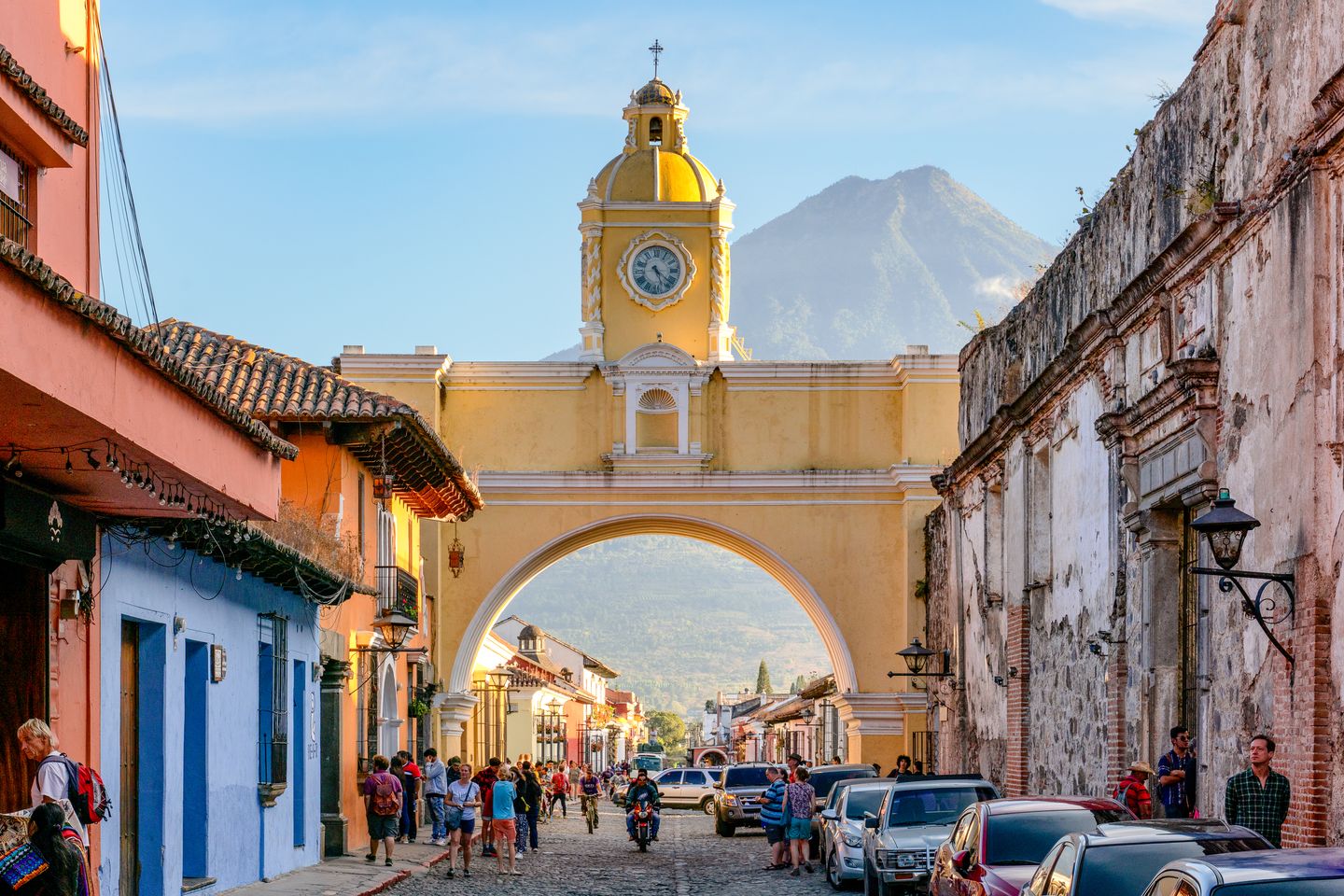
Antigua Guatemala was the capital of the entire Captaincy General of Guatemala for two hundred years, a seat of Spanish colonial power that ran a territory stretching from Chiapas to Costa Rica, and then an earthquake in 1773 broke it badly enough that the crown gave up and moved the capital forty kilometres away. What is left is one of the strangest and most beautiful cities in Central America: a perfect colonial street grid, cathedrals and convents in every state between pristine and rubble, and two enormous volcanoes standing close enough that on a clear afternoon you can watch cloud form on their flanks from a café table in the plaza.
This is not a ruin visited for its own sake, like an archaeological site fenced off from daily life. People live inside it. Tuk-tuks and chicken buses rattle over the same cobblestones the Spanish laid, language schools operate out of colonial courtyards, and a serious coffee industry grows on the volcanic soil in the surrounding valley. The 1773 destruction is the whole point of what makes Antigua interesting today — not a tragedy to tour past, but the reason the city stopped being rebuilt over and instead got frozen, patched, and eventually protected as a UNESCO World Heritage Site in 1979.
It rewards a slower visit than most itineraries give it. Two nights gets you the arch, a church or two and a volcano tour bolted onto a Lake Atitlán trip. Four or five nights lets the city's actual rhythm show itself — the market at dawn, the ruins at an hour when you have them to yourself, an overnight hike to watch a different, still-active volcano throw lava into the dark. Antigua is compact enough to walk in full inside a day and interesting enough to justify a week.
The caseWhy Antigua still earns the detour
Most colonial cities in Latin America were rebuilt after their disasters. Antigua largely wasn't, and that refusal is what makes it singular. Walk two blocks off the Parque Central and you pass from a fully restored baroque façade to a roofless nave open to the sky, its walls still standing at the exact angle the earthquake left them, weeds growing out of what used to be a choir loft. The city council has spent decades since debating how much to rebuild versus preserve as ruin, and the compromise — strict height limits, no modern signage on the historic core, restoration rather than replacement — is why Antigua still looks like 1773 interrupted rather than a theme-park version of itself.
The setting does the rest of the work. Volcán de Agua sits directly south of the city, a near-perfect cone that closes off the end of half the streets running north-south, so the volcano becomes part of the urban geometry rather than distant scenery. To the west, Fuego and Acatenango form a paired ridge, and Fuego is genuinely active — it vents ash regularly and occasionally puts on a visible eruption from town. Nowhere else combines this density of intact colonial architecture with an active volcanic backdrop you can hike in the same trip.
The calendarWhen to go
The dry season, roughly November through April, is the reliable window — clear skies for the volcano views, cobblestones that aren't slick, and the comfortable daytime temperatures Antigua's roughly 1,530-metre elevation gives it year-round. December through February is the coolest stretch and can turn genuinely chilly after dark, worth packing a real layer for despite the tropical latitude.
Semana Santa, the week before Easter, is Antigua's single biggest event and arguably the most elaborate Holy Week procession anywhere in the Americas — processions of hooded cucuruchos carrying enormous floats over the top of alfombras, intricate carpets of dyed sawdust and flower petals laid fresh each morning and destroyed within hours by the procession that walks over them. It is spectacular and it is also the most crowded, most expensive week of the year to be here; book accommodation months ahead if that is the draw.
May through October is the rainy season, though 'rainy' in Antigua usually means a clear morning and a reliable afternoon downpour rather than days lost entirely. The volcanoes cloud over more often in the wet months, which matters if a hike to see them erupt is the priority, but the city itself, the coffee harvest season, and the markets run exactly the same, with fewer visitors and lower prices.
LogisticsGetting around
Antigua is genuinely walkable — the colonial core is a tidy grid roughly eight blocks by eight, and almost everything on a first visit sits inside it or a short tuk-tuk ride beyond it. The cobblestones are uneven and the sidewalks are narrow and often blocked by parked cars, so wear real shoes; this is not a flip-flop city despite the climate.
Tuk-tuks are everywhere, cheap, and the easiest way to cover the slightly longer stretches or reach the edge-of-town viewpoints without a car. Chicken buses, the recycled and elaborately repainted American school buses that run across Guatemala, connect Antigua to Guatemala City and surrounding towns for very little money, though they are crowded and not the fastest option if time matters more than the experience.
Most visitors arrive via La Aurora International Airport in Guatemala City, roughly 45 minutes to an hour away by road depending on traffic, and the standard move is a shared shuttle van booked in advance rather than public transport straight off a flight. Renting a car buys flexibility for the surrounding valley and Lake Atitlán, but the mountain roads are winding and locals generally avoid driving them after dark; a private driver or organised tour is the easier choice for day trips if you would rather not do that stretch yourself.
The tableHow Antigua actually eats
Guatemalan food in Antigua runs on maize, beans and a short list of serious sauces, and the dish to actually order is pepián, a thick, toasted-spice stew usually built on chicken, considered by many Guatemalans their national dish. Jocón, a green stew built on tomatillo, cilantro and green chile, is the other essential, and both are worth ordering from a comedor — the small, family-run set-menu kitchens — over a tourist-facing restaurant, where the same dish is often better and considerably cheaper.
Antigua sits inside one of the world's genuinely serious coffee regions, and the local coffee is not a marketing line — the volcanic soil and altitude around the city produce beans that specialty roasters pay real premiums for. Drink it black, ask where it was grown, and take at least one finca tour seriously rather than treating it as a between-ruins filler; the better operations show you the whole process from cherry to cup, not just a gift shop.
Street food and the market are where the city's actual eating happens. Chuchitos — small, dense tamales wrapped in corn husk rather than banana leaf — make a good breakfast bought standing up. The mercado has a food section past the produce stalls worth pushing into rather than avoiding; it is where locals eat lunch, and the caldo and grilled meat stalls there beat most of what is plated for visitors around the plaza.
The mapGetting to know the grid
Antigua's streets are numbered avenidas (running north-south) and calles (running east-west), radiating out from the Parque Central, and once that clicks the whole city becomes trivially easy to navigate without a map. The blocks immediately around the plaza — La Catedral, the cabildo, the fountain — carry the highest concentration of restored buildings, restaurants and the Santa Catalina Arch a few blocks north on 5a Avenida Norte, the single most photographed street in the country.
San Bartolomé Becerra and the western edge of the grid are quieter and more residential, with cheaper guesthouses and a stronger local, less souvenir-driven feel, while still being a manageable walk to the centre. Toward the north, the streets climbing toward Cerro de la Cruz thin out into a mix of language schools, small hotels and the base of the hill itself. The eastern side, around Santo Domingo, mixes some of the grandest converted-convent hotels in the city with regular residential blocks — the contrast between a five-star courtyard and a corner tienda on the same street is very much the Antigua experience in miniature.
Field intelligencePractical intelligence
Altitude here is mild by Guatemalan highland standards — around 1,530 metres, noticeably cooler than the coast but rarely a problem even for visitors who feel altitude at elevation. The volcano hikes are a different story: Acatenango's summit sits above 3,900 metres, and the overnight trek is genuinely strenuous, cold at the summit camp regardless of season, and worth respecting rather than underestimating because the town below is warm and easy.
Safety in the historic centre is generally good by day; the usual city-centre cautions apply after dark, and it is worth asking your accommodation which streets to avoid walking alone at night rather than assuming the whole grid is equally safe once the shops close. Petty theft around crowded markets and bus terminals is the more common risk than anything violent.
Spanish-language schools are a genuine local institution here, not a gimmick — Antigua is one of the most popular places in the Americas to study Spanish, with a wide range of one-on-one immersion schools, many pairing lessons with a homestay. Even a visitor with no interest in formal study benefits from the byproduct: an unusually large number of English-speaking expats and long-term students who know the city well and are generally happy to talk. Tap water is not reliably potable; drink bottled or filtered, which every hotel and most restaurants provide as standard.
Field notesWhat to see & do
-
Santa Catalina Arch
A yellow arch straddling 5a Avenida Norte, built in the 17th century so cloistered nuns at the Santa Catalina convent could cross the street unseen, with Volcán de Agua framed perfectly behind it. The single most photographed spot in the country.
On the groundCome at sunrise before the tuk-tuks and tour groups fill the street — the light on the volcano is best in the first hour after dawn, and you will have the frame to yourself.
-
Parque Central and the Cathedral ruins
The city's founding square, with a Mermaid Fountain at its centre and the Cathedral of San José behind it — a fully restored front chapel gives way to a roofless, earthquake-shattered nave you can walk into for a small fee, arches open to the sky.
On the groundPay the entry to the ruined section behind the working chapel; most visitors only see the intact front and miss the more atmospheric half entirely.
-
Iglesia y Convento de La Merced
The best-preserved of Antigua's grand churches, with an ornate stucco façade the colour of egg yolk and a vast convent courtyard behind it holding the largest colonial fountain in Central America, shaped like a water lily.
On the groundClimb to the rooftop terrace for a volcano panorama that rivals Cerro de la Cruz without the walk out of town.
-
Cerro de la Cruz
A hilltop viewpoint on the northern edge of the city, topped with a large stone cross, giving the classic postcard shot: the whole grid of orange roofs laid out below with Volcán de Agua rising directly behind it.
On the groundRobberies were a real problem on this walk in the past; go in a group in daylight hours, or take a tuk-tuk up, which most drivers now do routinely and safely.
-
Santo Domingo ruins and Casa Santo Domingo
A former Dominican monastery, one of the largest in the Americas before 1773, now half archaeological site and half luxury hotel and museum complex built around the surviving cloisters, crypts and excavated foundations.
On the groundYou do not need to stay at the hotel to visit the museums and ruins inside — day tickets are sold separately and the on-site archaeology museum is genuinely worth the hour.
-
Las Capuchinas
The most architecturally unusual of the convent ruins: a circular tower of individual cloistered cells built around a courtyard, designed for near-total isolation, that still has one of the best-preserved layouts in the city.
On the groundThe circular cell tower is the highlight — climb to its upper level for a different, tighter-framed volcano view than the open plazas elsewhere in town.
-
Iglesia de San Francisco and Hermano Pedro
A working church and pilgrimage site holding the tomb of Hermano Pedro de Betancourt, Central America's first canonised saint, still visited daily by Guatemalans leaving written prayers and small offerings at the shrine.
On the groundThis is an active devotional site, not a museum — dress modestly and keep voices down, particularly if a Mass or a steady queue of pilgrims is in progress.
-
Mercado Central and Nim Po't
The working municipal market a few blocks west of the plaza, produce and food stalls giving way to a dense textile and craft section, with Nim Po't nearby holding one of the largest curated collections of Maya weaving and masks in the country.
On the groundBargain at the open market stalls; prices at Nim Po't are fixed but the quality and documentation of the pieces, including which community wove which pattern, is worth the difference.
On the groundWhere things are
Map data © OpenStreetMap contributors.
Where to stayBase yourself well
Around the Parque Central
Best for first-timers who want everything on footAs central as it gets — restaurants, the cathedral and the market all within a few minutes' walk, in the densest concentration of restored colonial buildings in the city. Busiest and priciest, especially at night when the plaza fills up.
A restored colonial courtyard hotel a block off the plaza
Look for a property built around an original interior courtyard — it is the defining Antigua hotel format, and the good ones keep original stonework and beams.
€€€A small guesthouse on a quiet side street near the market
One block off the busiest corners buys a genuinely quieter night without losing the walk-everywhere convenience.
€€5a Avenida Norte, near Santa Catalina Arch
Best for photographers and repeat visitorsThe postcard street itself — boutique hotels and cafés in restored townhouses, with the arch and its volcano view a short stroll from your door at any hour.
A boutique hotel with a rooftop terrace near the arch
A rooftop or upper-floor room here can mean a private volcano view with your morning coffee, worth asking about when booking.
€€€San Bartolomé Becerra and the western grid
Best for longer stays and language-school studentsQuieter, more residential streets a ten- to fifteen-minute walk from the plaza, with lower rates and a stronger sense of Antigua as a lived-in town rather than a set piece.
A family-run guesthouse near a language school
Many of these properties cater to students on multi-week Spanish courses and offer weekly rates that beat anything near the plaza.
€Santo Domingo and the eastern blocks
Best for a splurge stay with real architectureHome to the grandest converted-monastery hotels in the city, sitting a few minutes' walk from ordinary residential streets — the sharpest contrast in Antigua between luxury and everyday town.
A converted monastery hotel built around excavated ruins
These properties are attractions in their own right — ask whether ruins-access or museum entry is included in the room rate before booking elsewhere.
€€€€San Pedro El Panorama, the northern edge
Best for views and a slower paceUp the slope toward Cerro de la Cruz, a short tuk-tuk from the centre, trading a few minutes of walking distance for wide volcano views and a noticeably quieter night.
A small hilltop hotel with a volcano-facing terrace
Confirm the view before booking — 'volcano view' listings vary hugely in how much is actually visible from the room versus the shared terrace.
€€Affiliate notePostcardRoute is reader-supported. Some links to Booking.com (stays, flights, car hire, tickets and tours, airport transfers) are affiliate links, tracked through CJ Affiliate: if you book through them we may earn a small commission at no extra cost to you. We only recommend places we would send a friend.
Book the restEverything else for the trip
Stay sorted? These open Booking.com for the other legs of the journey.
-
Tours & tickets
Things to do in Antigua Guatemala
Skip-the-line tickets, tours and day trips.
Browse activities -
Wheels
Car hire in Antigua Guatemala
Compare pick-up points and rental companies.
Compare cars -
Air
Flights
Search fares, then come back for the neighbourhood advice.
Search flights -
Ground
Airport transfers
Book a taxi or private transfer before you land.
Book a transfer
Affiliate noteThese four links are affiliate links too: if you book through them we may earn a small commission at no extra cost to you.
Beyond the cityWorthwhile day trips
- Acatenango overnight, for Volcán de Fuego
A genuinely strenuous overnight trek up Acatenango to a summit camp facing Fuego, one of the most consistently active volcanoes in the Americas — on a clear night you watch it vent glowing rock from a few kilometres away. Book with a reputable operator and take the cold and altitude seriously.
- Volcán Pacaya
A far shorter, far easier hike than Acatenango, up a still-active volcano with recent lava fields you can walk across and, depending on current activity, roast marshmallows over residual heat. The standard half-day trip for anyone short on time or fitness.
- Lake Atitlán
Roughly two and a half hours by road, a volcano-ringed lake Aldous Huxley called the most beautiful in the world, with a string of distinct lakeside towns — San Pedro for budget travellers and nightlife, Santiago Atitlán for Maya culture, San Marcos for the wellness crowd.
- A coffee finca tour in the Antigua Valley
The volcanic soil around Antigua produces some of the most sought-after coffee in the world, and several working fincas on the city's outskirts run tours from cherry to cup. Worth doing properly rather than as a rushed add-on to another trip.
Before you goCommon questions
- How many days do you need in Antigua Guatemala?
- Two full days covers the historic core's main ruins and churches at a reasonable pace. Four or five days is better if you want to add a volcano hike and a day trip to Lake Atitlán without rushing either, and Antigua is a genuinely pleasant place to simply slow down in for a week.
- Is Antigua Guatemala safe for visitors?
- The historic centre is generally safe to walk during the day. Standard city precautions apply after dark — ask your accommodation which streets to avoid at night, and take a tuk-tuk rather than walking up to isolated viewpoints like Cerro de la Cruz alone. Petty theft around crowded markets and bus terminals is a more realistic risk than anything violent.
- Can you see an active volcano from Antigua?
- Yes. Volcán de Fuego, part of the ridge west of the city alongside Acatenango, is genuinely active and regularly vents visible ash and, at night, glowing rock. It is sometimes visible from town on a clear evening, but the reliable way to see it properly is the overnight Acatenango trek, which camps facing Fuego's cone.
- What is the best time of year to visit Antigua Guatemala?
- November through April, the dry season, gives the clearest skies for volcano views and the most comfortable hiking conditions. Semana Santa, the week before Easter, is the spectacular exception — elaborate processions over sawdust carpets — but also the most crowded and expensive week of the year.
- How do you get from Guatemala City to Antigua?
- La Aurora International Airport is roughly 45 minutes to an hour away by road depending on traffic. Most visitors book a shared shuttle van in advance rather than arranging transport on arrival; private transfers and chicken buses are the other common options, the latter cheap but slow and crowded.
- Why is so much of Antigua in ruins?
- A major earthquake in 1773 badly damaged the city, which was then the capital of the Captaincy General of Guatemala, and the Spanish crown chose to relocate the capital rather than rebuild in place. Much of the historic core was never fully restored, and the deliberate preservation of that ruined state — rather than replacing it — is now protected under Antigua's 1979 UNESCO World Heritage listing.