
Poland · Lesser Poland
Kraków, intact
Warsaw was leveled and rebuilt from scratch. Kraków, by a mix of luck and a fast surrender, kept its medieval bones — and its old town still works the way it was actually designed to.
The capital that never got flattened · 50.06° N · 19.95° E
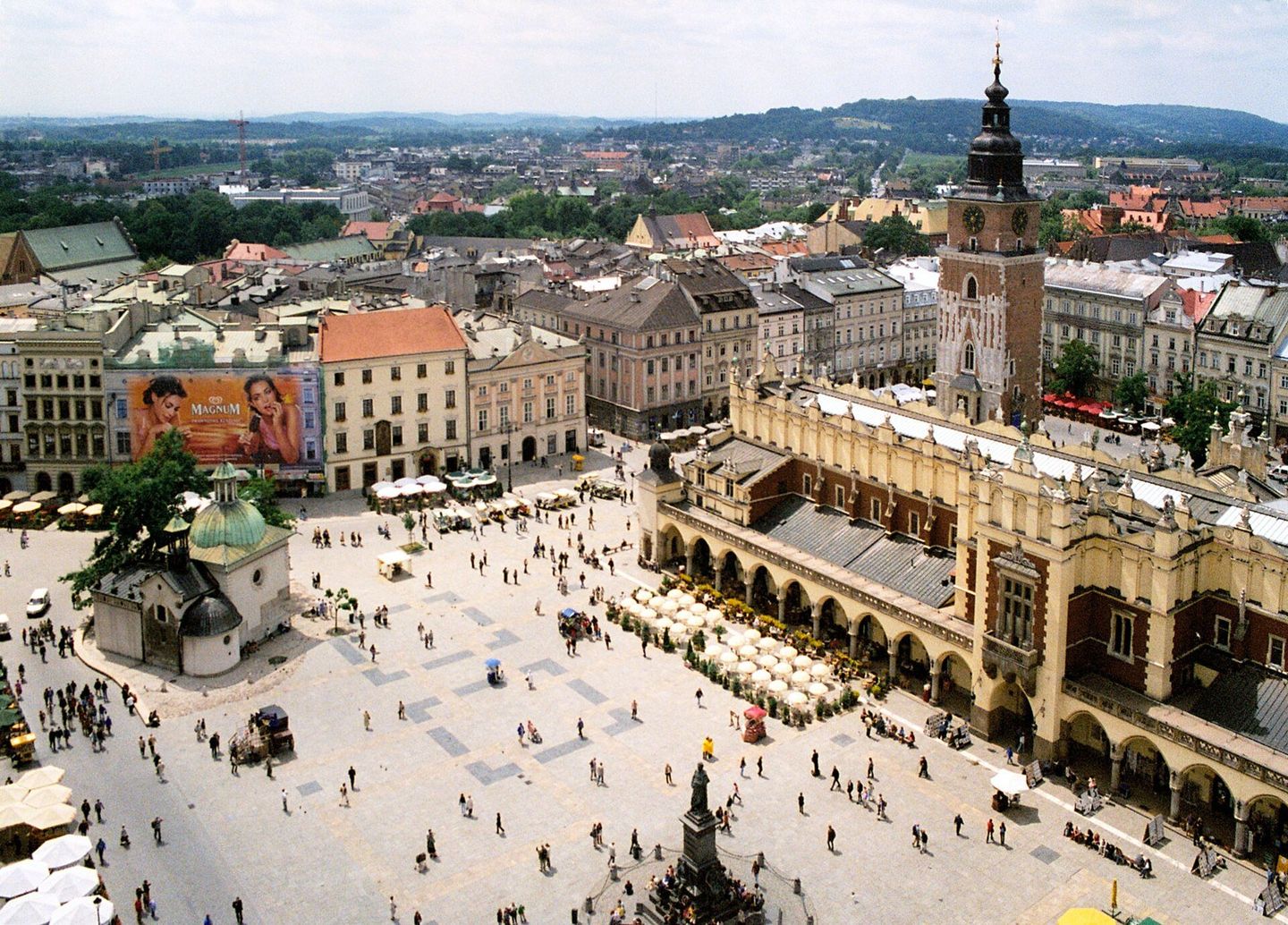
Most of Poland's great cities were rebuilt from rubble after 1945, brick by brick, from old photographs and architects' memories, because the Second World War left almost nothing standing. Kraków is the strange exception, and the reason is not a happy one: the city surrendered to the invading German army in September 1939 with barely a shot fired, and was later used as the administrative seat of the occupation rather than reduced to a battlefield. The human cost of that occupation, especially for Kraków's Jewish population, was catastrophic, and the city's own telling of its history does not look away from it. But the physical city — the medieval square, the Gothic spires, the Renaissance courtyards of Wawel — survived intact, which makes Kraków today the rarest thing in this part of Europe: a genuinely old capital you can still walk through as it was actually built, not a careful postwar reconstruction of one.
That intact core is also simply enormous by the standards of surviving medieval cities. The Main Square alone, at roughly 40,000 square metres, is the largest medieval town square left in Europe, and it sits at the centre of an old town compact enough to cross on foot in twenty minutes yet dense enough with Gothic churches, Renaissance arcades and buried cellars to occupy several unhurried days. Ring it with the Planty, a green park laid over the demolished medieval walls, and add Kazimierz, the old Jewish quarter a short walk south that has become the city's best eating and nightlife district without losing the weight of what happened there, and you have one of Central Europe's most complete and most layered cities.
This isn't a rundown of the ten photos to take in the square, although you will take them. It is a case for giving Kraków real time: understanding why Poland's kings were crowned and buried on Wawel Hill for five centuries, why a trumpeter's broken-off tune has been played from a church tower every hour since the Middle Ages, why Kazimierz feels different from every other nightlife district in Poland, and why the two heaviest day trips on this page — Auschwitz-Birkenau and the Wieliczka Salt Mine — both start from this one unusually well-placed city.
The caseWhy Kraków still earns the detour
Kraków was Poland's royal capital for over five centuries before the seat of power moved to Warsaw in 1596, and it still carries itself like a capital rather than a provincial city, despite now being Poland's second-largest. Wawel Hill, overlooking the Vistula at the old town's southern edge, held the coronation and burial site of Polish monarchs from the 11th century onward, and the cathedral and royal castle on top of it remain the single most loaded piece of real estate in the country — the place where Polish national identity, royal history and Catholic faith all physically converge. Few European cities let you stand in one unbroken, undamaged medieval-to-Renaissance core and feel the actual weight of a national story this directly.
The other reason to come is less solemn: Kraków is simply a superb city to spend days in. The Cloth Hall splits the Main Square like a spine, Gothic St. Mary's Basilica anchors one corner with an altarpiece that took Nuremberg master Veit Stoß twelve years to carve, and a trumpeter still leans out of the basilica's tower every hour, on the hour, to play a melody that breaks off mid-note — a tribute to a 13th-century watchman whose warning call was supposedly cut short by a Mongol arrow. Underneath all of it, literally, runs the Rynek Underground museum, a walk through excavated medieval market stalls and foundations unearthed during a 2000s renovation of the square's paving. Layer in Jagiellonian University, founded in 1364 and one of the oldest universities in Europe, and Kraków reads less like a single sight and more like a five-century cross-section you can walk through in an afternoon.
The calendarWhen to go
Late April through June and September into early October are Kraków's best windows — mild temperatures, long daylight, the Main Square's outdoor tables in full use, and crowds that are present but not overwhelming. May in particular benefits from the Juwenalia student festival, when Jagiellonian University effectively hands the city over to a week of concerts and parades, and the lead-up to Midsummer brings warm evenings without July's peak crush.
July and August are Kraków's busiest and hottest months, and the old town's narrow lanes concentrate both the heat and the tour groups; booking skip-the-line tickets for Wawel and Auschwitz well ahead becomes essential rather than optional. December flips the calculation entirely in the city's favour: Kraków's Christmas market, strung across the Main Square with mulled wine, oscypek grilled cheese and wooden stalls under the Cloth Hall's arcades, is one of the most atmospheric in Poland, and the cold keeps the crowds thin enough to actually enjoy it. Winter proper (January–February) is genuinely cold, with temperatures regularly below freezing, but it is also the cheapest and quietest time to see Wawel and the old town's interiors without a single queue.
LogisticsGetting around
The old town and Kazimierz are both entirely walkable, and walking is genuinely the right default — the historic core is barely a kilometre across, pedestrianised through most of the Main Square, and the Planty ring park gives you a pleasant, tree-lined perimeter route whenever you want to cut across rather than through. Save transport for crossing the river to Podgórze (the former Jewish ghetto and Schindler's Factory Museum) or reaching the train and bus stations.
Kraków's tram network is dense, cheap, and the fastest way to cover longer hops; buy tickets from machines at stops or the jakdojade/mobilet apps rather than hunting for a kiosk, and validate on boarding. A single ticket covers both trams and buses, and short-stay tourist passes (24, 48 or 72 hours) are good value if you're moving around a lot. Kraków Główny, the main train station, sits at the old town's northeastern edge inside a modern shopping-centre shell and connects directly to Warsaw (around 2.5 hours by fast train), Wrocław and the regional trains that reach Zakopane and the Tatras. For Auschwitz-Birkenau and Wieliczka, organised minibuses and direct public buses both run regularly from the city centre; renting a car buys little here and parking in the old town is both restricted and expensive.
The tableHow Kraków actually eats
Pierogi are the obvious starting point, and Kraków does not disappoint: look past the tourist-trap versions on the Main Square for a milk bar (bar mleczny), a surviving institution from the communist era that still serves cheap, filling, genuinely good Polish home cooking — ruskie (potato and curd cheese) pierogi, żurek sour rye soup, and schabowy breaded pork cutlet, usually for a few złoty and no ceremony. Obwarzanek krakowski, a boiled-then-baked bread ring that predates the bagel and has its own protected geographical status, is sold from carts all over the old town and is the correct thing to eat while walking rather than sitting down for.
Kazimierz is where the more adventurous eating and drinking happens. Plac Nowy, the old Jewish quarter's round former kosher butcher hall, now runs a nightly ring of zapiekanka stalls — open-faced baguette halves loaded with mushrooms, cheese and whatever else, grilled to order, eaten standing up, and considered a genuine local institution rather than a tourist snack. The surrounding streets hold Kraków's best concentration of craft beer bars, natural wine spots and the kind of unmarked speakeasy-style cocktail bars that have made Kazimierz the city's actual nightlife centre, well ahead of the more postcard-pretty but quieter Main Square after dark. Vodka deserves a serious mention too: Poland's vodka culture runs deeper and drier than most visitors expect, and a proper vodka bar pouring flavoured infusions (żubrówka with apple juice is the classic starter) is worth an evening on its own.
The mapNeighbourhoods to know
The Old Town (Stare Miasto), ringed by the Planty where the medieval walls once stood, is the obvious centre of gravity — the Main Square, the Cloth Hall, St. Mary's Basilica, and the dense web of streets fanning out toward Wawel Hill to the south. It is compact, almost entirely pedestrian at its core, and the single best base for first-timers who want everything within a short walk, though also the most expensive and most touristed patch of the city.
Kazimierz, immediately south of the old town and a flat ten-minute walk away, was Kraków's independent Jewish town for over five centuries before being absorbed into the city, and it still holds seven historic synagogues, the Remuh Cemetery, and the kind of layered, slightly ragged beauty that comes from a neighbourhood never fully gentrified in a straight line. By day it is a quiet, dignified district for understanding Jewish Kraków's long history; by night, especially around Plac Nowy, it is the city's real bar and nightlife centre. Across the Vistula from Kazimierz, Podgórze was the site of the Nazi-era Jewish ghetto and holds the Schindler's Factory Museum (Oskar Schindler's actual former enamelware plant) and the stark, chair-filled Ghetto Heroes Square memorial — a heavier, quieter district that rewards a slower, more deliberate visit. Further out, Nowa Huta, a vast planned socialist-realist district built from scratch in the 1950s around a steelworks, is Kraków's strangest neighbourhood and worth a half-day for anyone curious about communist-era urban planning rather than medieval architecture.
Field intelligencePractical intelligence
Poland uses the złoty, not the euro, despite EU membership, and cards are accepted almost everywhere including market stalls and milk bars — carrying some cash still helps for the smallest vendors and public toilets. Tipping 10% is customary at sit-down restaurants and appreciated but not strictly obligatory elsewhere; rounding up is the norm for taxis and casual service.
Book Auschwitz-Birkenau tickets online well ahead, especially in summer — the memorial caps daily visitor numbers and free entry slots sell out, while guided tours (effectively mandatory in peak season for the main route) need their own separate booking. Wawel Cathedral and the Royal Castle sell timed tickets for specific interiors separately, and the complex overall sells out its daily cap in high season, so arrive early or book online rather than queuing on the day. Polish is the local language and English coverage is strong in anything tourist-facing, though less so the moment you step outside the centre; a few basic phrases (dzień dobry, dziękuję) go a long way. And pack for genuine seasonal extremes — Kraków runs properly cold and occasionally smoggy in winter (the city has a well-documented air-quality problem on still, cold days) and properly hot and humid at the height of summer.
What to see & do
-
Main Square (Rynek Główny) & the Cloth Hall
At roughly 40,000 square metres, the largest medieval town square surviving in Europe, split down the middle by the Renaissance-arcaded Cloth Hall, still trading amber, leather and souvenirs under the same roof merchants used in the 14th century.
Tip:Climb the Town Hall Tower on the square's edge for the best overhead view of the Cloth Hall's roofline and the square's true scale.
-
St. Mary's Basilica
A soaring Gothic brick church on the square's corner, home to Veit Stoß's monumental wooden altarpiece, and the source of the hourly trumpet call that breaks off mid-note from its taller tower.
Tip:Time a visit to the top of the hour to hear the hejnał played live, then go inside afterward when the crowd by the tower thins out.
-
Wawel Royal Castle & Cathedral
The hilltop seat of Polish monarchy for over five centuries — a Renaissance royal residence beside a Gothic cathedral stacked with royal tombs, crypts and chapels, overlooking a bend in the Vistula.
Tip:Book timed tickets online in advance; the complex caps daily visitors to its paid interiors and sells out in summer.
-
Kazimierz
Kraków's former independent Jewish town, now a dense, atmospheric district of synagogues, the Remuh Cemetery, and the city's best concentration of bars, natural wine spots and the nightly Plac Nowy zapiekanka stalls.
Tip:Walk it slowly by day for the synagogues and history, then come back after dark for the bars clustered around Plac Nowy.
-
Schindler's Factory Museum
Oskar Schindler's actual former enamelware plant in Podgórze, now a sobering, immersive museum covering Kraków's occupation, the ghetto and the Holocaust — one of the most essential, least optional stops in the city.
Tip:Book a timed slot ahead; the museum limits visitor numbers per hour and the exhibition rewards unhurried, quiet time rather than a rushed pass-through.
-
Rynek Underground Museum
An archaeological museum built directly beneath the Main Square's paving, walking visitors through excavated medieval market stalls, foundations and trade-route artefacts uncovered during a 2000s renovation.
Tip:Buy a timed ticket in advance online — it's one of the city's most popular museums and daily slots sell out, especially in summer.
-
Wieliczka Salt Mine
A working salt mine since the 13th century, just outside the city, with over two hundred kilometres of tunnels and a series of chapels and chambers carved entirely from rock salt, including an entire underground cathedral.
Tip:Book the tourist route online ahead and wear layers — the mine sits at a constant cool temperature year-round regardless of the weather above.
-
Dragon's Den & the Wawel Dragon statue
A limestone cave beneath Wawel Hill tied to Kraków's founding legend of a dragon defeated by a clever cobbler, exited beside a modern metal dragon statue that breathes real fire on a timer by the riverbank.
Tip:Check the dragon statue's fire-breathing schedule online — it only fires every few minutes, and timing your exit from the cave to catch it is worth the wait.
On the groundWhere things are
Map data © OpenStreetMap contributors.
Where to stayBase yourself well
Old Town (Stare Miasto)
Best for first-timers who want everything on footThe medieval core around the Main Square — Gothic churches, the Cloth Hall, and the densest concentration of sights within an easy walk of each other. Central, atmospheric and the priciest patch of the city.
A boutique hotel on a quiet lane off the Main Square
Look just off the square itself rather than directly on it to trade a little postcard view for a quieter night's sleep.
€€€An apartment near the Planty ring
A short walk from the square with the park as a green buffer from the old town's busiest lanes.
€€Kazimierz
Best for food- and nightlife-focused staysThe former Jewish quarter south of the old town — synagogues and quiet courtyards by day, Kraków's best bars and restaurants by night. A ten-minute flat walk from the Main Square with noticeably lower rates.
A converted townhouse near Plac Nowy
Puts the zapiekanka stalls and the neighbourhood's bar cluster at the doorstep; expect some evening noise on weekends.
€€A design-led guesthouse on a quieter Kazimierz side street
A few streets back from Plac Nowy keeps the walkability without the weekend crowd noise.
€€Podgórze
Best for value and a calmer baseAcross the river from Kazimierz, the former ghetto district and home to the Schindler's Factory Museum — quieter, more residential, and noticeably cheaper, with a short tram or walk back into the centre.
A modern apartment block near Ghetto Heroes Square
Steps from the Schindler museum and a flat walk or one tram stop from Kazimierz's bars.
€Near Kraków Główny station
Best for late arrivals and day-trip logisticsThe modern commercial district around the main train station, a few minutes' walk north of the old town — larger business hotels, easy arrivals with luggage, and strong transit links for day trips.
A hotel inside or adjacent to the Galeria Krakowska complex
Built directly onto the station, convenient for early departures to Auschwitz, Wieliczka or Zakopane.
€€Affiliate notePostcardRoute is reader-supported. Some links to Booking.com (stays, flights, car hire, tickets and tours, airport transfers) are affiliate links, tracked through CJ Affiliate: if you book through them we may earn a small commission at no extra cost to you. We only recommend places we would send a friend.
Book the restEverything else for the trip
Stay sorted? These open Booking.com for the other legs of the journey.
-
Tours & tickets
Things to do in Kraków
Skip-the-line tickets, tours and day trips.
Browse activities -
Wheels
Car hire in Kraków
Compare pick-up points and rental companies.
Compare cars -
Air
Flights
Search fares, then come back for the neighbourhood advice.
Search flights -
Ground
Airport transfers
Book a taxi or private transfer before you land.
Book a transfer
Affiliate noteThese four links are affiliate links too: if you book through them we may earn a small commission at no extra cost to you.
Beyond the cityWorthwhile day trips
- Auschwitz-Birkenau
The former Nazi concentration and extermination camp, roughly ninety minutes west by bus or car, preserved as a memorial and museum. Heavy, essential, and worth booking well ahead — guided entry is effectively required in peak season.
- Wieliczka Salt Mine
A working salt mine since the 13th century, twenty minutes southeast of the city, with chapels, chambers and an entire underground cathedral carved from rock salt across two hundred-plus kilometres of tunnels.
- Zakopane & the Tatra Mountains
Poland's mountain resort town, about two hours south by bus or train, with distinctive wooden architecture, a lively pedestrian street, and direct access to Tatra National Park's hiking and, in winter, skiing.
- Ojców National Park
A compact limestone valley twenty-five minutes north of the city, with two medieval castle ruins, caves and walking trails — a far quieter, greener day out than the other three options on this list.
Before you goCommon questions
- How many days do you need in Kraków?
- Three full days covers the old town, Wawel and Kazimierz properly, with a day left over for one major day trip. Four or five days lets you add both Auschwitz-Birkenau and the Wieliczka Salt Mine without feeling rushed, since both deserve a full half-day or more on their own terms.
- What is the best area to stay in Kraków for first-timers?
- The Old Town, for sheer walkability to the Main Square, Wawel and the Cloth Hall. Kazimierz is the close runner-up and arguably the better pick if food and nightlife matter as much to you as sightseeing — it's a flat ten-minute walk from the old town and noticeably cheaper.
- Is Kraków expensive to visit?
- No, relative to Western Europe — Kraków remains one of the better-value major Central European destinations, with milk bars, markets and public transport all cheap by comparison. The Main Square's restaurants and the priciest old-town hotels are the main exceptions; eat and stay a few streets back and costs drop noticeably.
- How do you get to Auschwitz-Birkenau from Kraków?
- Direct public buses and organised minibus tours both run regularly from the city centre, taking roughly ninety minutes each way. Book your museum entry slot online well in advance, especially between April and October, when free individual entry and guided tour spots both sell out days ahead.
- Is Kazimierz safe and worth visiting at night?
- Yes — it's Kraków's actual nightlife centre and generally well-trafficked and safe by ordinary city standards after dark, particularly around Plac Nowy. Keep normal awareness as you would in any busy bar district, and it's an easy, well-lit walk back to the old town or across to Podgórze.
- What is the best time of year to visit Kraków?
- Late April through June and September into early October offer the best mix of mild weather and manageable crowds. December's Christmas market on the Main Square is a strong, atmospheric alternative if you don't mind the cold, while July and August bring the heaviest heat and the biggest crowds.
- Do people speak English in Kraków?
- Yes, widely in hotels, restaurants and anything tourist-facing, especially among younger Poles and around the university. Coverage thins out a little once you're away from the centre or dealing with older residents, so a few basic Polish phrases are appreciated even if not strictly necessary.