
Belgium · Brussels-Capital Region
Brussels, unresolved on purpose
A gilded medieval square five minutes from a glass-and-steel EU quarter, comic-strip murals on the walls of Baroque guildhalls, and a food culture built on frites and formality in equal measure. Nothing here quite matches, and that is the whole point.
A capital that never decided what kind of city it wanted to be, and is better for it · 50.85° N · 4.35° E
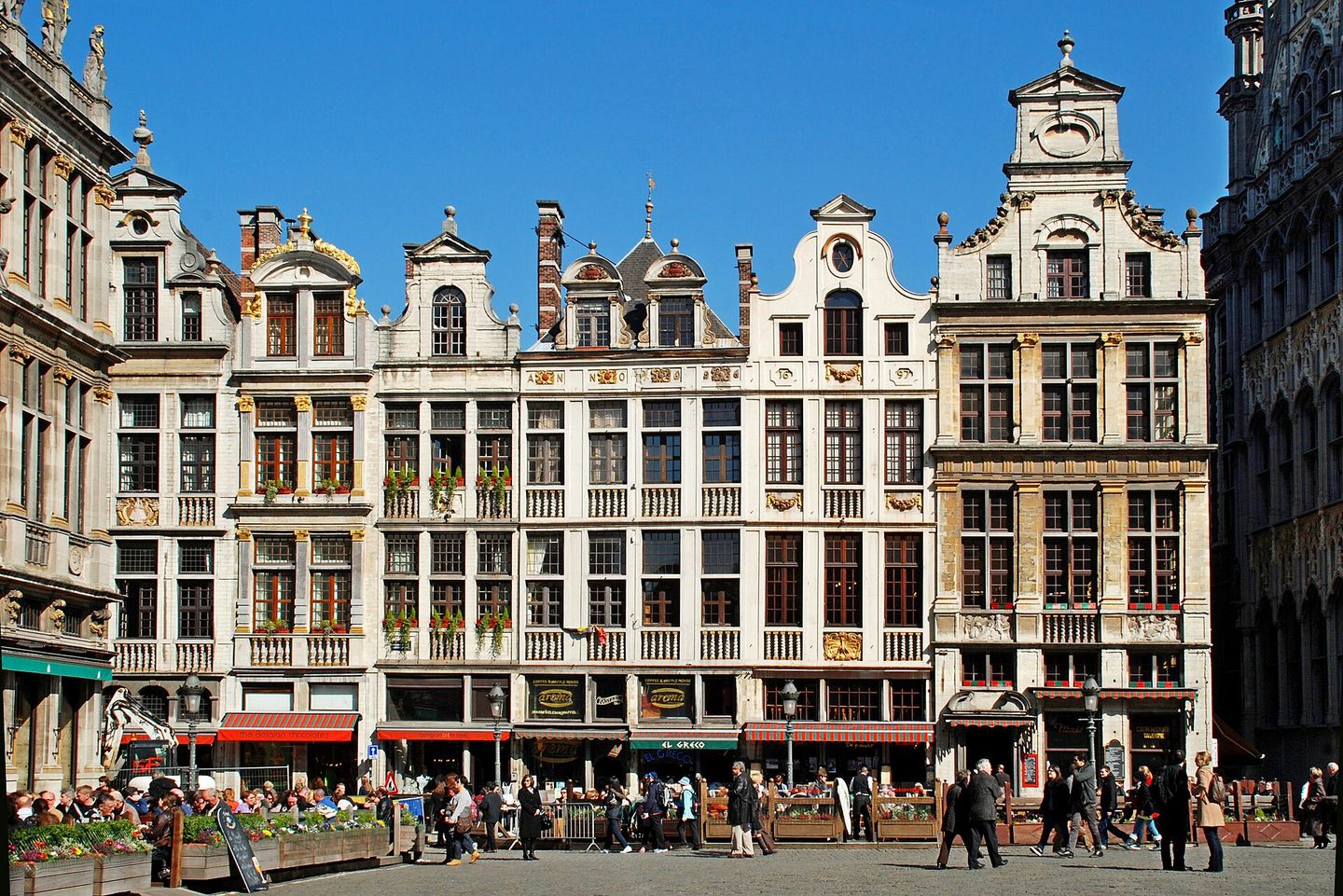
Brussels gets a strange reputation for a city this interesting: capital of the European Union, headquarters of NATO, host to an alphabet soup of international institutions, and somehow still the butt of jokes about being grey, bureaucratic and forgettable. People who repeat that joke have usually only seen the European Quarter, a genuinely charmless stretch of office towers that has almost nothing to do with the rest of the city. Walk fifteen minutes in any other direction and you land in a place that is bilingual by law, surrealist by temperament, and quietly one of the best-eating, best-looking capitals in Europe.
The city's defining trait is that it never fully committed to being one thing. It is French-speaking and Dutch-speaking at once, with every street sign doubled and every argument about language policy still very much alive. It produced René Magritte and the Smurfs and Tintin within a few decades of each other, and treats all three with the same civic seriousness — there are murals of comic-book panels on the sides of apartment blocks across the old town, an official comic strip route, and a museum dedicated to the medium housed in an Art Nouveau department store. It is a capital that runs on committee meetings by day and on beer, chocolate and unapologetic carb consumption by night. None of it is coordinated. All of it works.
This dispatch skips the lazy Brussels-is-boring take entirely. What follows is the city underneath the EU-capital stereotype: the gilded medieval square that still functions as the city's living room, the Art Nouveau townhouses hiding in residential streets most visitors never reach, the unglamorous but essential facts about where to eat a proper carbonnade, and which of the city's genuinely different neighbourhoods should decide where you sleep.
The caseWhy Brussels deserves more than a layover
Most visitors arrive in Brussels by accident — a connecting train, a work trip, a long weekend tacked onto Bruges or Amsterdam — and that accidental quality has kept the city refreshingly free of the tourist-trap inflation that has reshaped so much of Western Europe. The Grand-Place is rightly on every list: a cobbled square ringed by gilded 17th-century guildhalls and the soaring Gothic town hall, floodlit at night into something closer to a stage set than a civic square. It is also, unusually for a headline sight in a major capital, still genuinely the city's social centre rather than a roped-off museum piece.
What the square doesn't tell you is that Brussels is one of the best cities in Europe for a specific, narrow kind of architecture obsessive: Art Nouveau. Victor Horta, one of the style's founding figures, built most of his masterworks here, and the wider Ixelles and Saint-Gilles districts are stitched with whiplash ironwork, sinuous stone facades and stained glass that most visitors walk straight past because nothing about them screams tourist attraction. Pair that with a genuinely serious food and beer culture — this is the country that gave the world Trappist ales, pralines and the double-fried frite, and takes all three with total sincerity — and a surrealist streak that runs from Magritte's bowler hats to a 50-metre stainless-steel model of an iron crystal built for a 1958 World's Fair, and Brussels stops looking like a layover and starts looking like a destination that simply never bothered to market itself.
The calendarWhen to go
Late spring and early autumn are the easiest windows, the same as most of northern Europe: May and June bring reliably mild days, long evenings on café terraces, and the Jazz Marathon turning bars across the centre into free live-music venues for a late-May weekend. September and the first half of October trade a little warmth for thinner crowds and a city that has fully reopened after the quieter August lull, when much of the EU-adjacent workforce and a fair few restaurants take their own holiday.
Summer brings the single most photogenic event on the Brussels calendar, if you can time it: every two years in mid-August, the Grand-Place is carpeted in roughly 700,000 begonia blooms for the Flower Carpet, an afternoon-only display that draws serious crowds but is genuinely worth planning a trip around (check the current year before booking — it does not run annually). Winter has its own case: a proper Christmas market sprawls from the Grand-Place down to Sainte-Catherine from late November, with an ice rink, a Ferris wheel and a nightly sound-and-light show projected onto the town hall facade, and hotel rates drop noticeably once the market closes in early January. Rain is a year-round fact of Brussels life regardless of season — pack for it and don't let a grey forecast change your plans.
LogisticsGetting around
The historic centre — the Pentagon, named for its pentagonal ring of boulevards tracing the old city walls — is compact enough to walk end to end in under half an hour, and walking is genuinely the best way to catch the Art Nouveau details and comic-strip murals that make the city interesting at street level. The cobblestones are real and uneven in places, so the same advice applies here as in Rome: wear shoes that can take a beating.
For anything beyond the centre, the STIB/MIVB network of metro, tram and bus covers the city well on a single ticket type, and the metro in particular is worth riding for its own sake — several stations double as free public art installations, full-scale murals and sculptures commissioned from major Belgian and international artists rather than advertising space. Buy a Brussels Card if you're museum-heavy for a couple of days; it bundles transit with free or discounted entry to a genuinely long list of sights. From Brussels Airport (Zaventem), the Airport Express train runs direct into the city centre in around 20 minutes and is almost always faster and cheaper than a taxi. If you're arriving by international train, note that Brussels has three main stations — Midi/Zuid for Eurostar and most international services, Centrale/Centraal for the historic centre, and Nord/Noord — so check which one your ticket actually lands you at before booking a hotel near "Brussels station."
The tableHow Brussels actually eats
Start with the obvious and do it properly: Belgian fries, twice-fried in beef fat at a proper friture or fritkot stand, served in a paper cone with a startling range of sauce options beyond ketchup and mayonnaise — andalouse and samurai sauce both deserve a try. Treat them as a legitimate meal, not a snack, the way locals do. Moules-frites, mussels steamed in white wine and herbs with a side of those same fries, is the closest thing the city has to a national dish, and it is taken seriously enough that arguing about the best preparation (natuur versus white wine versus beer) is a genuine local pastime.
Beyond the clichés, Brussels cooking leans hearty and French-Belgian: carbonnade flamande, beef stewed for hours in dark beer until it falls apart, stoemp, a comforting mash of potato and vegetables usually served with sausage, and waterzooi, a creamy chicken or fish stew that rewards a cold day. Chocolate and beer both deserve more care than the souvenir-shop versions suggest — seek out an actual chocolatier rather than the mass-market gift boxes near the Grand-Place, and drink Trappist and abbey beers at a proper beer café rather than a tourist terrace, where the selection and the glassware both matter and staff will generally talk you through what you're drinking if you ask. Waffles split into two genuinely different traditions worth knowing apart: the crisp, caramelised Liège waffle eaten plain and warm from a street stand, and the lighter, more rectangular Brussels waffle, traditionally served with toppings and a fork. Lunch is a good value anchor here as in most of Belgium — look for a plat du jour or dagschotel at a brasserie rather than paying dinner prices at midday.
The mapNeighbourhoods to know
The Grand-Place and the surrounding Îlot Sacré form the tourist core — dense, lively, and genuinely beautiful, though restaurant quality drops the closer you sit to the square itself; walk a few streets further for a meal. Sainte-Catherine, just north, has quietly become the city's best food neighbourhood, built around the old fish market with excellent seafood restaurants, natural wine bars and a noticeably calmer, more local pace than the Îlot Sacré a short walk away.
Le Sablon, south of the centre, is Brussels at its most polished — antique dealers, chocolate shops with genuine pedigree, and a Saturday-and-Sunday antiques market on the square outside Notre-Dame du Sablon, whose stained glass alone justifies stepping inside. Immediately downhill from Sablon sits the Marolles, the old working-class quarter and the exact opposite register: a raucous daily flea market on Place du Jeu de Balle, cheap eats, and a neighbourhood that has resisted gentrification longer than almost anywhere else this central. Ixelles and Saint-Gilles, further south again, are where the Art Nouveau obsession pays off — leafy, residential, studded with Horta buildings, and home to the city's best concentration of independent restaurants and the Flagey area's lively café scene. The European Quarter around Schuman, finally, is worth a brief walk for the contrast rather than a base to sleep in: glass towers, flag-lined roundabouts, and a sense of a different, far less characterful city grafted onto the edge of this one.
Field intelligencePractical intelligence
Brussels is officially bilingual, French and Dutch, and street names, metro announcements and signage appear in both — a venue called Grand-Place in French is Grote Markt in Dutch, and the two names are not interchangeable typos but a genuine bilingual reality worth knowing before you get confused by a map that only uses one. English is widely and comfortably spoken in the centre and in hospitality generally, and defaulting to English rather than guessing at French or Dutch is usually the path of least friction for a short visit.
Tipping is modest and not a strict obligation: service is included by law, and rounding up a bill by five to ten percent for good service is generous rather than expected. Belgium uses the euro. Many museums, including the Royal Museums of Fine Arts, offer free entry on the first Wednesday afternoon of the month — worth checking before you book a paid ticket. Pickpocket risk concentrates around the Grand-Place, the metro, and Midi station specifically, which has a rougher edge than the rest of the centre after dark; keep normal city awareness rather than any special alarm. And bring real waterproofs regardless of season — Brussels rain is frequent, often light, and rarely dramatic enough to cancel a day, so plan to walk through it rather than around it.
What to see & do
-
Grand-Place / Grote Markt
The gilded 17th-century guildhalls and soaring Gothic town hall that anchor the old city, floodlit at night and still functioning as Brussels' actual civic square rather than a roped-off set piece.
Tip:Come back after dark for the floodlighting, and check whether your visit coincides with the biennial Flower Carpet in mid-August — it only runs on even years and only for a single afternoon.
-
Manneken Pis
A small bronze fountain of a urinating boy, wildly disproportionate to its fame, that has become the city's unofficial mascot and is dressed in rotating costumes from an official wardrobe of several hundred outfits.
Tip:Don't make a special trip — it's genuinely tiny and underwhelming in person. See it on the way between the Grand-Place and Sainte-Catherine rather than as a destination in itself.
-
Royal Museums of Fine Arts & the Magritte Museum
Belgium's major art collection, from Flemish Primitives through Bruegel and Rubens, with a dedicated Magritte Museum next door holding the largest collection of the surrealist's work anywhere.
Tip:Buy a combined ticket if you want both; the Magritte Museum alone easily absorbs two hours and rewards going slowly rather than rushing to the headline paintings.
-
Comic Strip Route & Belgian Comic Strip Center
A self-guided trail of large-scale murals painted directly onto the sides of apartment buildings across the old town, plus a dedicated museum in a former Horta-designed department store celebrating Belgium's outsized comics heritage.
Tip:Pick up a map of the mural route from the tourist office rather than hunting for them blind — many are tucked into unremarkable side streets you'd otherwise walk past.
-
Place du Jeu de Balle flea market, Marolles
A raucous daily flea market in the heart of the old working-class Marolles district, where junk, genuine antiques and everything between get haggled over from early morning, oldest and best on weekends.
Tip:Go before 9am on a Sunday for the real theatre and the best finds, then eat a cheap, honest lunch at one of the surrounding Marolles cafés.
-
Atomium
A 102-metre stainless-steel model of an iron crystal magnified 165 billion times, built for the 1958 World's Fair and somehow still the single strangest, most endearing landmark skyline in Europe.
Tip:Book a timed ticket to go up to the top sphere for the view; the surrounding Parc de Bruxelles-area Mini-Europe miniature park makes an easy pairing if you're travelling with kids.
-
Horta Museum & the Art Nouveau quarter
Victor Horta's own former house and studio in Saint-Gilles, preserved as a complete Art Nouveau environment down to the door handles, and the obvious anchor for a wander through the whiplash-ironwork streets of Ixelles and Saint-Gilles beyond it.
Tip:Book ahead — visitor numbers are capped daily to protect the fragile interior — and combine it with a self-guided walk past the nearby Hôtel Tassel and Hôtel Solvay facades.
-
Notre-Dame du Sablon & the Sablon antiques quarter
A soaring Gothic church with some of the finest stained glass in the city, at the centre of Le Sablon's genteel streets of antique dealers and serious chocolate shops, with a long-running weekend antiques market on the square outside.
Tip:Visit on a Saturday or Sunday morning to catch the antiques market itself, then walk downhill into the Marolles for the complete contrast in the same half-day.
On the groundWhere things are
Map data © OpenStreetMap contributors.
Where to stayBase yourself well
Grand-Place & the Îlot Sacré
Best for first-timers and short staysThe historic core, cobbled and dense, with the city's headline sight steps from the door — the most convenient base for a short first visit, though noisier and pricier than almost anywhere else in the city.
A boutique hotel on a quiet lane off the Grand-Place
Look for a small property tucked a block or two back from the square itself to get the location without the nightly crowd noise.
€€€A modern apartment near the Bourse
The restored former stock exchange building is a short, flat walk from the Grand-Place with slightly calmer streets around it.
€€Sainte-Catherine
Best for food-focused visitors who still want centralThe city's best food neighbourhood, built around the old fish market, a genuinely short walk from the Grand-Place with a noticeably calmer, more local pace once the day-trip crowds thin out in the evening.
A design-led hotel near the Place Sainte-Catherine
Puts the neighbourhood's seafood restaurants and wine bars on the doorstep, with the Grand-Place a ten-minute walk away.
€€€Le Sablon
Best for a refined, low-key basePolished, antique-dealer elegant, and quiet at night — a genteel base a short walk south of the centre, best for visitors who want calm evenings over nightlife.
A classic hotel near the Sablon antiques market
A short walk from both the Marolles and the Royal Museums, with a noticeably quieter street scene after dark than the Grand-Place area.
€€€€A small apartment toward the Marolles border
Edge downhill toward the flea market streets for lower rates and a grittier, more local feel on the same walk to the centre.
€€Ixelles & Saint-Gilles
Best for longer stays and architecture-focused visitorsLeafy, residential, and the heart of the Art Nouveau quarter, with the city's best concentration of independent restaurants and the lively Flagey café scene — a short tram ride rather than a walk from the historic core.
A converted townhouse guesthouse near Flagey
Puts you among the Art Nouveau streets and Ixelles' restaurant scene, with a direct tram line into the centre.
€€Affiliate notePostcardRoute is reader-supported. Some links to Booking.com (stays, flights, car hire, tickets and tours, airport transfers) are affiliate links, tracked through CJ Affiliate: if you book through them we may earn a small commission at no extra cost to you. We only recommend places we would send a friend.
Book the restEverything else for the trip
Stay sorted? These open Booking.com for the other legs of the journey.
-
Tours & tickets
Things to do in Brussels
Skip-the-line tickets, tours and day trips.
Browse activities -
Wheels
Car hire in Brussels
Compare pick-up points and rental companies.
Compare cars -
Air
Flights
Search fares, then come back for the neighbourhood advice.
Search flights -
Ground
Airport transfers
Book a taxi or private transfer before you land.
Book a transfer
Affiliate noteThese four links are affiliate links too: if you book through them we may earn a small commission at no extra cost to you.
Beyond the cityWorthwhile day trips
- Bruges
An hour by direct train to the canal-laced medieval city most visitors picture when they imagine Belgium — undeniably touristy in the centre, but worth it for the Belfry, the canals, and a chocolate shop or three.
- Ghent
Roughly forty minutes by train to a less manicured, more lived-in rival to Bruges, with a genuinely great medieval centre, a thriving student population, and far fewer day-trip coaches.
- Antwerp
Under an hour by train to Belgium's fashion and diamond capital, with a soaring cathedral, Rubens' former studio-house, and one of the most striking contemporary train stations in Europe.
- Leuven
Twenty-five minutes by train to a compact university town with an extraordinary Gothic town hall, a historic beguinage, and a beer culture anchored by the AB InBev brewery on its doorstep — an easy half-day.
Before you goCommon questions
- How many days do you need in Brussels?
- Three full days covers the Grand-Place, the Art Nouveau quarter, a museum or two and a proper sit-down meal with the pace it deserves. Two days works if you're disciplined about picking one or two neighbourhoods rather than trying to cover all of them, and a single day is enough to hit the headline sights but not to understand why people come back.
- What is the best area to stay in Brussels for first-timers?
- The Grand-Place and Îlot Sacré for sheer convenience, or Sainte-Catherine a few minutes north for the same central access with better food and a calmer evening. Both put almost everything in the historic centre within comfortable walking distance.
- Is Brussels expensive to visit?
- It sits in the middle of the Western European pack — pricier than Southern or Eastern Europe, noticeably cheaper than London, Paris or Zurich. Fries, waffles and a plat du jour lunch keep food costs manageable, museums have regular free-entry windows, and the compact centre means you can walk rather than taxi almost everywhere.
- Do people in Brussels speak French or Dutch?
- Both — Brussels is officially bilingual, and the city itself leans majority French-speaking day to day while sitting administratively between French-speaking Wallonia and Dutch-speaking Flanders. Street signs and metro announcements appear in both languages, and English is widely spoken in the centre and in hospitality, so visitors rarely need more than a few words of either.
- What is the best time of year to visit Brussels?
- Late spring (May–June) and early autumn (September–early October) bring the easiest weather and manageable crowds. Winter has its own strong case around the Christmas market and ice rink on the Grand-Place, and mid-August brings the biennial Flower Carpet in years it runs — check the current year before planning around it.
- How do I get from Brussels Airport into the city centre?
- The Airport Express train runs directly from Brussels Airport (Zaventem) into the city's main stations in around 20 minutes and is almost always the fastest, cheapest option. A taxi takes longer in traffic and costs considerably more for the same journey.
- Is Brussels worth visiting if I'm only doing a day trip from Bruges or Amsterdam?
- Yes, but treat it as an appetiser rather than the full meal — a single day covers the Grand-Place, Manneken Pis and a short Art Nouveau walk, but misses the Marolles flea market, the Sablon, and the slower neighbourhood pace that makes Brussels worth a proper stay rather than a stopover.