
Switzerland · Canton of Zürich
Zurich, unbuttoned
The reputation is banks, watches and Swiss punctuality. The reality also includes office workers swimming the river home from work and a squat that invented Dada. Both are the real city.
Dispatch from the banking capital that swims in its own river on lunch break · 47.38° N · 8.54° E
Plan this trip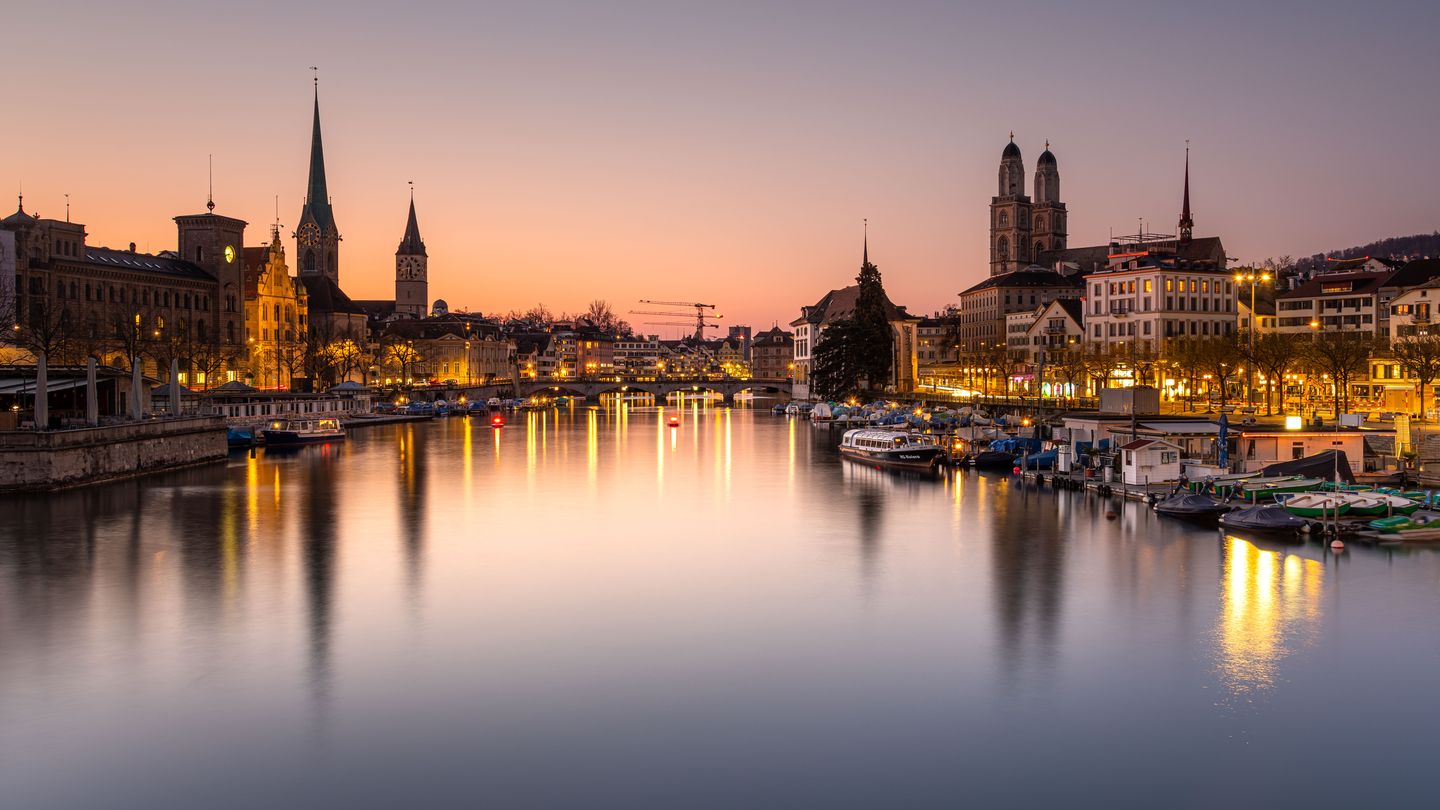
Zurich carries a reputation it partly earned and mostly outgrew. Yes, this is where a large share of the world's private wealth sits in vaults beneath a shopping street, where the trams run so precisely that a two-minute delay counts as a small scandal, and where the Swiss National Bank keeps its headquarters a short walk from a lake clean enough to drink from. None of that is exaggerated. What the reputation leaves out is a city that spends its short, intense summer half-submerged: bankers in swim trunks drifting down the Limmat with their work clothes sealed in a dry bag, office towers emptying onto lakeside lidos at lunch, an entire municipal culture built around the idea that a body of water this clean should obviously be used rather than admired from a bench.
The other half of the story is the old squat on Spiegelgasse where a handful of exiled artists founded Dada in 1916, a deliberate act of nonsense in the middle of a war, a few doors from the building where Lenin was living at the same time working out the last details of a revolution. Zurich has never quite decided whether it is the most orderly city in Europe or a magnet for people who came here specifically to be disorderly, and the honest answer is that it has always been both at once, the wealth funding the eccentricity and the eccentricity keeping the wealth from calcifying into something merely dull.
This dispatch treats Zurich as what it actually is: a compact, walkable, expensive, occasionally surreal small city built around a river and a lake, with a old town of two distinct temperaments on opposite banks, a lively post-industrial west side, and a set of rules about noise, recycling and Sunday trading that are worth understanding before you get here rather than after you have already broken one of them. What follows is where to sleep so the city's rhythm works for you, when the lake water is warm enough to justify the trip, how the trams actually function, and the practical detail that turns four days of blank confusion at supermarket prices into four days of actually enjoying one of the wealthiest, weirdest small cities in Europe.
The caseWhy Zurich earns more than a banking layover
Most visitors treat Zurich as a connection — a night before the Alps, an afternoon before a train to Milan or Munich. That undersells a city that packs a genuinely rare combination into a walkable core: a lake clean enough to swim laps in from a downtown pier, two cathedral towers you can climb for a view over the whole basin, a contemporary art museum with one of the finest Giacometti and Munch holdings outside their home countries, and a former industrial district that has become one of the more interesting nightlife and design neighbourhoods in German-speaking Europe without losing its concrete bones.
What makes it worth more than a layover is the density. Zurich's old town, financial district, lake baths, main museums and best neighbourhoods for eating and drinking all sit within roughly a forty-minute walk of each other, which means a short visit does not have to be a compromise the way it does in a sprawling capital. The trade-off is cost — this is consistently ranked among the most expensive cities on earth — but the compensation is a city that runs with a competence and cleanliness that makes every other logistical decision easier than it would be almost anywhere else.
The calendarWhen to go
June through August is lake season, and it is the version of Zurich most worth planning a trip around if swimming, riverside evenings and long daylight matter to you. Days regularly reach the mid-to-high twenties Celsius, the public lidos and river bathing spots run at full capacity, and the city's outdoor bars along the Limmat and the lakeshore stay busy well past nine in the evening thanks to the long northern-latitude light. The trade-off is the occasional sharp summer thunderstorm and the highest hotel rates of the year, especially during any major congress or the August Street Parade weekend, which fills the city with a very different, louder crowd than its reputation suggests.
LogisticsGetting around
Zurich airport sits roughly ten minutes by direct train from Hauptbahnhof, the main station, and that train alone is a reasonable introduction to how the whole city functions: frequent, clean, silent, and running to a printed schedule that assumes you will actually be there on time. Buy a Zurich Card if you are museum-heavy or here for more than two days — it covers the airport transfer, unlimited trams, buses, boats and trains within the city zone, and free or discounted entry to most major museums, and it pays for itself faster than buying individual tickets.
Inside the city, walk the old town and the lakefront — both banks of the Limmat are compact enough to cross in fifteen minutes and the cobbled lanes were never built with cars in mind. For anything further, the tram network (run by VBZ, part of the wider ZVV regional system) is dense, frequent even late at night, and the default way locals move around; buy tickets from the machines at each stop before boarding; inspectors do check, and fines for riding without a valid ticket are steep and non-negotiable. The lake itself is a legitimate transit corridor too — the ZSG steamers connect lakeside towns and villages, run on the same ZVV ticketing, and turn an errand into a small excursion. Renting a bike is pleasant on the flatter lakeside stretches but the old town's cobbles and hills make walking the more comfortable choice there.
The tableHow Zurich actually eats
Zürcher Geschnetzeltes — veal (or, increasingly, mushroom for a vegetarian version) sliced thin and simmered in a white wine and cream sauce, served over a pan-fried potato rösti — is the dish locals will tell you to order at least once, and it is worth doing at a proper Stube rather than a tourist-menu version near the station. Fondue and raclette exist here too, but treat them as cold-weather food; ordering a bubbling pot of melted cheese on a warm July evening marks you as a visitor faster than a map in hand. Sprüngli, the confectioner with the flagship shop on Paradeplatz, invented the Luxemburgerli — a lighter, fragile cousin of the French macaron — and a small box of them makes a better souvenir than most of what is sold in the old town's gift shops.
The city's real food culture runs on markets and unfussy neutral ground more than on formal dining. The Saturday market on Bürkliplatz, right on the lake, sells produce, flowers and street food side by side with a view most restaurants would charge extra for. Zürich West and the Im Viadukt market halls, built into the arches of a disused railway viaduct, have become the city's most interesting food-and-shopping stretch — small producers, wine bars and a food hall that reads as the city's answer to a covered market, all inside repurposed 19th-century brickwork. Café Odeon on Bellevue, a fixture since 1911 with a genuine claim to Lenin, Joyce and Mussolini having all sat at its tables at different points, is worth a coffee for the room alone. Whatever you eat, budget for it seriously — a casual sit-down meal for two with drinks routinely runs to the equivalent of a mid-range meal in London or New York, and the supermarket, particularly Migros and Coop, is where a surprising number of visitors end up eating at least one meal out of pure sticker shock at restaurant menus.
The mapNeighbourhoods to know
The Altstadt splits into two distinct halves across the Limmat, and the split is more than geographic. Niederdorf, on the east bank, is the narrow-laned medieval tangle of bars, restaurants and small shops that most visitors picture when they think of old Zurich — lively, a little touristy near the main drag, genuinely charming a block or two off it, and home to the Grossmünster's twin towers. Lindenhof, on the west bank, is quieter and higher, a terraced hilltop park on the site of a former Roman customs post and Carolingian palace, with the best free view over the old town roofline and the river below.
Seefeld, stretching along the lake's eastern shore, is Zurich's most polished residential quarter — leafy, expensive, dotted with the city's most-used lidos and a genuinely pleasant lakeside promenade for a long walk or run. Zürich West, centred on the former industrial district of Kreis 5, is the opposite register entirely: converted factories, the Freitag flagship store built from stacked shipping containers, Im Viadukt's market arches, and a concentration of clubs and design studios that has made this the city's most talked-about neighbourhood for a decade running. Kreis 4, around Langstrasse, was long the red-light and immigrant district and still carries some of that edge, but it has become one of the best-value, most genuinely multicultural stretches for eating and drinking in the city, with a nightlife scene that runs later and looser than almost anywhere else in Zurich.
Field intelligencePractical intelligence
Zurich is not exaggerating its reputation for cost — this is consistently one of the two or three most expensive cities in the world for a visitor, and a coffee, a tram ticket and a casual lunch will each cost noticeably more than the equivalent in most European capitals. The compensations are real: tap water is excellent and free, drawn straight from over twelve hundred public fountains scattered across the city, many of them centuries old and all of them legally required to run drinkable water, so refilling a bottle costs nothing all day.
Shops close early on weekdays by international standards, usually by six or seven in the evening, and almost everything except restaurants, the train station's shopping level and a handful of kiosks is shut entirely on Sundays — plan grocery runs accordingly. Recycling and rubbish rules are taken seriously enough that unauthorised bags left out for collection can draw an actual fine, so if you are self-catering in an apartment, use the official Zürisack bags sold at any supermarket. Tipping is not obligatory since service is included by law, though rounding up a bill or leaving small change for good service is normal and appreciated. And do use the fountains and the lake as the locals do — swimming in the Limmat itself, floating downstream from the Bürkliplatz area toward Landesmuseum with your clothes sealed in a dry bag rented cheaply from a lakeside kiosk, is one of the few truly free, purely local things to do here, and doing it once explains more about how this city actually thinks of itself than any museum.
Field notesWhat to see & do
-
Grossmünster
The twin-towered Romanesque church on the east bank where Huldrych Zwingli launched the Swiss Reformation in 1519, with modern stained glass by Augusto Giacometti and a climbable tower delivering the best paid view over the old town.
On the groundClimb the south tower (Karlsturm) rather than skip it — the staircase is narrow and warm but the rooftop panorama over both riverbanks is worth the queue.
-
Fraumünster
A former abbey church whose plain Gothic interior is transformed by five stained-glass windows Marc Chagall designed in his late eighties, glowing blue, green, red and yellow across the choir on a sunny afternoon.
On the groundPhotography is banned inside, so budget real time sitting with the windows rather than trying to capture them — the colour shifts noticeably as clouds pass.
-
Lindenhof
A quiet terraced hilltop park on the site of a Roman customs post and later a Carolingian royal palace, now mostly used by locals playing outdoor chess and giant Jass card games, with the best free panorama of the old town and river below.
On the groundCome at golden hour — it is one of the only central viewpoints in Zurich that costs nothing and rarely feels crowded even in summer.
-
Bahnhofstrasse and the underground vaults
The world's most expensive shopping street by retail rent, running dead straight from the main station to the lake — sit at street level, and famously sits atop layers of private bank vaults most visitors never see and are never meant to.
On the groundThe shopping itself is mostly flagship luxury stores; the more interesting exercise is simply walking its full length to the lake at Bürkliplatz for the view rather than the retail.
-
Lake Zurich lidos and river swimming
A network of public lake baths (Seebad Enge, Frauenbad, Männerbad and others) and a genuine local habit of swimming the Limmat itself in summer, floating downstream from the city centre with belongings sealed in a rented dry bag.
On the groundFrauenbad Stadthausquai is women-only by day and becomes a mixed bar in the evening — check the posted hours before you turn up expecting to swim.
-
Kunsthaus Zürich
Switzerland's largest art museum outside Bern, recently expanded with a David Chipperfield-designed wing, holding major Giacometti, Munch and Monet collections alongside a strong modern and contemporary program.
On the groundThe Chipperfield extension is free to enter and worth a look even if you skip the paid collection — check whether your visit falls on a free-entry evening, which the museum runs periodically.
-
Cabaret Voltaire
The narrow Niederdorf storefront where a handful of artists founded the Dada movement in 1916 as a deliberate response to the First World War's carnage — still an active performance space and small museum on the movement's history.
On the groundCheck the evening events calendar; catching an actual Dada-inspired performance here is a stranger and better experience than the daytime museum visit alone.
-
Uetliberg
Zurich's own small mountain, reachable by a twenty-minute S-train ride (the S10) directly from Hauptbahnhof, with a summit ridge walk, a lookout tower, and a genuinely wide view over the city, the lake and the Alps on a clear day.
On the groundRide the train up and walk the ridge trail down to Felsenegg, then take the cable car and bus back — a manageable half-day loop with the views concentrated on the walking half.
On the groundWhere things are
Map data © OpenStreetMap contributors.
Where to stayBase yourself well
Niederdorf / Altstadt
Best for first-timers who want to walk everywhereThe medieval east-bank old town — narrow lanes, the Grossmünster on your doorstep, and the highest concentration of restaurants and bars in the city. Central, walkable, and noisy at night near the main strip.
A small boutique hotel on a quiet Niederdorf side lane
Pick a room off the main Niederdorfstrasse strip to keep the old-town location without the late-night bar noise underneath your window.
€€€A converted guesthouse near the Grossmünster
Waking up a two-minute walk from the twin towers and the river is the classic first-time-in-Zurich base.
€€€€Seefeld
Best for a calmer base near the lakeThe polished lakeside residential quarter east of the centre — leafy streets, the best-used lidos, and a long lakefront promenade. Quieter and more expensive than the old town, with an easy tram into the centre.
A design hotel a few streets back from the Seefeld lakefront
Far enough from the tourist core to feel residential, close enough to walk to a lido before breakfast.
€€€€Zürich West (Kreis 5)
Best for nightlife and a more contemporary baseThe former industrial district turned design-and-nightlife neighbourhood — converted factories, the Im Viadukt market arches, and the city's most talked-about clubs and restaurants. Grittier and younger than the lakeside.
A converted warehouse hotel near Im Viadukt
Puts the market halls, the Freitag Tower and the west side's bars within a short walk, with a tram ride into the old town.
€€€A mid-range chain hotel near Hardbrücke station
The neighbourhood's main transit hub, useful if you want fast tram and train links in several directions at once.
€€Kreis 4 / Langstrasse
Best for budget travellers and late nightsThe formerly rougher, still genuinely multicultural district around Langstrasse — the best-value food in the city, a later and looser nightlife scene, and noticeably cheaper rooms than the old town or the lake.
A no-frills hotel just off Langstrasse itself
Choose a room on a side street rather than directly on Langstrasse, which stays loud well past midnight on weekends.
€€Affiliate notePostcardRoute is reader-supported. Some links to accommodation are affiliate links: if you book through them we may earn a small commission at no extra cost to you. We only recommend places we would send a friend.
Beyond the cityWorthwhile day trips
- Rhine Falls (Rheinfall)
Europe's largest waterfall by volume, about an hour north near Schaffhausen by direct train — a genuinely thunderous half-day trip, best combined with the nearby medieval town of Stein am Rhein.
- Lucerne
An hour southwest by train, with its own covered wooden bridge, a lake ringed by snow-capped peaks, and cable cars up Mount Pilatus or Rigi for an alpine day trip without leaving the rail network.
- Rapperswil
A 35-minute train or a scenic ZSG lake steamer to this small lakeside town, nicknamed the 'town of roses' for its rose gardens, with a hilltop castle and one of the best lake views outside Zurich itself.
Before you goCommon questions
- How many days do you need in Zurich?
- Two full days cover the old town, the main museums and a lake swim comfortably. Three or four lets you add a day trip to the Rhine Falls or Lucerne without feeling rushed. Zurich's compactness means even a single day is workable for a layover, focused on the old town and the lakefront.
- What is the best area to stay in Zurich for first-timers?
- Niederdorf, the old town's east bank, puts you within walking distance of the Grossmünster, the river and the highest concentration of restaurants, and it is the easiest base for a short visit with no car. Seefeld is the quieter, lake-adjacent alternative if you would rather trade a few minutes of tram time for calm.
- Is Zurich as expensive as people say?
- Yes. Zurich is routinely ranked among the two or three most expensive cities in the world, and restaurant meals, hotel rooms and public transport all cost noticeably more than most European capitals. Tap water from the city's public fountains is free everywhere, and the supermarket is where many visitors end up eating at least one meal a day to manage the budget.
- Can you swim in the lake or river in Zurich?
- Yes, and it is one of the city's defining local habits. Public lidos around the lake (Seebad Enge, Frauenbad, Männerbad and others) charge a small entry fee, and swimming the Limmat itself downstream from the centre with belongings sealed in a rented dry bag is a genuinely common summer activity for locals, not a tourist stunt.
- What is the best time of year to visit Zurich?
- June through August for lake swimming and long daylight, accepting the highest prices and occasional summer storms of the year. Late spring and early autumn offer milder weather and thinner crowds. December brings a well-regarded Christmas market on Bahnhofstrasse, including a large illuminated tree inside the main train station.
- How do I get from Zurich Airport into the city centre?
- A direct train from the airport terminal to Hauptbahnhof, the main station, takes roughly ten minutes and runs several times an hour. A Zurich Card bought at the airport covers this transfer along with unlimited city transport and museum discounts for the length of your stay.