
Poland · Masovian Voivodeship
Warsaw, built twice
Roughly nine in ten buildings here were deliberately levelled in 1944. What stands in the Old Town today is a reconstruction, argued over, imperfect, and one of the most interesting things a European capital has ever done to itself.
Dispatch from the city that rebuilt itself from a painting · 52.23° N · 21.01° E
Plan this trip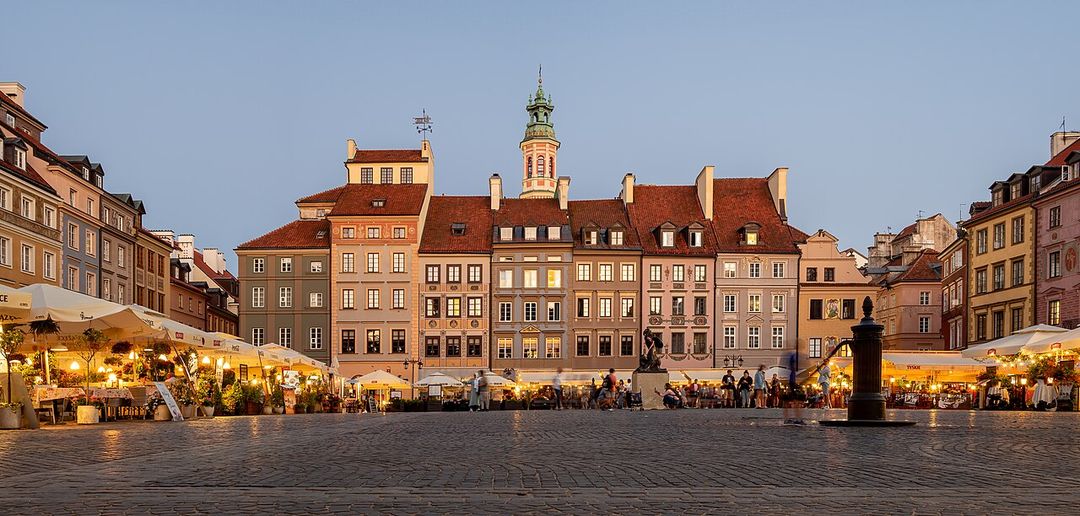
Warsaw does not photograph the way Kraków or Prague do, and it is worth saying so plainly before you arrive with the wrong expectations. This is not a city that survived the twentieth century intact and is now simply old and handsome. In August 1944 the city's underground army rose against German occupation, fought for sixty-three days, and lost. In reprisal, German forces spent the following months systematically dynamiting and burning what was left of the city, block by block, on direct orders from Berlin. By the time Soviet troops finally crossed the Vistula in January 1945, something like eighty-five percent of Warsaw was gone. The Old Town, specifically, was closer to ninety percent rubble.
What you walk through today in the Old Town Market Square is a reconstruction, completed between 1949 and 1963, built from two unlikely sources: a set of eighteenth-century cityscape paintings by the Italian artist Bernardo Bellotto, who worked in Warsaw under the name Canaletto and painted the square with near-photographic precision, and a set of measured architectural drawings that Warsaw Polytechnic students had made of every building in the historic core during the 1930s, as a training exercise nobody could have known would become an archive. UNESCO listed the rebuilt Old Town as a World Heritage Site in 1980, an unusual honour for something so young, awarded specifically because the reconstruction itself was judged an act of cultural significance rather than a fake.
This dispatch treats that history as the organising fact of the city rather than a footnote, because it explains almost everything else about how Warsaw looks and feels: the jarring juxtaposition of pastel-coloured old town facades next to Stalin-era towers and glass skyscrapers, the fierce, slightly defensive local pride in a downtown that is younger than most of the tourists visiting it, and the very different, ungentrified character of Praga on the river's east bank, which was spared the worst of the destruction almost by accident. Come for the history, the food, and the fact that this is still one of the most affordable capitals in the European Union. Do not come expecting a museum piece — Warsaw is a working, striving, occasionally ugly city that rebuilt itself on purpose, and it would rather you understood that than admired its cobblestones.
The caseWhy Warsaw earns a spot on the map
The most honest argument for Warsaw is that it is the best place in Europe to think seriously about what a city actually is. Every other capital wears its history as decoration. Warsaw wears its history as an open wound that it chose, deliberately and expensively, to dress and keep walking around on. The Old Town reconstruction is not incidental scenery for a nice weekend — it is the single most interesting thing about the city, and the two museums that flank the story from either side, the Warsaw Rising Museum and POLIN, are genuinely world-class and will change how you read every other building you pass.
Beyond the history, Warsaw has quietly become one of the more exciting food and drink cities in Central Europe, without losing the parts of Polish eating culture that make it distinctive: milk-bar cafeterias sit a few blocks from restaurants that picked up the country's first Michelin stars in the early 2020s, and both are worth your time. The city is also cheap by Western European standards for accommodation, food and drink of a comparable quality, well connected by direct flights from most of Europe, and small enough to see properly on foot with the tram network filling in the gaps.
What Warsaw is not is conventionally pretty in the way its reputation abroad still lags behind. Large stretches of the city centre are Soviet-era blocks, brutalist infrastructure and contemporary office towers, because that is genuinely what most of it is. If you need every neighbourhood to be photogenic, this will frustrate you. If you are curious about how a nearly-erased city rebuilds its own idea of itself, three or four days here rewards that curiosity more than almost anywhere else on the continent.
The calendarWhen to go
Late May through June and September into early October are the reliable windows: warm enough for the riverside bars and Łazienki Park to be in full use, without the muggy peak of July and August, and with noticeably thinner crowds than the high summer months. September in particular pairs mild days with the return of the free Sunday Chopin concerts in the park and a city that feels lived-in rather than overrun.
July and August are Poland's own peak holiday season, so expect warm, occasionally hot weather, longer queues at the Rising Museum and POLIN, and Varsovians themselves largely out of town at the coast or the lakes — the city can feel oddly quiet of locals even while busy with visitors. Winter, November through February, is genuinely cold and gets dark by mid-afternoon, but the Old Town Christmas market in December has real charm, hotel rates drop sharply, and a light dusting of snow on the reconstructed rooftops is one of the better arguments for visiting in the cold.
Avoid scheduling around 1 August if precision matters to you: that is the anniversary of the 1944 Uprising, marked citywide at 5pm with air-raid sirens, a moment of silence, and traffic that stops in the streets. It is a moving thing to witness once you understand it, and a confusing one if you do not — read up on it before you land if your dates overlap.
LogisticsGetting around
Chopin Airport (WAW) sits about ten kilometres south of the centre and is the easy option: the SKM commuter rail line and the airport bus both reach central Warsaw in twenty to twenty-five minutes for a couple of złoty. Budget carriers, Ryanair especially, often fly into Modlin (WMI) instead, roughly forty kilometres north — factor in the dedicated bus-plus-train connection, which takes closer to an hour, when you compare fares.
Inside the city, the tram network is the real backbone of Warsaw transport and has been since the nineteenth century; it is dense, frequent, and covers routes the two metro lines do not reach. The metro itself is limited to a north-south line and a newer east-west line that only fully opened in the 2020s, useful for specific long hops but not a substitute for the trams. A single ZTM ticket covers bus, tram and metro interchangeably, and the mobile app or a contactless bank card tapped directly on the reader both work, so there is rarely a reason to queue at a machine.
The historic centre itself — Old Town, the Royal Route down to Łazienki, Powiśle along the river — is compact and genuinely walkable, and the flat terrain makes Warsaw one of the better cycling cities in the region; the Veturilo bike-share system is inexpensive and well distributed. Praga, across the river, is a short tram or metro ride from the centre rather than a separate excursion, which is easy to forget given how different it feels once you arrive.
The tableHow Varsovians actually eat
Start with the bar mleczny, the milk bar — a subsidised cafeteria format that dates to the communist era and has stubbornly refused to disappear, because it is cheap, filling, and genuinely good. Order at the counter, carry your own tray, and expect a menu of pierogi, żurek (a sour rye soup, often served with boiled egg and sausage), gołąbki (cabbage rolls), and kotlet schabowy (a breaded pork cutlet the size of a dinner plate) for a few złoty a plate. Prasowy near Plac Trzech Krzyży has become a fixture on every visitor's list for good reason, but any bar mleczny doing steady local trade will do you just as well and probably better.
Pierogi deserve their own paragraph. The boiled dumplings come stuffed with everything from potato-and-cheese (ruskie, the classic) to meat, mushroom-and-cabbage, or sweet fillings like blueberry served with cream — and the difference between a mediocre plate and a great one is almost entirely about the dough being thin enough and the filling not skimped on. Zapiecek and similar chains are reliable and touristy in equal measure; ask a local for their actual neighbourhood spot and you will eat better for less.
Warsaw's higher end has moved fast. The country's first Michelin stars were awarded in the early 2020s, several of them to Warsaw kitchens working a modern, ingredient-led take on Polish tradition rather than abandoning it, and it is worth booking one table like this even on a short trip to see where the cuisine is heading. Craft beer has had its own quiet boom over the last decade, concentrated in Praga's converted industrial spaces, and Żubrówka, the bison-grass-flavoured vodka, remains the correct thing to order a shot of once, properly cold, ideally with apple juice the way it is actually drunk locally rather than neat.
The mapDistricts to know
Stare Miasto, the Old Town, is the reconstructed core and the reason most visitors come: the Market Square, the Royal Castle rebuilt to its pre-war form, and the red-brick city walls. It is compact, genuinely beautiful once you know its story, and unapologetically full of tourists — treat it as a morning, not a base for every meal.
Śródmieście, the city centre proper, is where reconstruction gives way to everything since: the Palace of Culture and Science, a 1955 gift from Stalin that Varsovians have a complicated, mostly affectionate relationship with, sits beside glass towers including Varso, now the tallest building in the European Union. This is the working, striving Warsaw of offices, shopping streets and the main railway station, useful to stay in for connections but not where the character lives.
Praga, across the Vistula on the right bank, is the district to actually seek out. It escaped the worst of the 1944 destruction largely because Soviet forces halted there for months while the Uprising and its reprisals played out on the left bank, which means Praga's pre-war tenement blocks, courtyards and street layout are genuinely original rather than rebuilt. For decades that made it Warsaw's roughest neighbourhood; over the last fifteen years it has become its most interesting one, with the Koneser complex — a former vodka factory turned galleries, restaurants and the Vodka Museum — anchoring a wave of studios, street art and craft breweries without (so far) fully sanding off the grit.
Powiśle, the riverside strip below the university, pairs café culture and the University of Warsaw Library's rooftop garden with the Vistula boulevards, which fill with beach bars, food trucks and open-air events all summer. Mokotów and Żoliborz, further out, are mostly residential but worth knowing if you are staying longer or want a sense of how most Varsovians actually live, well outside any tourist circuit.
Field intelligencePractical intelligence
Poland uses the złoty (PLN), not the euro, despite EU membership, and it is worth having a working card or some local cash rather than assuming euros will be accepted — they generally are not, outside a handful of tourist-trap stalls at inflated rates. Contactless card payment is close to universal, including on public transport, so a foreign card with no fees abroad covers almost every situation.
English is widely spoken among younger Varsovians, in hospitality, and in the business districts, considerably less so among older residents or in more everyday neighbourhood spots — a few basic Polish phrases go a long way and are genuinely appreciated. Tipping around ten percent is customary in sit-down restaurants and is not automatically added to the bill; check before doubling up.
Warsaw is a safe capital city by any reasonable European standard, with the usual advice about bags and pockets in crowded tourist areas and late-night transit hubs rather than anything more specific. The standard European two-pin plug is used throughout. And a genuinely useful piece of context: because so much of central Warsaw was rebuilt after 1945, addresses and building dates that read as centuries old are very often, on inspection, mid-twentieth-century reconstructions — the plaques on many Old Town buildings will tell you so directly if you look, and it is worth reading a few of them rather than assuming.
Field notesWhat to see & do
-
Old Town Market Square & Royal Castle
The rebuilt heart of the city: pastel burgher houses ringing a cobbled square, and the Royal Castle at its edge, reconstructed to its pre-war form using Bellotto's paintings and pre-war architectural surveys as the blueprint.
On the groundVisit the castle's interior for the best explanation anywhere in the city of exactly how much was rebuilt and how the reconstruction team worked.
-
Warsaw Rising Museum
An immersive, unflinching account of the 1944 Uprising and the reprisal destruction that followed, built inside a former tram power station in the Wola district. Essential context for understanding the rest of the city.
On the groundBudget at least three hours, and go before the Old Town rather than after — it changes how you see everything that follows.
-
POLIN Museum of the History of Polish Jews
A major museum tracing a thousand years of Polish-Jewish history, built on the site of the former Warsaw Ghetto, with the core exhibition running from medieval settlement through to the Holocaust and the postwar period.
On the groundThe core exhibition alone easily takes half a day; do not try to combine it with the Rising Museum on the same day.
-
Palace of Culture and Science
A 1955 Stalinist skyscraper, gifted by the Soviet Union and still the most visible, most argued-about building in the city. The 30th-floor viewing terrace gives the one view of Warsaw that actually makes sense of its layout.
On the groundGo up at dusk — you get the daylight skyline and the lit-up city within the same visit without a second ticket.
-
Łazienki Park & Palace on the Isle
A genuinely grand royal park with peacocks, a lake-set Baroque palace, and a large Chopin monument that hosts free open-air piano concerts on summer Sunday afternoons.
On the groundTime a visit for a Sunday between May and September and you may catch a free Chopin concert at the monument for nothing more than showing up early enough for a bench.
-
Praga & the Koneser Centre
The right-bank district that survived 1944 largely intact, its pre-war tenements now sitting alongside a former vodka factory turned galleries, restaurants, the Vodka Museum and a cluster of craft breweries.
On the groundCombine it with the nearby Neon Museum, a warehouse of rescued Cold War-era neon signage that is far more charming than it sounds.
-
Wilanów Palace
A Baroque royal residence on the city's southern edge, sometimes called Poland's Versailles, that survived the war essentially untouched and gives a sense of pre-partition Polish grandeur the city centre largely lost.
On the groundCombine the palace with a walk through its formal gardens, which are cheaper to enter separately if the interior queue is long.
-
University of Warsaw Library rooftop garden
A free, little-known rooftop garden on top of the university library building in Powiśle, with sweeping, unobstructed views over the Vistula and the Praga skyline.
On the groundCome in the late afternoon and stay for sunset — it is one of the few genuinely uncrowded viewpoints in the centre.
On the groundWhere things are
Map data © OpenStreetMap contributors.
Where to stayBase yourself well
Stare Miasto & Nowe Miasto (Old Town & New Town)
Best for first-timers who want the history on their doorstepCobbled, postcard-pretty, and thick with tourists by day. Staying inside the walls means falling asleep and waking up inside the reconstruction itself, at the cost of being a short tram ride from the city's actual working centre.
A small hotel just off the Old Town Market Square
Rooms directly on the square get noise from evening crowds; a block back keeps the walk short and the nights quiet.
€€€A guesthouse toward the New Town end of the district
New Town is quieter than the Old Town proper and only a few minutes further on foot.
€€Śródmieście (City Centre)
Best for business travellers and anyone prioritising transport linksThe Palace of Culture, the main station and the business towers — central, well connected by every tram and metro line, and short on charm after dark once the offices close.
A business hotel near the Palace of Culture
Walking distance to the main station and both metro lines, useful if you are day-tripping out of the city.
€€€Powiśle
Best for a quieter, café-culture base close to the centreRiverside cafés, the university library gardens and the Vistula boulevards, a ten-minute walk from the Old Town without the tourist density. Increasingly the neighbourhood locals recommend to visitors who ask twice.
An apartment near the university library
Puts the riverside boulevards and their summer beach-bar scene directly outside the door.
€€Praga
Best for longer stays and visitors who have already done the Old Town oncePre-war tenements, street art, craft breweries and the Koneser complex — grittier, cheaper, and the district most repeat visitors end up preferring once they know it exists.
A design-led hotel in a converted Praga tenement
A short tram or metro ride from the Old Town, with noticeably lower rates for a comparable standard of room.
€€Affiliate notePostcardRoute is reader-supported. Some links to accommodation are affiliate links: if you book through them we may earn a small commission at no extra cost to you. We only recommend places we would send a friend.
Beyond the cityWorthwhile day trips
- Żelazowa Wola
Frédéric Chopin's birthplace, about an hour west of Warsaw by bus or organised tour, set in a manor house and gardens where recitals of his own music are performed most weekends in season.
- Kazimierz Dolny
A well-preserved Renaissance riverside town on the Vistula, roughly two hours south, popular with Varsovians for its market square, granaries and easy walking trails along the river cliffs.
- Łódź
A post-industrial city ninety minutes southwest, built on nineteenth-century textile wealth, with kilometres of restored red-brick factories, Piotrkowska Street's café strip, and one of Poland's best contemporary art museums.
- Kampinos National Park
A forest and wetland reserve on the city's northwestern edge, reachable by local bus in under an hour, with marked hiking and cycling trails through dunes and marsh a short ride from the office towers.
Before you goCommon questions
- How many days do you need in Warsaw?
- Three full days covers the essentials properly: a day for the Old Town and the two big history museums, a day for Praga and the riverside, and a day for Łazienki, Wilanów or a single day trip. Two days works if you accept skipping one of those. A single day only really allows the Old Town and one museum.
- Is Warsaw worth visiting if I'm also going to Kraków?
- Yes, and the two cities are complementary rather than redundant. Kraków survived the war largely intact and gives you genuine medieval density; Warsaw gives you the more sobering, more contemporary story of a capital that had to rebuild its own identity from scratch. A fast train connects them in under two and a half hours, making both in one trip entirely realistic.
- Does Poland use the euro?
- No. Poland's currency is the złoty (PLN), and euros are not generally accepted outside a handful of tourist-oriented spots charging poor exchange rates. Contactless card payment is widely accepted almost everywhere, including on public transport.
- Is Warsaw safe for visitors?
- Yes, Warsaw is a safe capital city by ordinary European standards. Normal precautions around bags and pockets in crowded tourist spots and late-night transit hubs apply, but violent crime targeting visitors is rare.
- Why does Warsaw's Old Town look centuries old if the city was destroyed in 1944?
- Because it is a careful, deliberate reconstruction completed between 1949 and 1963, built from eighteenth-century paintings by Bernardo Bellotto and pre-war architectural survey drawings made by Warsaw Polytechnic students in the 1930s. UNESCO recognised the rebuilt Old Town as a World Heritage Site in 1980, specifically citing the reconstruction itself as culturally significant.
- What is the best neighbourhood to stay in for first-time visitors?
- Stare Miasto (the Old Town) or Powiśle just south of it, both within easy walking distance of the historic core and the river. Praga is worth strong consideration on a return visit or a longer stay, once you know the city well enough to appreciate what makes it different.
- Is English widely spoken in Warsaw?
- Widely among younger residents, in hospitality and in business districts, less so among older Varsovians or in neighbourhood spots away from the centre. A few basic Polish phrases are genuinely appreciated and go a long way.