
Lithuania · Vilnius County
Vilnius, the old town Europe forgot to crowd
The largest surviving baroque old town east of Italy, a self-declared artist republic across the river, and a capital still cheap and unhurried enough to feel like a discovery rather than a stop on a list.
Baroque spires, a river-bend bohemia, and Europe's largest surviving old town nobody quite expects · 54.69° N · 25.28° E
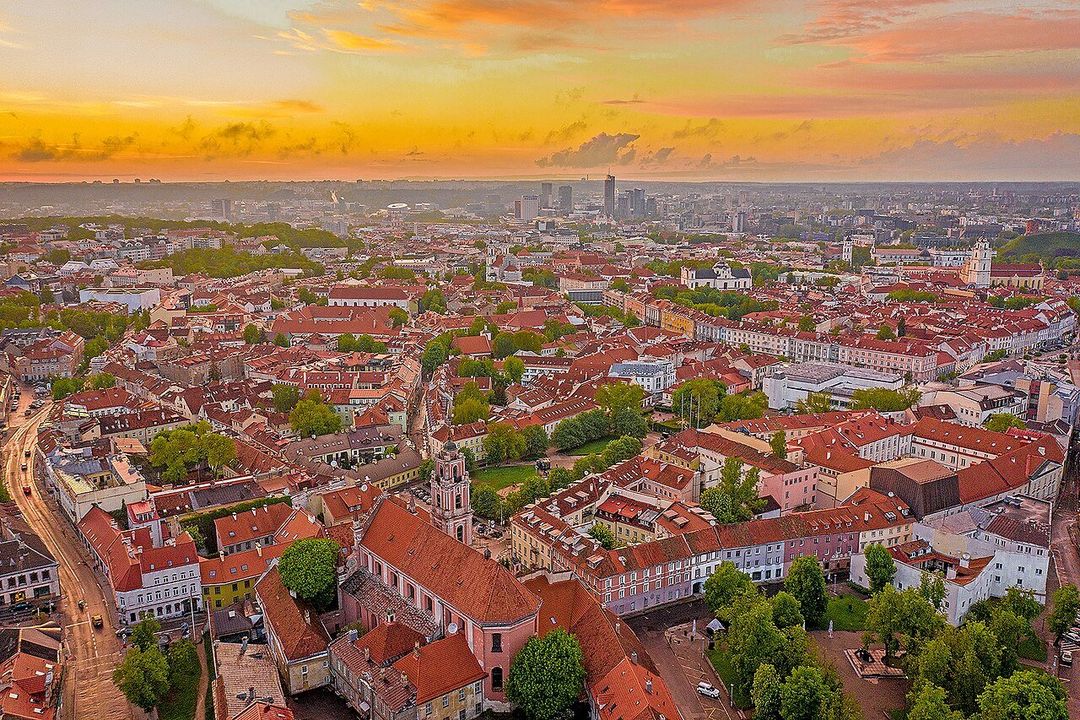
Vilnius has an image problem that works entirely in its favour: most of Europe still can't place it on a map, let alone explain why its old town is the largest intact baroque quarter east of Italy. That obscurity is the whole appeal. Here is a UNESCO World Heritage Old Town of cobbled lanes, church towers stacked three and four to a skyline, and courtyards that open onto courtyards, and you can walk all of it on a Tuesday afternoon without once breaking stride for a tour group. Prague had this exact atmosphere thirty years ago. Vilnius still has it now.
The city earns its baroque reputation honestly — Vilnius University's enclosed courtyards date to 1579, making it one of the oldest universities in Eastern Europe, and the skyline is genuinely dense with churches built across four centuries by Lithuanian dukes, Polish kings and Jesuit missionaries competing to outbuild one another. But cross the Vilnia river on any of the small footbridges east of the Old Town and the register changes completely: Užupis, a few hundred metres of crooked streets and riverside studios, declared itself an independent republic in 1997, wrote its own tongue-in-cheek constitution, and has spent the decades since being quietly, defiantly bohemian rather than quaint. The two halves of Vilnius — devout baroque capital and self-mocking artist enclave — sit a five-minute walk apart and explain more about the city than any single monument could.
This isn't a countdown of the ten churches you're obligated to photograph, though several of them earn the detour and appear below. What follows is the information that actually shapes a Vilnius trip: when the light and the crowds favour you, how a compact capital's transit actually works, what Lithuanian food looks like once you get past the tourist cepelinai stalls, and which of the city's few genuinely distinct neighbourhoods is worth sleeping in. Vilnius rewards three or four unhurried days more than a frantic one, mostly because there's nothing here forcing you to rush.
The caseWhy Vilnius earns the detour
Start with scale: the Old Town covers roughly 360 hectares, one of the largest surviving medieval and baroque urban cores anywhere in Europe, and almost none of it has been rebuilt into a sanitised tourist set. Walk from Cathedral Square down to the Gate of Dawn and you pass genuine working churches, university buildings still teaching students, and apartment courtyards where laundry hangs between the baroque facades — this is a lived-in old town, not a preserved one, and the difference is obvious within the first hour.
The second reason is Užupis, and it is not a minor one. Few cities anywhere have a neighbourhood that formally declared independence as satire and then built an entire creative identity around the joke — resident artists, a 41-point constitution posted in dozens of languages on a single wall, an Angel statue that doubles as the republic's unofficial symbol, and a national day (1 April, deliberately) celebrated with passport stamps at the bridge. It reads as a gimmick until you actually walk it and realise the galleries, workshops and riverside bars are real, not performed for visitors.
Then there is the plain fact of value. Vilnius delivers a genuine European capital experience — opera, serious museums, a university with four and a half centuries of continuous history, a skyline of baroque spires — at prices closer to a regional Polish or Baltic city than to Prague or Vienna. Add in a national history that runs from the largest territorial state in medieval Europe through Soviet occupation to a hard-won, still-young independence, told without flinching at the Museum of Occupations and Freedom Fights, and Vilnius offers more substance than its quiet reputation suggests.
The calendarWhen to go
Late May through September is the easy answer and the right one for most visitors: long daylight (sunset well past 9pm in June), terraces and riverside bars running at full capacity, and a reliable run of warm, dry weather that this far north cannot be taken for granted outside those months. July and August bring the only real crowds Vilnius sees, and even peak season here is mild by the standards of Prague or Dubrovnik.
September is arguably the connoisseur's pick — the student population returns, giving the city its proper energy back after a quieter August when many locals head to the countryside, while the weather generally holds through early autumn and the crowds have already thinned. Winter is a genuine option for anyone who doesn't mind the cold and the dark: Vilnius commits fully to its Christmas market on Cathedral Square from late November, the baroque facades look striking under snow, and daylight shrinks to a scant seven or eight hours by December, which shapes your days whether you plan for it or not. Spring, by contrast, is the season to deprioritise — March and April tend to be grey, muddy with thaw, and short on the compensating charm that winter's festive lighting provides.
LogisticsGetting around
Vilnius is compact enough that the Old Town, Užupis and the New Town's Gediminas Avenue corridor are all within a comfortable twenty-minute walk of each other, and most visitors will do the bulk of their sightseeing on foot without ever needing transit. The cobbles are real but gentler than Tallinn's or Granada's hills — flat river-valley terrain rather than a fortress on a slope — so this is an easier walking city than several others in this guide.
When you do need to cross further out — to the TV Tower, the main bus or rail station, or a neighbourhood like Žvėrynas — Vilnius runs an efficient bus and trolleybus network covering the whole city cheaply, payable with a contactless Vilniečio Kortelė card or, increasingly, a bank card tapped directly on the reader. Taxis and ride-hailing apps (Bolt is dominant locally) are inexpensive and useful for the airport run, which is itself unusually convenient: Vilnius Airport sits about six kilometres from the centre, a fifteen-minute bus or train ride, making this one of the easier European capitals to arrive into without a costly transfer.
The tableHow Vilnius actually eats
Lithuanian food is heavier and more rooted in root vegetables, dairy and dill than its Baltic neighbours' cuisines often get credit for, and it rewards actually seeking out rather than assuming it's interchangeable with Polish or Russian fare nearby. Cepelinai — potato dumplings stuffed with minced meat or curd cheese, named for their zeppelin shape and served under a sour-cream-and-bacon-fat sauce — are the dish every menu leads with, and they're genuinely worth eating at least once, ideally at a kitchen that isn't purely coasting on tourist traffic. Šaltibarščiai, a vivid pink cold beetroot soup served with a hot boiled potato on the side, is the summer counterpart and an easy, refreshing introduction if cepelinai sound too heavy for the weather.
Halės Market, a restored 1906 covered market just outside the Old Town, is the best single stop for a cheap, varied lunch — stalls run from traditional Lithuanian cooking to contemporary bistro counters, with none of the self-conscious staging of a food hall built purely for visitors. For something more specific to the region, seek out kibinai, a savoury pastry stuffed with meat or mushroom that originated with the Karaim community historically settled around nearby Trakai — several Vilnius bakeries now make a very good version without the lake-town trip. Lithuania also has a serious, underrated craft beer scene; the Vilnius microbrewery boom of the last decade has produced bars with genuinely ambitious tap lists, and a dark rye bread and smoked-fish culture that rewards drinking alongside rather than instead of a meal. Don't skip midus, Lithuanian mead, at least as a curiosity — it ranges from sweet and simple to genuinely complex depending on who's making it.
The mapNeighbourhoods to know
The Old Town (Senamiestis) is the obvious centre of gravity — Cathedral Square and Gediminas Hill at its northern edge, the Gate of Dawn marking its southern boundary, and a dense grid of baroque churches, university courtyards and restaurant-lined lanes in between. It rewards slow wandering over a checklist approach; the best version of the Old Town is the one you find by taking an unplanned turn down a side street rather than the one mapped between numbered sights.
Across the small Vilnia river to the east, Užupis is Vilnius's other essential neighbourhood and a genuinely different register — artist studios in converted riverside buildings, a self-written constitution posted on a wall near the main bridge, and a relaxed, slightly scruffy charm that stands in deliberate contrast to the Old Town's grandeur. It's small enough to properly see in an hour, though the cafés and galleries reward lingering longer.
Naujamiestis, the New Town centred on Gediminas Avenue, is where contemporary Vilnius does its shopping, government business and evening drinking — a wide, handsome 19th-century boulevard running from Cathedral Square out to the parliament building, lined with shops, restaurants and the presidential palace nearby. Žvėrynas, west across the Neris river, is the quieter alternative: a leafy, almost entirely residential district of wooden houses and tree-lined streets that feels like a provincial town somehow stitched into the capital, worth the short walk or bus ride for anyone wanting a calmer base or a genuine break from the Old Town's density.
Field intelligencePractical intelligence
Lithuania uses the euro, and contactless card payment is the default virtually everywhere, including market stalls and the trolleybus — carrying cash is rarely necessary. English is widely spoken among anyone who came of age after independence, especially in the Old Town's restaurants and shops, though a few words of Lithuanian (labas for hello, dėkui for thank you) land well with older residents.
Tipping around 10 percent is appreciated in sit-down restaurants but not obligatory the way it is in the United States. Vilnius sits in the same time zone as the rest of the Baltics and Finland, and the seasonal daylight swing is dramatic for a capital this far south of the Arctic Circle — budget your sightseeing hours accordingly if visiting November through February, when usable daylight can run to barely seven hours. The Stebuklas tile near the Cathedral, where tradition holds that spinning once on the spot grants a wish, is a genuinely charming local custom rather than a manufactured tourist trap, and worth the thirty seconds it costs you.
What to see & do
-
Gediminas Castle Tower
The surviving remnant of Vilnius's Upper Castle, perched on a wooded hill above the Old Town since the early 1400s and rebuilt in the 1930s — the single best panoramic viewpoint over the baroque skyline and the river valley beyond.
Tip:Take the funicular up if you'd rather save your legs for the Old Town below; the walk down through the castle hill park is the nicer direction to do on foot.
-
Cathedral Square & Vilnius Cathedral
The Old Town's civic and spiritual centre, framed by a neoclassical cathedral, a free-standing bell tower converted from a medieval defensive structure, and the Stebuklas wishing tile set into the cobbles.
Tip:Come back after dark; the cathedral's floodlit facade against the night sky is a different, quieter version of the square than the daytime crowds suggest.
-
Vilnius University
One of Eastern Europe's oldest universities, founded in 1579, its enclosed baroque courtyards still used daily by students and open to wander between lectures.
Tip:Climb St John's bell tower inside the university grounds for a second, less crowded panoramic viewpoint than Gediminas Tower.
-
Užupis
A self-declared artist republic across the Vilnia river, complete with its own tongue-in-cheek constitution posted on a wall, an Angel statue as unofficial symbol, and a bohemian cluster of studios, galleries and riverside cafés.
Tip:Read the full multilingual constitution near the main footbridge — it's funnier and sharper than most summaries give it credit for, and sets up the neighbourhood's tone perfectly.
-
Gate of Dawn & Aušros Vartai Chapel
The sole surviving gate of the city's medieval defensive wall, housing a chapel and revered icon of the Virgin Mary that remains an active pilgrimage site for Catholics across the region.
Tip:Visit in the early morning if you want to see the chapel genuinely used for prayer rather than photographed as a monument.
-
St. Anne's Church
A soaring red-brick Gothic facade from the late 15th century, built from 33 distinct brick shapes in a style so intricate that Napoleon is said to have wanted to carry it back to Paris stone by stone.
Tip:View it from across the small square in late-afternoon light, when the brickwork's texture and colour read most clearly.
-
Museum of Occupations and Freedom Fights
A former KGB headquarters and prison, preserved largely as found, documenting Soviet and Nazi occupation, deportations and the underground resistance that eventually won Lithuania's independence.
Tip:This is a heavy, unsanitised visit rather than a polished exhibition — go with time to sit afterward, and budget at least ninety minutes.
-
Hill of Three Crosses
A hilltop monument recalling a local legend of martyred monks, rebuilt in the 1980s after the Soviets demolished the original, with one of the city's best wide-angle views over the Old Town's rooftops.
Tip:Climb up for sunset — the crosses themselves are lit and the Old Town below catches the last light particularly well from here.
-
Halės Market
A restored 1906 covered market just outside the Old Town walls, mixing traditional Lithuanian produce stalls with contemporary food counters, and the single best stop for a varied, inexpensive lunch.
Tip:Go at midday on a weekday to see it working as a genuine local market rather than a weekend visitor draw.
On the groundWhere things are
Map data © OpenStreetMap contributors.
Where to stayBase yourself well
Old Town (Senamiestis)
Best for first-timers and walkersCobbled baroque lanes with the highest concentration of churches, restaurants and sights within a short walk of your door — central, atmospheric, and the obvious first-timer base.
A boutique hotel in a converted merchant house near Cathedral Square
Look for a small historic-building hotel just off the main square itself for the shortest possible walk to the skyline's best viewpoints.
€€€An apartment near the university quarter
Staying among the university's baroque courtyards puts you close to St John's bell tower and the quieter southern half of the Old Town.
€€Užupis
Best for a bohemian, local-feeling stayCrooked riverside streets a few minutes' walk from the Old Town, with an artsy, slightly scruffy charm and noticeably calmer nights once the Old Town's restaurants wind down.
A design-led guesthouse near the Užupis constitution wall
A handful of small stays occupy converted riverside buildings here, putting you inside the 'republic' itself rather than just visiting for an afternoon.
€€Naujamiestis (New Town)
Best for modern conveniences and nightlifeThe wide 19th-century boulevards around Gediminas Avenue — shopping, government buildings and evening bars, with the Old Town a flat ten-minute walk away.
A contemporary hotel on or near Gediminas Avenue
The avenue's straight, flat walk into Cathedral Square makes this a practical base without sacrificing much proximity.
€€€Žvėrynas
Best for a calmer, local-feeling baseA leafy, almost entirely residential district of wooden houses across the Neris river — quiet, provincial in feel, and a genuine change of pace from the Old Town's density.
A quiet apartment among Žvėrynas's wooden houses
You'll trade a short bus or walk into the centre for genuinely residential streets and a noticeably slower pace at night.
€€Affiliate notePostcardRoute is reader-supported. Some links to Booking.com (stays, flights, car hire, tickets and tours, airport transfers) are affiliate links, tracked through CJ Affiliate: if you book through them we may earn a small commission at no extra cost to you. We only recommend places we would send a friend.
Book the restEverything else for the trip
Stay sorted? These open Booking.com for the other legs of the journey.
-
Tours & tickets
Things to do in Vilnius
Skip-the-line tickets, tours and day trips.
Browse activities -
Wheels
Car hire in Vilnius
Compare pick-up points and rental companies.
Compare cars -
Air
Flights
Search fares, then come back for the neighbourhood advice.
Search flights -
Ground
Airport transfers
Book a taxi or private transfer before you land.
Book a transfer
Affiliate noteThese four links are affiliate links too: if you book through them we may earn a small commission at no extra cost to you.
Beyond the cityWorthwhile day trips
- Trakai Island Castle
A fairytale lake-island castle thirty minutes west of the city by train or bus, built by the Karaim community's historic homeland — climb the tower, rent a boat on the lake, and try the local kibinai pastry before heading back.
- Kernavė
A UNESCO-listed archaeological site an hour northwest, considered the first capital of the Grand Duchy of Lithuania — a cluster of ancient hillforts and burial mounds set in open countryside with almost no crowds.
- Kaunas
Lithuania's second city, about an hour by train, with its own distinct Art Deco interwar architecture and a livelier, more student-driven bar scene than the capital.
Before you goCommon questions
- How many days do you need in Vilnius?
- Three full days covers the Old Town, Užupis and one day trip comfortably. Two days works for a focused visit to the headline sights, and the Old Town alone can be walked in a single long day if that's genuinely all the time available.
- What is the best area to stay in Vilnius for first-timers?
- The Old Town (Senamiestis), for the sheer convenience of having the cathedral, university and restaurants within walking distance. Užupis is the better pick for a quieter, more bohemian stay a short walk from the same sights.
- Is Vilnius expensive to visit?
- No — it's one of the more affordable European capitals for comparable quality, especially on food and accommodation. Eating at markets like Halės, using public transit over taxis, and visiting free sights like Užupis and the Old Town's churches keeps a trip genuinely cheap.
- What is the best time of year to visit Vilnius?
- Late May through September for the warmest, longest days, with September offering a slightly quieter, more local-feeling alternative to peak summer. Winter brings a genuine Christmas market and snow on the baroque rooftops, at the cost of very short daylight hours.
- Is Užupis actually an independent country?
- No — it's a satirical, self-declared 'republic' within Vilnius with its own tongue-in-cheek constitution and a mock national day on 1 April, not a real political entity. The joke is part of the neighbourhood's genuine artistic identity, not a tourist gimmick layered on top.
- Do I need to speak Lithuanian to visit Vilnius?
- No. English is widely spoken, especially by anyone who grew up after independence, and most Old Town restaurants and shops operate comfortably in English. A few basic Lithuanian words are appreciated but not necessary.