
Croatia · Split-Dalmatia County
Split, lived-in since 305 AD
No other European city centre is also a retired Roman emperor's retirement palace, still inhabited, still working, still selling fish two streets from where he built his mausoleum.
Dispatch from the only city built inside a retired emperor's palace · 43.51° N · 16.44° E
Plan this trip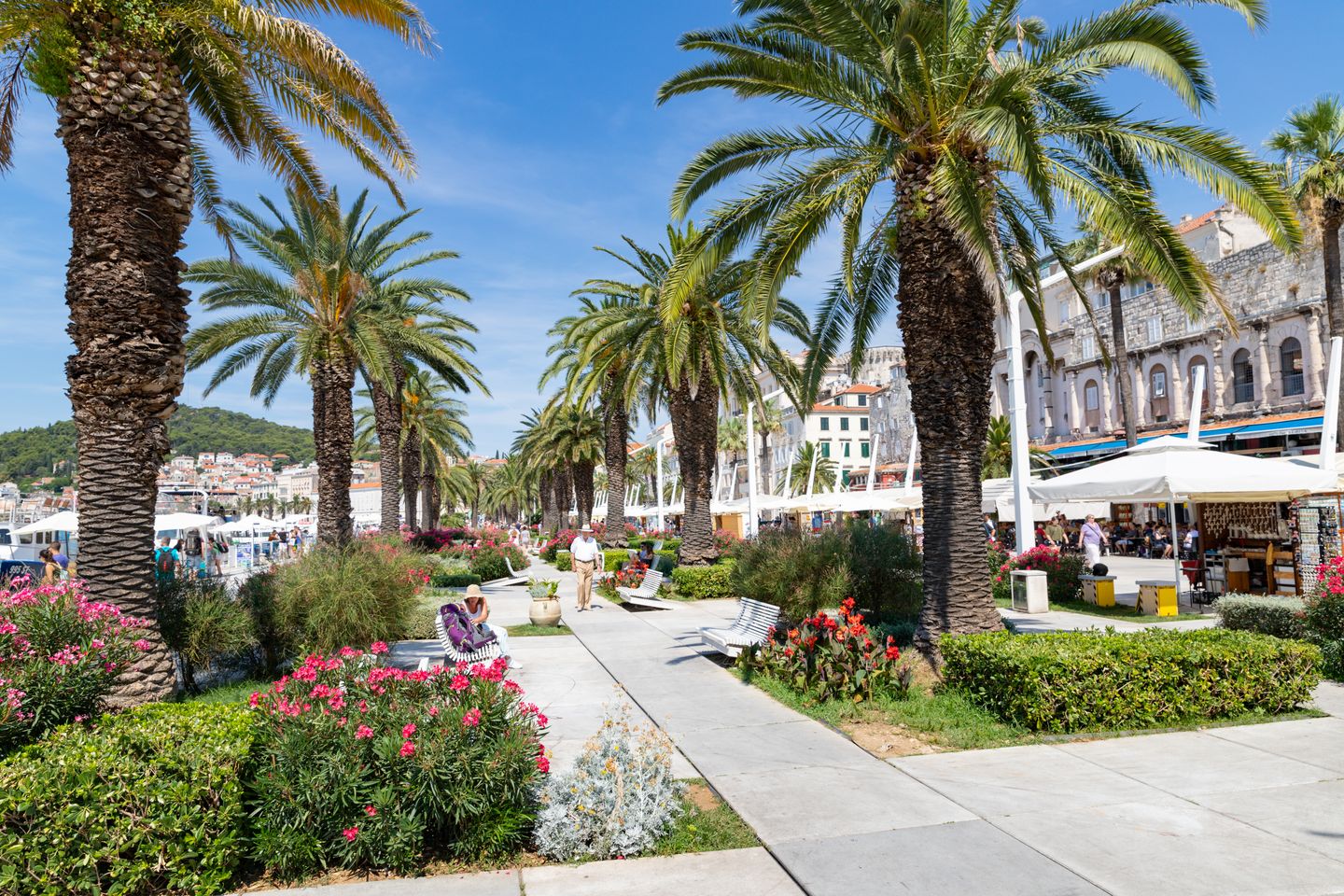
Most European old towns grew up organically over centuries, one building leaning against the next. Split's did that too, but it started from a genuinely strange foundation: a fortified retirement palace the Roman emperor Diocletian built for himself in 305 AD, laid out like a military camp with four gated walls and a cross-axis of colonnaded streets. When Diocletian died, the palace didn't become a ruin or a museum. Refugees fleeing a nearby sacked city moved into its walls in the 7th century and never really left — they built houses into the imperial arcades, turned the emperor's mausoleum into a cathedral, and kept living there for the next thirteen hundred years. Split's old town is not a recreation or a heritage set piece. It is a working Roman palace with laundry hanging from balconies bolted into 1,700-year-old stone.
That premise alone would make Split worth a stop, but it also happens to sit at the hinge point of the Dalmatian coast — the main ferry hub for Hvar, Brač and Vis, a city with a real university-town energy of its own, and a waterfront promenade, the Riva, that does the thing Mediterranean waterfronts are supposed to do and rarely pull off this well. Split spent a long stretch as the place people passed through on the way to the islands. That has changed fast in the last decade — cruise ships and budget flights found it — but the palace's maze of side alleys and the neighbourhoods just beyond the old walls still reward anyone willing to walk five minutes past the obvious photo spots.
This dispatch treats Split as a city to actually spend time in, not a ferry terminal with a nice backdrop. What follows covers when to come, how to get in and out of the old town's genuinely confusing layout, where Splićani eat when they're not selling ćevapi to tourists, and how to use the city as a base for the islands without losing a base worth returning to each evening.
The caseWhy Split earns more than a ferry changeover
Split gets treated by a lot of itineraries as a logistics problem — the port you pass through between Dubrovnik and the islands. That undersells a city where you can stand in a Roman peristyle with fluted granite columns shipped from Egypt seventeen centuries ago, climb a bell tower built directly into the emperor's mausoleum, and twenty minutes later be swimming off a pebble beach with the old town's rooftops visible across the bay. Few places compress that much layered history into a walkable half-kilometre.
The palace itself is the headline, but Split's other case is simpler: it's a real Croatian city with a real Croatian rhythm, not a resort built for visitors. Marjan Hill, the pine-covered peninsula the whole old town backs onto, is where Splićani actually go to run, climb and swim, and it costs nothing to join them. The fish market a few streets from the cathedral still runs on local trade first. Split rewards visitors who treat it as a place to live in for a few days rather than a checklist item before the ferry.
The calendarWhen to go
Late May through June, and September into early October, are the sweet spots, and the margin matters more here than in most of Europe. July and August bring reliable heat, but also the full cruise-ship and package-tour crush layered onto a genuinely tiny old town — the peristyle at midday in August can feel more like a queue than a Roman ruin. Come in June or September and you get the same sea temperature and most of the same sunshine with noticeably more room to breathe.
Off season, roughly November through March, much of the Dalmatian coast's tourism infrastructure quietly shuts down — island ferries thin out, some restaurants close for the winter, and the bura wind can make the waterfront genuinely unpleasant. Split itself stays functional year-round since it's a real working city, unlike some smaller coastal towns, but plan an island day trip for anything outside April to October and check ferry schedules carefully, since winter timetables shrink hard.
LogisticsGetting around
The old town is entirely pedestrian and genuinely tiny — you can walk from the Golden Gate on the north wall to the Riva on the south side in about ten minutes, though the palace's warren of narrow passages means first-time visitors get pleasantly lost doing it. Don't bother with a car inside the walls; there's nowhere to put one and nothing gained by trying. Everything in the historic centre is on foot.
Beyond the old town, Split is walkable to a point — Marjan Hill and the Bačvice beach area are both reachable in fifteen to twenty minutes on foot from the Riva — but the city buses (run by Promet Split) are cheap and useful for reaching the ferry port's outer terminals or neighbourhoods further out. The real logistics question in Split is usually the ferry port, not the city itself: it sits directly at the eastern end of the Riva, an easy walk from the old town, with separate terminals for the Jadrolinija car ferries and the faster passenger catamarans to Hvar, Brač and beyond — check which terminal your specific route uses, since they're a genuine walk apart.
The tableHow Split actually eats
Dalmatian food runs simpler and more Italian-inflected than food further inland in Croatia — olive oil, grilled fish, prosciutto-style pršut, and a serious wine culture built on indigenous grape varieties like Plavac Mali that rarely make it onto export lists. The honest baseline meal here is grilled fish bought by weight, dressed in nothing but oil, garlic and blitva (Swiss chard with potatoes), and it's worth actively seeking out over the fried-squid tourist-menu default.
The fish market, Ribarnica, sits just outside the palace's eastern wall and is worth a visit even if you're not cooking — it runs on a genuine local schedule, mornings only, and the surrounding streets have some of the best small konoba taverns in the old town, distinguished from the tourist-menu restaurants mainly by the absence of laminated photos on the door. Burek, a flaky pastry filled with meat or cheese, is the breakfast of choice grabbed standing up, ideally with a small yoghurt drink to wash it down, exactly as bakeries here have served it for decades. And don't skip rakija, the local fruit brandy offered as a welcome drink or digestif in most family-run konobas — a fig or herb variety is the interesting order over the generic grape version.
The mapNeighbourhoods to know
Diocletian's Palace, the old town proper, is the obvious centre of gravity — a warren of Roman-founded streets now packed with cafés, boutiques and residential doorways, bounded by the Riva to the south and the four old gates (Golden, Silver, Iron and Bronze) on the other sides. Base yourself here or immediately adjacent for maximum walkability, but understand that peak-season foot traffic through the peristyle at midday is heavy.
Varoš, just west of the palace walls climbing toward Marjan Hill, is the old fishermen's quarter — steep cobbled lanes, small stone houses, and a noticeably quieter, more residential feel five minutes from the tourist core. Bačvice, southeast of the centre near the ferry port, is where locals actually swim — a shallow sandy cove (rare for this rocky coastline) that turns into an open-air nightlife strip after dark. Marjan itself isn't a neighbourhood so much as the city's green lung, a forested peninsula of pine trails, cliffside swimming spots and a genuinely different pace than the old town below it.
Field intelligencePractical intelligence
Croatia uses the euro, and prices in the old town run noticeably higher than a few streets away or in Varoš — a coffee on the peristyle costs a real premium over the same coffee two minutes' walk uphill. Book island ferries and catamarans ahead in July and August; the popular Split–Hvar routes sell out on peak summer mornings, and Jadrolinija's website and the Krilo/TP Line catamaran operators are the ones to check directly rather than relying on a single aggregator.
Tap water is safe and genuinely good throughout the city. Croatia is generally a safe, low-hassle destination, but the cruise-ship-crowd hours (roughly late morning through mid-afternoon on days multiple ships are in port) are worth timing around if you want the peristyle and cathedral without a wall of people — early morning or after 6pm both work well. And bring proper shoes: the palace's marble-smoothed Roman streets get genuinely slippery when wet, a detail more than one visitor learns the hard way in a sudden Dalmatian rain shower.
Field notesWhat to see & do
-
Diocletian's Palace
Not a ruin you visit but a neighbourhood you walk through — a fortified Roman palace from 305 AD whose colonnaded streets, vaulted substructures and central peristyle have been continuously inhabited for over a millennium.
On the groundCome at dawn before the tour groups and cruise crowds arrive; the peristyle empty and lit by early light is a different place entirely from its midday version.
-
Cathedral of Saint Domnius & bell tower
Diocletian's own octagonal mausoleum, repurposed as a cathedral since the 7th century — making it, by most reckonings, the oldest cathedral building in the world still in use, with a Romanesque bell tower you can climb for the best rooftop view in the old town.
On the groundClimb the bell tower's narrow, slightly vertiginous stairs for the money shot over the terracotta roofs to the harbour — go close to opening to beat both the heat and the queue.
-
Riva waterfront promenade
The palm-lined seafront running along the palace's south wall, paved in pale stone and lined with café terraces — Split's genuine civic living room, where the whole city turns out for the evening korzo stroll.
On the groundSkip the cafés directly on the Riva for markedly better prices one block back, then bring your coffee down to a bench on the water instead.
-
Marjan Hill
A pine-forested peninsula rising directly behind the old town, laced with walking and running trails, small hillside chapels, and rocky swimming coves — Split's green escape and the best panoramic view of the city and bay.
On the groundTake the trail toward Vidilica viewpoint for the classic postcard shot of the old town roofline against the sea, best an hour or two before sunset.
-
Bačvice beach
A rare sandy, shallow cove a short walk southeast of the old town, popular for swimming by day and famous locally as the home of picigin, a Split-invented beach game played in the shallows, and for its open-air nightlife after dark.
On the groundVisit mid-morning on a weekday for space to actually swim; weekend afternoons in summer get seriously crowded given how compact the cove is.
-
Fish market (Ribarnica)
An open-air market just outside the palace's eastern wall, running on a genuine local morning trade rather than a tourist schedule — the best single spot to see how Split actually shops and eats.
On the groundGo before 10am for the real selection and the least performative version of the market; by early afternoon most stalls have packed up.
-
Gregorius of Nin statue
Ivan Meštrović's towering bronze of a defiant 10th-century bishop, standing just outside the palace's Golden Gate — famous locally for its enormous polished big toe, rubbed for luck by generations of visitors.
On the groundRub the toe (everyone does), then step back to actually look at the scale and posture of the sculpture, which gets skipped in the toe-rubbing rush.
-
Meštrović Gallery
A purpose-built villa gallery west of the centre on the way to Marjan, showcasing the sweeping sculptural work of Ivan Meštrović, Croatia's best-known 20th-century sculptor, in the seaside home he designed for himself.
On the groundCombine it with a Marjan Hill walk since the gallery sits right on the route — the garden terrace overlooking the sea is worth lingering in as much as the collection itself.
On the groundWhere things are
Map data © OpenStreetMap contributors.
Where to stayBase yourself well
Inside Diocletian's Palace
Best for first-timers who want to wake up inside the ruinSleeping inside the actual Roman walls, in converted stone apartments and small boutique hotels tucked into the palace's alleys — maximum atmosphere and zero commute to the sights, at the cost of noise and higher rates.
A converted stone apartment inside the palace walls
Look for something off the main peristyle-to-Golden-Gate thoroughfare for a meaningfully quieter night's sleep.
€€€A small boutique hotel near the Silver Gate
The palace's quieter eastern side puts you close to the fish market and a short walk from the Riva.
€€Varoš
Best for a quieter base with real neighbourhood textureThe old fishermen's quarter climbing toward Marjan Hill, immediately west of the palace walls — steep cobbled lanes and a noticeably more residential, local feel just five minutes from the tourist core.
A guesthouse on a Varoš side lane
Trade a short uphill walk for genuinely lower rates and a neighbourhood that still functions as a neighbourhood after dark.
€€Bačvice & the port side
Best for island-hopping logistics and beach accessEast of the old town near the ferry terminals and Bačvice beach — practical for early island departures and beach mornings, with a livelier nightlife scene after dark than the historic core.
A modern hotel near the ferry port
Worth the trade-off on any trip built around early catamarans to Hvar or Brač — you lose old-town atmosphere but gain sleep.
€€Meje & the Marjan side
Best for travellers prioritising quiet and green space over doorstep nightlifeA leafy residential district between the old town and Marjan Hill, favoured by well-off locals — genuinely calm, close to the peninsula's trails and swimming coves, a short walk or bus ride from the centre.
An apartment on the Meje side of Marjan
Best for anyone building their trip around hiking or swimming on Marjan rather than late nights on the Riva.
€€Affiliate notePostcardRoute is reader-supported. Some links to accommodation are affiliate links: if you book through them we may earn a small commission at no extra cost to you. We only recommend places we would send a friend.
Beyond the cityWorthwhile day trips
- Hvar
An hour or so by fast catamaran, Croatia's glossiest island — lavender fields, a hilltop fortress, and a harbour town that turns into a genuine party scene by night. Book the boat ahead in summer.
- Krka National Park
A little over an hour by car or organised tour, a cascade of travertine waterfalls through wooded gorges, with a swimming area beneath the main falls open in season.
- Brač & the Zlatni Rat beach
A short ferry to Croatia's third-largest island, home to the famously shape-shifting shingle spit of Zlatni Rat and the quieter inland stone-mason town of Škrip.
- Trogir
A UNESCO-listed medieval walled town on its own tiny islet, half an hour by bus or car — smaller and calmer than Split's old town, with a genuinely well-preserved Romanesque-Gothic core.
Before you goCommon questions
- How many days do you need in Split?
- Two full days covers the old town, Marjan Hill and Bačvice beach comfortably. Add a third day if you want to fit in a day trip to Krka or Trogir without rushing, or treat Split purely as a one- or two-night base before heading out to the islands.
- Is Split worth visiting or just a ferry stop to the islands?
- It's genuinely worth its own time, not just a port to pass through. Diocletian's Palace is a living, inhabited Roman-era neighbourhood rather than a roped-off ruin, and the city has real local energy — Marjan Hill, Bačvice beach and Varoš — well beyond the old-town core most itineraries stop at.
- What is Diocletian's Palace and is it still standing?
- It's a fortified retirement palace the Roman emperor Diocletian built for himself around 305 AD. It's still standing because people never stopped living in it — refugees moved into its walls in the 7th century and residents have occupied it continuously ever since, making today's old town Split a working neighbourhood inside a 1,700-year-old Roman structure.
- How do I get to the islands from Split?
- The ferry port sits at the eastern end of the Riva, an easy walk from the old town, with Jadrolinija running car ferries and several operators running faster passenger catamarans to Hvar, Brač, Vis and beyond. Book ahead for July and August departures, when the popular routes sell out.
- What is the best time of year to visit Split?
- Late May through June and September into early October are the sweet spots — warm enough to swim, without the full July-August cruise-ship and package-tour crush that fills the old town's narrow streets at midday.
- Is Split expensive?
- It's moderately priced by Mediterranean standards, though prices climb noticeably inside the old town's most visible spots — a coffee on the Riva costs more than the same coffee a block back in Varoš. Eating where locals eat and booking island ferries directly rather than through resellers both help control costs.