
Dominican Republic · Distrito Nacional
The first city, still clocking in
Santo Domingo has the oldest cathedral, the oldest paved street and the oldest fortress in the Americas — and a motorbike will still cut across all three at speed, because people live here.
Dispatch from the oldest European city in the Americas, which flatly refuses to behave like a museum · 18.49° N · 69.93° W
Plan this trip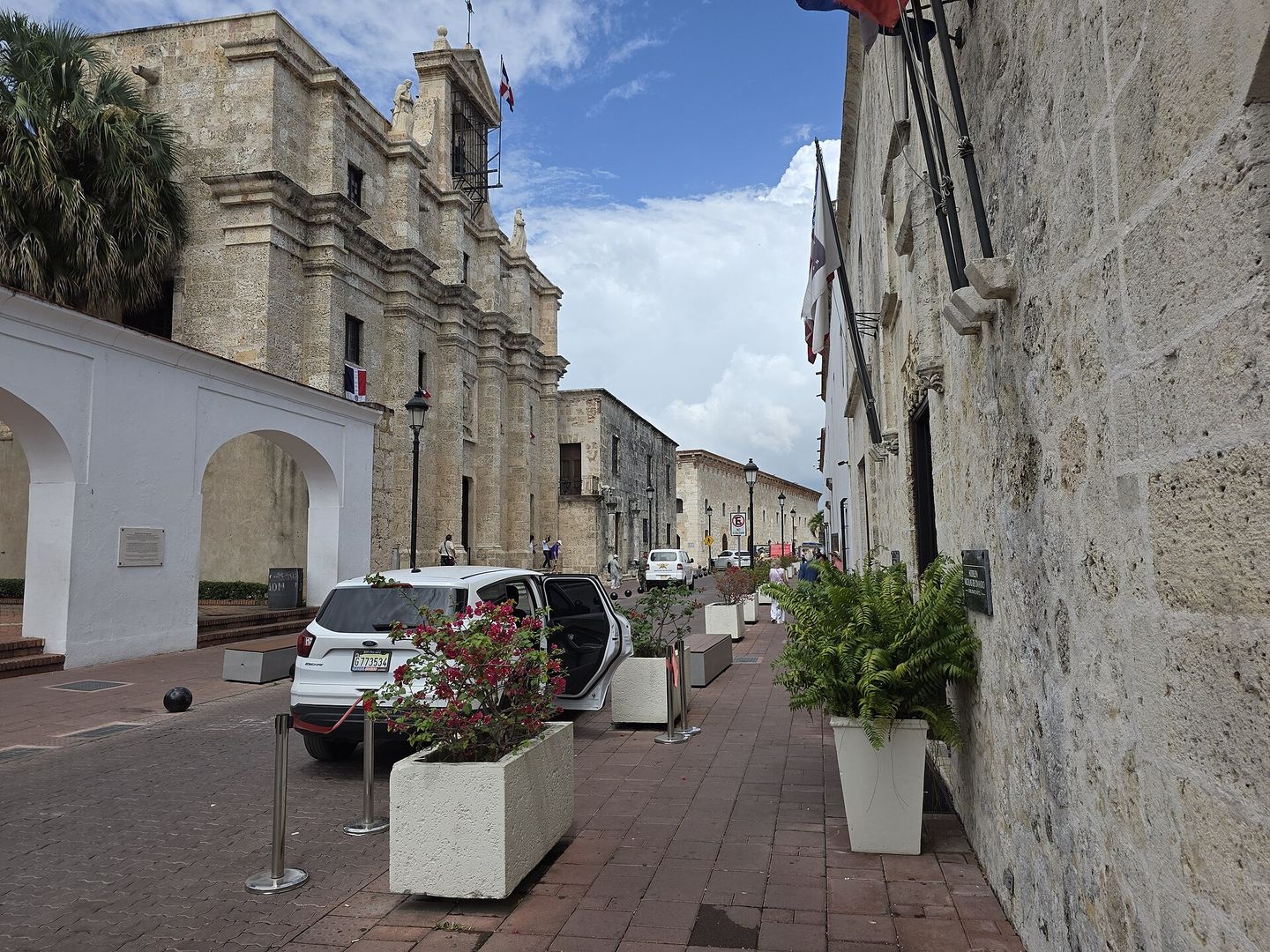
Santo Domingo holds a set of superlatives that sound invented until you walk them in a single morning: the first cathedral built in the Americas, the first paved street, the first fortress, the first monastery, the first hospital. Ovando laid out the grid on the west bank of the Ozama in 1502, and that grid is still the grid. You can stand at one end of Calle Las Damas and see five centuries of masonry lined up in order, which is a thing almost nowhere else on this side of the Atlantic can offer.
What makes the city genuinely interesting is that none of this is cordoned off. The Zona Colonial is a UNESCO World Heritage Site and also a neighbourhood of roughly seven thousand people, with a hardware shop under a sixteenth-century arch, a colmado blasting dembow across from a cathedral consecrated in 1541, and schoolchildren cutting through Plaza de España because it is the short way home. Havana has been preserved into something closer to a set. Cartagena has been polished for cruise passengers. Santo Domingo has resisted both fates, partly on purpose and partly because it is the working capital of a country of eleven million and has better things to do.
This dispatch is researched and compiled for the traveller who wants the city rather than the monuments alone — which means it spends as much time on where to sleep, how to move, what the tapón does to your schedule and how a Dominican restaurant bill is actually assembled as it does on the Alcázar. Give Santo Domingo three days and it is a very good colonial city. Give it five, with an afternoon in Gazcue and a Sunday evening at the San Francisco ruins, and it becomes something you argue about with people who only did the beach.
The caseWhy bother with the capital at all
Most people who fly to the Dominican Republic never see Santo Domingo. They land at Punta Cana, get bussed to an all-inclusive, and leave with a perfectly pleasant impression of a country they have not visited. This is the single biggest missed opportunity in Caribbean travel, and the case against it is simple: the Dominican Republic is not a resort with a country attached, it is a country with resorts on one corner of it, and the capital is where the argument about what that country is has been conducted for five hundred years.
The historical density is the obvious draw and it is not oversold. Within about twelve walkable blocks you have the Catedral Primada de América, consecrated in 1541 and still holding mass; the Alcázar de Colón, built for Diego Colón, Christopher's son, in the 1510s and furnished today with period pieces rather than left as an empty shell; the Fortaleza Ozama, whose Torre del Homenaje has been standing since the 1500s and served as a prison into the twentieth century; and the roofless shell of the Monasterio de San Francisco, wrecked by earthquake and hurricane and then quietly repurposed as the best free live-music venue in the city. That last detail is the whole point of Santo Domingo in miniature.
The less obvious draw is the music. Merengue is the national form and it is everywhere, but bachata is the one that matters culturally — it was born in this country, was dismissed for decades as música de amargue, the music of bitterness, played in bars nobody respectable admitted to visiting, and is now on UNESCO's intangible heritage list and in the global pop charts. You can hear all of it without buying a ticket to anything. Colmados — the corner shops that double as bars, credit unions and community noticeboards — put a speaker on the pavement at dusk and that is the evening's entertainment sorted.
And it is cheap in a way that Caribbean travel generally is not. A serious dinner in Piantini costs what a mediocre one costs in San Juan. The metro fare is under a dollar. The beach is forty minutes away if you want it. The honest summary is that Santo Domingo delivers more per day than almost anywhere else in the region, and it does it without the polite fiction that you are the first person to discover it.
The calendarWhen to go, and when not to
The short answer is late November through April, and the real answer has more to do with rain and hurricanes than with temperature, which barely moves. Santo Domingo sits at eighteen degrees north and runs somewhere in the high twenties to low thirties Celsius essentially all year. Nobody has ever needed a jacket here. What changes is humidity, rainfall and risk.
December to March is the sweet spot: lower humidity, reliable sun, comfortable evenings, and the city's best stretch of civic calendar. February is the month to aim for if you want the country at full volume. Carnival runs every Sunday through February in towns across the republic, and while La Vega's is the famous one and worth the two-hour drive, the capital hosts the Desfile Nacional del Carnaval on the Malecón at the end of the season — a genuinely enormous parade of diablos cojuelos in horned masks and mirrored costumes, swinging inflated bladders at the crowd, which is traditional and does sting. Independence Day on 27 February falls in the middle of it, so the whole month runs hot.
Hurricane season officially spans 1 June to 30 November, and the part that actually concerns you is August through October. Santo Domingo is on the south coast and is generally better sheltered than the north, but a passing system means days of rain, cancelled flights and streets that flood faster than you would believe. September is the statistical peak. If those are your only dates, come anyway — the odds of a direct hit in any given week are low, and the city is cheap and empty — but buy the flexible fare and watch the forecast rather than assuming.
The overlooked window is late April into early June. The winter crowd has gone, prices soften, the rains have not fully arrived, and the Malecón in the evening is all locals. Avoid Semana Santa, Holy Week, unless you specifically want it: the whole country moves to the beach at once, Santo Domingo empties in a way that is atmospheric but closes half the restaurants you wanted, and the roads out of town on the Wednesday are genuinely grim. Christmas through early January is festive and loud and the airport is chaos, because the diaspora comes home.
LogisticsGetting around a city built for horses and then for cars
Walk the Zona Colonial. This is not advice, it is the only sensible option — the streets are narrow, one-way, frequently cobbled, and the whole district is about a kilometre across. Everything inside the old walls is fifteen minutes on foot from everything else. Wear shoes with a sole; the colonial paving is charming and it is also uneven limestone and river cobble that has been settling since the 1520s.
Outside the Zona, the city is a different and much larger animal, and you will need wheels. The most useful tool is the app-based rideshare, which works properly here and is inexpensive — a crosstown ride to Piantini runs a few dollars. It is also the safest default after dark and removes the fare negotiation that street taxis will otherwise open with. Keep small bills; some drivers genuinely will not have change for a large note.
The Metro de Santo Domingo is a real metro, clean, air-conditioned, absurdly cheap and almost entirely useless to tourists, which is worth understanding before you plan around it. Two lines cross at Juan Pablo Duarte; Line 1 runs north to south, Line 2 east to west. Neither goes into the Zona Colonial, because you cannot tunnel under a World Heritage Site without a fight. The closest you get is the western edge of Calle El Conde near Parque Independencia, and from there you walk in. Where the metro does earn its keep is the run up to the Plaza de la Cultura museums or out toward the northern districts, and as a way to skip the tapón entirely at rush hour. The teleférico, a cable car integrated into the same fare system, crosses the Ozama river to the eastern districts and is one of the better cheap views in the city.
Then there are the guaguas and the carros públicos — minibuses and shared saloon cars running fixed routes, flagged down anywhere, stuffed well past the manufacturer's intentions, costing almost nothing. They are an experience and locals use them constantly. They are also confusing without Spanish and without knowing the route names, and they are not the right call with luggage. Try one once on a short hop in daylight if you are curious.
The word you will learn on day one is tapón: the traffic jam. Santo Domingo's is severe and predictable, roughly seven to nine in the morning and five to eight in the evening, and it will double any crosstown journey. Plan around it rather than through it. Do not rent a car for a city stay — parking in the Zona is scarce, driving norms are assertive, and you will use it twice. Rent one for a day trip out of town, from an agency in the modern city, and give it back.
The tableHow Dominicans actually eat
Breakfast is mangú: green plantains boiled and mashed with a little of their cooking water and topped with pickled red onion, sharp with vinegar. Order it with los tres golpes — the three hits — and it arrives flanked by fried salami, fried cheese and fried egg. It is heavy, it is excellent, and it costs very little in a neighbourhood comedor. Wash it down with a morir soñando, orange juice and milk and sugar over ice, which sounds like it should curdle and does not.
Lunch is the main meal and the dish is la bandera dominicana, the Dominican flag: white rice, stewed red beans, a piece of stewed meat, salad, often a side of fried plantain. Every comedor in the country does it, the price is fixed at something reasonable, and it is served from about noon. This is where you eat if you want to eat as the city does. On Sundays the dish is sancocho, a dense stew that in its full ceremonial version uses seven meats and takes most of a morning, and which Dominicans will tell you cures a hangover, a breakup and a bad week.
The things worth going out of your way for: mofongo, mashed fried plantain pounded with garlic and pork crackling in a wooden pilón, best when it has some structural integrity rather than arriving as a paste; chicharrón, properly done, from a roadside place with a queue; casabe, the flat cassava bread that predates all of this and is the one genuinely Taíno thing still on every table; and habichuelas con dulce, a sweet bean dessert that appears around Lent and which no description makes sound appealing but which is very good. On the Malecón, yaniqueque — a fried, blistered disc of dough sold from carts, salty and hot.
Drinking: Presidente is the beer, and the thing to know is that it is served vestida de novia, dressed as a bride, meaning the bottle comes so cold it has gone frosted white. The large bottle is for sharing and it is normal to pour into small plastic cups for the table. Rum is the serious category — Brugal, Barceló and Bermúdez are the big three and all make aged expressions well worth drinking neat. Mamajuana is the herbal rum-and-wine infusion sold to tourists as a folk aphrodisiac; the good stuff, from a place that makes its own, is genuinely interesting, and the souvenir-shop bottles are not.
Two practical notes that catch people out. First, restaurant bills here carry an 18 percent ITBIS tax and a 10 percent service charge, both added by law, which means the number at the bottom is roughly 28 percent above the menu prices — this is not a scam and it is not optional, and it also means additional tipping is a gesture rather than an obligation. Second, the good neighbourhood food is not in the Zona Colonial's main square. Parque Colón is ringed with places charging tourist prices for adequate food. Walk three blocks in any direction, or go to Ciudad Nueva or Gazcue, and both the quality and the value improve immediately.
The mapNeighbourhoods to know
The Zona Colonial is the reason you came, and it is about twelve blocks square, bounded by the Ozama river to the east and by remnants of the city wall elsewhere. Within it, understand that there are two Zonas. The first is the spine — Calle El Conde, the pedestrianised shopping street running west from Parque Colón, and the plazas around the cathedral — which is where the tour groups, the souvenir stalls and the street hustle concentrate. The second is everything two streets off it, which is residential, quiet, full of colour-washed low houses, and where the district is actually pleasant. Calle Las Damas, the oldest paved street in the Americas, runs parallel to the river and is the single best short walk in the city.
Ciudad Nueva sits immediately west and south of the colonial walls and is the underrated choice — the same era of low-rise streets without the World Heritage designation, cheaper, more local, a five-minute walk from the Zona, and with better casual food. It shades gradually into Gazcue, which is the city's best neighbourhood and the one almost no visitor sets foot in. Gazcue is early-twentieth-century residential: broad streets, enormous mature trees, Victorian-influenced wooden houses alongside art deco and mid-century modernist villas, some immaculate and some going gracefully to seed. It holds the Plaza de la Cultura with its cluster of national museums and the Palacio Nacional. Walking Gazcue on a Sunday morning is, for a certain kind of traveller, the best hour available in Santo Domingo.
Bella Vista and the Malecón strip run along the coast west of Gazcue — the Avenida George Washington seafront, big hotels, the casinos, and the long seawall promenade that fills with walkers, joggers and vendors at dusk. Understand that the Malecón is not a beach and the water below it is not swimmable; it is a promenade, and on that basis it is superb, particularly at sunset and during Carnival and the Merengue Festival when it becomes the city's main stage.
Piantini and Naco, north of the centre, are modern Santo Domingo — glass towers, embassies, the serious restaurant scene, the malls, the money. There is nothing historic here and that is fine; this is where you go for a genuinely good dinner or a cocktail bar that would hold its own in Miami. Across the Ozama to the east, Santo Domingo Este is where most of the metropolitan population actually lives and where the Faro a Colón and Los Tres Ojos sit. And in the middle of everything, north of the Zona, Villa Consuelo and the area around the Mercado Modelo give you the unvarnished commercial city: botánicas selling ritual supplies, motorbike repair, produce, noise.
Field intelligencePractical intelligence
Money. The currency is the Dominican peso and you should use it. Dollars are accepted in hotels and tourist restaurants at rates that are consistently poor. Withdraw pesos from a bank ATM inside a branch or a mall rather than a standalone machine, carry small denominations because change for large notes is a perpetual problem, and expect cash to be necessary for colmados, street food, guaguas and most of the good cheap places. Cards work fine in the modern city and in the Zona's better restaurants.
Language. Spanish, and less English than the resort corridor leads people to expect. Dominican Spanish is fast, drops the letter s at the end of syllables, and swaps r for l in some regions, so even confident Spanish speakers need a few days to tune in. Hotel and museum staff in the Zona generally manage English. A comedor in Ciudad Nueva may not. Learn a dozen words and the temperature of every interaction changes.
Safety. Santo Domingo is a large Caribbean capital with real inequality and it demands ordinary urban sense rather than anxiety. The Zona Colonial is heavily patrolled, including by the tourist police, and is fine to walk in the evening on the lit streets. Take a rideshare after dark rather than walking between districts, do not wander the unlit edges of the Zona toward the river late at night, keep your phone in your pocket rather than in your hand on the street, and do not take valuables to the Malecón at night. Petty theft and distraction scams are the realistic risk; violent crime against tourists is not the common story.
Power, water, heat. Blackouts — apagones — still happen, less than they used to but often enough that any hotel worth booking has a generator and an inverter. Ask. Do not drink the tap water; bottled is universal and cheap, and restaurants serve it by default. The sun at this latitude is stronger than northern visitors expect and the Zona Colonial offers almost no shade between eleven and three, which is a real argument for sightseeing early, retreating for lunch, and going out again at four.
Timing your days. Museums generally open around nine and many close on Mondays; the Zona's churches keep their own hours and close for services. Sunday is the day to be in the city rather than out of it — the Monasterio de San Francisco ruins host free live son and merengue in the early evening, an institution the city calls Bonyé, and it is one of the best things that happens in Santo Domingo all week. Get there before it starts, buy a beer from the cart, and stand with everyone else.
Field notesWhat to see & do
-
Catedral Primada de América
Begun in 1512 and consecrated in 1541, the oldest cathedral in the Americas — a heavy, sober Gothic body with a Renaissance limestone facade, side chapels running the length of both aisles, and a nave that stays about ten degrees cooler than the square outside.
On the groundGo in the first hour after opening. It is a working cathedral, mass schedules close it to visitors, and the coral limestone catches morning light through the west door in a way it does not later.
-
Alcázar de Colón
The palace built in the 1510s for Diego Colón, Christopher Columbus's son and the colony's viceroy, and the only Columbus-family residence left standing anywhere. Restored and furnished with period furniture, tapestries and household objects rather than left as bare rooms.
On the groundTake the audio guide — the building is much more interesting once you understand it as a functioning seat of government. Then walk out onto Plaza de España behind it, which is the best open space in the Zona and free.
-
Fortaleza Ozama and the Torre del Homenaje
The oldest European military structure in the Americas, guarding the river mouth since the 1500s. The Tower of Homage is a squat stone keep you can climb, and the fortress served as an active prison until well into the twentieth century.
On the groundClimb the tower for the view over the Ozama and the container port — it is the only high vantage point in the Zona and it explains the city's geography in about thirty seconds.
-
Ruinas del Monasterio de San Francisco
The first monastery in the Americas, ruined by earthquake, hurricane and Drake's raid and never rebuilt — a roofless shell of pale stone arches on a hill above the Zona. On Sunday evenings it becomes a free open-air concert venue.
On the groundSunday from around five is the Bonyé session: a live son and merengue band, beer from a cart, and a crowd of all ages dancing in the ruins. It is the single best free thing in the city — arrive early for a spot on the wall.
-
Calle Las Damas
The oldest paved street in the Americas, running parallel to the river past the Panteón Nacional, the Museo de las Casas Reales, colonial mansions and the Fortaleza gates. Named for the ladies of the viceregal court who walked it in the afternoons.
On the groundWalk it late in the day when the stone has stopped throwing heat and the light goes gold on the facades. It is ten minutes end to end and worth doing twice.
-
Museo del Hombre Dominicano
The national anthropology museum in the Plaza de la Cultura, covering Taíno material culture, the transatlantic slave trade, and the African religious and musical inheritance that shaped the country. The Carnival costume collection on the upper floor is extraordinary.
On the groundThe building is tired and the labelling is largely Spanish-only, which puts some visitors off. Push through — the Taíno holdings and the Carnival room are the best context available for everything else you will see.
-
Los Tres Ojos
A collapsed limestone cavern east of the river holding three open freshwater lagoons — plus a fourth reached by a hand-pulled raft — in a sinkhole floored with ferns and hanging roots, about twenty metres below the surrounding park.
On the groundGo on a weekday morning. On weekends the stairways down bottleneck badly, and the still water photographs best before the sun is directly overhead.
-
Faro a Colón
The enormous cruciform concrete monument across the Ozama, built for the 1992 quincentenary, which projects a cross of light into the sky when it is switched on. It claims to hold Columbus's remains — a claim Seville disputes and probably wins.
On the groundIt is architecturally divisive and locally controversial, given the neighbourhoods cleared to build it. Visit for the museum galleries and the argument, not for beauty, and combine it with Los Tres Ojos on the same side of the river.
-
The Malecón at sunset
The Avenida George Washington seawall, running for kilometres along the Caribbean with palms, monuments, joggers, domino tables and food carts. The city's front porch, at its best in the hour before dark.
On the groundBuy a yaniqueque from a cart and walk rather than sitting in one of the hotel bars. Not a swimming beach — the water below is rough and the rocks are sharp.
-
Jardín Botánico Nacional
Two square kilometres of gardens in the north of the city — a serious collection of Hispaniolan endemics, a large Japanese garden, an orchid house and a palm collection, with a little open-sided train that loops the grounds.
On the groundThe most reliable escape from the heat and noise in Santo Domingo, and a genuine ecological collection rather than a park with labels. Weekday mornings are empty.
On the groundWhere things are
Map data © OpenStreetMap contributors.
Where to stayBase yourself well
Zona Colonial
Best for first-timers and anyone here for the historySleeping inside the World Heritage site, in converted sixteenth- and seventeenth-century houses with courtyards, thick stone walls and no lift. Everything historic is on foot, the evening street life is right outside, and you pay a premium for the address.
A converted colonial mansion hotel near Plaza de España
The northern end of the Zona is quieter at night than the El Conde corridor while staying two minutes from the Alcázar. Ask specifically for a courtyard-facing room.
$$$A small courtyard guesthouse off Calle Las Damas
The residential eastern streets give you the Zona without the souvenir-stall noise; several restored townhouses run as eight- or ten-room properties here.
$$Ciudad Nueva
Best for longer stays and travellers who want a neighbourhoodDirectly outside the colonial walls and materially cheaper for it — low-rise residential streets, neighbourhood comedores, and a five-minute walk into the Zona. Less polished, more lived-in, and where the value is.
A family-run guesthouse near Parque Independencia
Puts you at the western end of Calle El Conde, which means you walk into the Zona rather than through it, and the local food starts at your door.
$Gazcue
Best for repeat visitors and anyone who wants the residential cityThe city's loveliest residential district — huge trees, art deco and mid-century villas, broad quiet streets — with the Plaza de la Cultura museums and the Palacio Nacional inside it. Few hotels, almost no tourists, genuinely calm at night.
A boutique hotel in a converted villa near the Plaza de la Cultura
Gazcue's stock is mostly small properties in old houses. You trade walkability to the Zona for shade, quiet and the national museums on your doorstep.
$$Bella Vista & the Malecón
Best for sea views, pools and reliable business-hotel standardsThe seafront hotel strip on Avenida George Washington — the big international properties, the casinos, sea views and the promenade below. Impersonal, well equipped, and the Carnival and Merengue Festival parades pass the door.
A seafront tower hotel on Avenida George Washington
Book a sea-facing room high up; the lower floors get the traffic noise off the Malecón, which runs late at weekends.
$$$Piantini & Naco
Best for food-led trips and business travellersModern Santo Domingo — glass towers, embassies, the malls, and the serious restaurant and cocktail scene. Nothing historic within walking distance, but the best dinners in the country are here and a rideshare to the Zona is quick outside rush hour.
A high-rise business hotel near Avenida Winston Churchill
Reliable air conditioning, generators and gyms, and you can walk to a dozen excellent restaurants — which is the actual reason to stay up here.
$$$Affiliate notePostcardRoute is reader-supported. Some links to Booking.com (stays, flights, car hire, tickets and tours, airport transfers) are affiliate links, tracked through CJ Affiliate: if you book through them we may earn a small commission at no extra cost to you. We only recommend places we would send a friend.
Book the restEverything else for the trip
Stay sorted? These open Booking.com for the other legs of the journey.
-
Tours & tickets
Things to do in Santo Domingo
Skip-the-line tickets, tours and day trips.
Browse activities -
Wheels
Car hire in Santo Domingo
Compare pick-up points and rental companies.
Compare cars -
Air
Flights
Search fares, then come back for the neighbourhood advice.
Search flights -
Ground
Airport transfers
Book a taxi or private transfer before you land.
Book a transfer
Affiliate noteThese four links are affiliate links too: if you book through them we may earn a small commission at no extra cost to you.
Beyond the cityWorthwhile day trips
- Boca Chica and Juan Dolio
The capital's beaches, thirty to fifty minutes east along the coast road. Boca Chica is a shallow, reef-protected lagoon you can wade across, lively and loud and unashamedly local at weekends; Juan Dolio, further on, is calmer and more resort-shaped. Go midweek if you want quiet.
- Altos de Chavón and La Romana
A recreated sixteenth-century Mediterranean village built in the 1970s above the Chavón river gorge — entirely a construction, and the setting and the amphitheatre are genuinely spectacular anyway. About two hours east; pair it with the Cueva de las Maravillas, a properly lit cave of Taíno pictographs, on the way.
- Bayahibe and Isla Saona
The launching point for the Parque Nacional del Este and the boat trip out to Saona — the postcard Caribbean island, palms and sandbar and all. Roughly two hours each way, so it makes a long day; the trips are heavily packaged, and the smaller operators are worth the extra effort to find.
- San Cristóbal
Forty minutes west, Trujillo's birthplace and the site of the grandiose houses he built himself — the Castillo del Cerro among them, now largely empty and all the more unsettling for it. A short, serious trip for anyone who wants to understand the dictatorship that shaped the modern country.
Before you goCommon questions
- How many days do you need in Santo Domingo?
- Three full days covers the Zona Colonial properly, the Plaza de la Cultura museums and Los Tres Ojos, with an evening on the Malecón. Four or five lets you add Gazcue, a day trip to the coast or La Romana, and a Sunday evening at the San Francisco ruins — which is when most people stop treating the city as a stopover.
- Is Santo Domingo safe for tourists?
- Yes, with ordinary big-city precautions. The Zona Colonial is well patrolled, including by tourist police, and comfortable to walk in the evening on lit streets. Take a rideshare rather than walking between districts after dark, keep your phone out of your hand on the street, avoid the unlit edges of the Zona near the river late at night, and treat petty theft and distraction scams as the realistic risk rather than anything worse.
- Is the Zona Colonial worth staying in, or should I stay elsewhere?
- Stay in the Zona on a first visit — waking up inside it and walking out at seven in the morning before the heat and the tour groups is most of the value. On a repeat trip, Ciudad Nueva next door is cheaper and more local, and Gazcue is the nicest neighbourhood in the city. Piantini makes sense only if the trip is really about the restaurants.
- What is the best time of year to visit Santo Domingo?
- December through April: lower humidity, reliable sun and no hurricane risk. February is the best single month, with Carnival running every Sunday and Independence Day on the 27th. Avoid August through October if you can, which is the peak of hurricane season, and avoid Semana Santa unless you want a city that has emptied itself onto the beaches.
- Do I need Spanish in Santo Domingo?
- More than in the resort areas, yes. Hotel and museum staff in the Zona Colonial generally have English; neighbourhood restaurants, colmados, guagua drivers and markets often do not. Dominican Spanish is also fast and drops end-of-syllable consonants, so even competent speakers need a couple of days to adjust. A dozen words of Spanish noticeably changes how the city treats you.
- How do I get from Las Américas airport into the city?
- Las Américas (SDQ) is about thirty kilometres east of the centre, roughly thirty to forty-five minutes depending on the tapón. App-based rideshare is the cheapest reliable option and works from the airport; the fixed-rate airport taxis are considerably more expensive but are queued and regulated. Book the hotel transfer only if you are arriving very late.
- Why is my restaurant bill so much higher than the menu prices?
- Dominican restaurant bills carry an 18 percent ITBIS tax and a 10 percent service charge, both added by law, so the total lands roughly 28 percent above what the menu says. It is not a scam and not negotiable. It also means the 10 percent service is already paid, so additional tipping is a genuine gesture rather than an expectation.