
Austria · Salzburg (state)
Salzburg, between the river and the cliff
A compact baroque capital that photographs better than almost anywhere in Europe and, for a few summer weeks, fills up accordingly. Here's how to see it without fighting the crowds for it.
A baroque old town squeezed between a river and a cliff, with Mozart's name on every third door · 47.81° N · 13.05° E
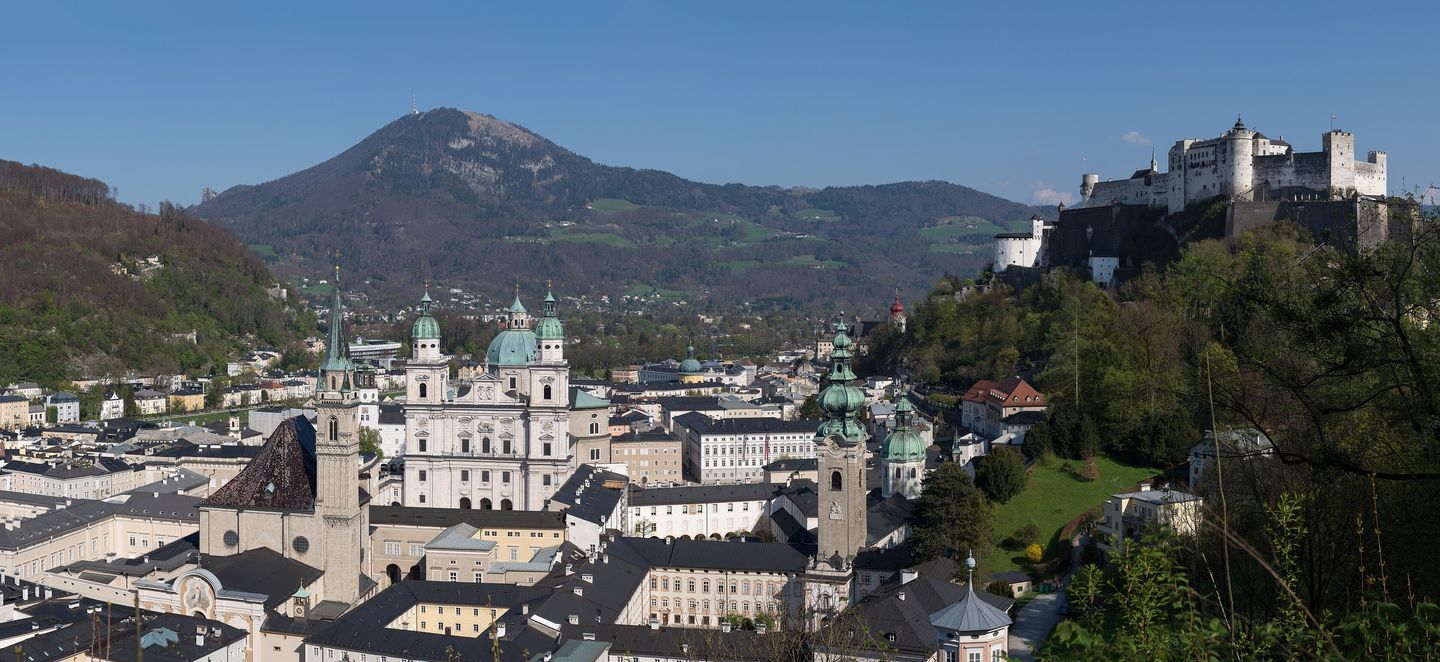
Salzburg is a small city that behaves like it knows exactly how good it looks. Pinched between a loop of the Salzach river and a wall of cliffs, the Altstadt packs a fortress, a cathedral, one of the oldest working monasteries in the German-speaking world, and the house where Mozart was born into a space you can walk end to end in twenty unhurried minutes. It is, by any honest measure, a very small place carrying a very large reputation, and most of the time it earns it.
The reputation comes with baggage. Two things made Salzburg a household name well beyond Austria — Wolfgang Amadeus Mozart, born here in 1756, and The Sound of Music, filmed here in 1964 and barely watched by Austrians but devoured everywhere else — and the city has built an entire tourism economy around both. That means a steady supply of Mozartkugel chocolate shops, gift-shop violins, and bus tours chasing gazebo photo ops, running alongside a city that is, underneath the souvenir layer, a genuinely serious regional capital with a working university, a world-class music festival, and locals who mostly ignore both legends and get on with their lives.
The real skill in visiting Salzburg is holding both of those things at once — enjoying the postcard version without mistaking it for the whole story, and giving the compact old town enough unhurried time that it stops feeling like a checklist and starts feeling like a place. Do that, and a city some visitors wrap up in an afternoon on the way to the Alps becomes one worth two or three full days on its own terms.
The caseWhy Salzburg earns the detour
Set aside Mozart and the von Trapps for a moment and Salzburg is still one of the best-preserved baroque townscapes in Europe, largely because it avoided the serious bombing that flattened so much of urban Austria and Germany in 1945. UNESCO put the whole Altstadt on its World Heritage list in 1996 for exactly this reason: a dense, intact set-piece of 17th- and 18th-century prince-archbishop ambition, squeezed into a river bend and overlooked by a genuinely imposing medieval fortress.
That density is the point. Where a city like Vienna or Munich makes you choose a neighbourhood and commit to it, Salzburg's core sights sit within a fifteen-minute walk of one another — fortress, cathedral, abbey, birthplace, gardens, all close enough that a single well-planned day covers most of the headline list without a single tram ride. Few European cities offer that much concentrated, genuinely significant architecture in a package this walkable.
And then there is the setting, which does a lot of work that the buildings alone wouldn't. The Alps start more or less at the city limits — the Untersberg massif fills the southern skyline, and the surrounding Salzkammergut lake district is close enough to visit on a day trip and still be back for dinner. Few state capitals anywhere put mountains, water, and a historic centre this close together, which is the main reason Salzburg rewards staying two or three nights rather than treating it as a half-day stop between Vienna and Munich.
The calendarWhen to go — and when to actively avoid
Late May through June, and again mid-September into October, are the sweet spots: long daylight, blooming or still-green Mirabell Gardens, and crowds that are present but manageable. Spring brings the added bonus of the Salzach running high and fast off the mountain snowmelt, which makes the riverside walks genuinely dramatic rather than merely pleasant.
July and August are Salzburg Festival season (the Salzburger Festspiele, running late July into the last days of August), and this is the single biggest variable in how a summer visit feels. The Festival is a genuinely world-class programme of opera, theatre and classical music that has run since 1920, and the city during it has an electric, dressed-up energy worth experiencing once. It is also the point at which hotel prices spike hardest, the Altstadt's narrow lanes get genuinely uncomfortable at midday, and every restaurant worth eating at needs a booking days ahead. Come for the Festival deliberately, with tickets and a room booked months out, or avoid July–August altogether if crowds bother you — there is very little comfortable middle ground in peak season.
Winter is the other overlooked option. December brings a proper Christmas market on Residenzplatz and Mozartplatz, snow on the fortress, and a city working at a quarter of its summer tourist volume. January and February are quiet to the point of sleepy, which has its own appeal if the goal is museums without queues rather than alpine scenery in full bloom.
LogisticsGetting around
Walk. The entire Altstadt is pedestrianised and most of it is also effectively car-free by geography — narrow medieval lanes that were never built for traffic in the first place. From the main train station (Salzburg Hauptbahnhof) to the heart of the old town is a twenty-minute walk or a short bus ride; most visitors staying anywhere near the centre will rarely need public transport at all once they've arrived.
When you do need it, Salzburg's bus network (run by the regional operator, with tickets valid across buses) is dense and reliable, and a SalzburgCard — sold in 24, 48 and 72-hour versions — bundles unlimited public transport with free or discounted entry to the Fortress, Mozart's birthplace, the funicular, and most of the other paid sights. For anyone planning to see more than two or three paid attractions in a day, the maths on the card usually works out in its favour; for a lighter one-sight day, it often doesn't, so tally up the specific list before buying.
Two funiculars are worth knowing about specifically: the Festungsbahn, which hauls you up the cliff face to Hohensalzburg Fortress in under a minute, and the separate Mönchsbergaufzug lift to the top of the Mönchsberg ridge, which serves the modern art museum and a genuinely spectacular viewpoint for a fraction of the fortress crowds. Neither is included in a basic train ticket and both are worth the few euros regardless of whether you buy the SalzburgCard.
The tableWhat to actually eat
Two Salzburg specialities get disproportionate airtime and both are worth trying once, with caveats. The Mozartkugel — a round pistachio-marzipan-and-nougat praline dipped in chocolate — was invented here in 1890 by confectioner Paul Fürst, and the original recipe is still sold, hand-wrapped, at Café Fürst on Alter Markt under the name Original Salzburger Mozartkugel. Every other version wrapped in gold foil with Mozart's face on it, sold in every souvenir shop in the Altstadt, is a machine-made imitation by a different company — pleasant enough, but not the thing the locals actually rate.
Salzburger Nockerl is the other signature, a towering soufflé of egg white and sugar baked into three golden domes meant to echo the city's three hills (Mönchsberg, Kapuzinerberg, Festungsberg), dusted with icing sugar and served still rising at the table. It is sweet enough to share between two or three people and is on the menu at a good number of traditional restaurants, with St. Peter Stiftskulinarium — inside the old St. Peter's Abbey complex, and plausibly one of the oldest continuously operating restaurants in Europe — among the most atmospheric places to order it.
Beyond the specialities, this is proper Austrian eating territory: Wiener Schnitzel done well at traditional Gasthaus kitchens, hearty Knödel (dumplings) as a side or a meal, and a strong beer culture anchored by Stiegl, the city's own brewery since 1492, whose Stiegl-Brauwelt museum and taproom on the edge of town is worth the tram ride for anyone who cares where their beer comes from. Lunchtime set menus (Mittagsmenü) at ordinary restaurants are the best value in the city — look for handwritten boards outside rather than the menus translated into five languages, which is usually a reliable tell for where locals actually eat.
The mapThe two sides of the river, and what's past them
Salzburg reads cleanly as a handful of distinct pieces. The Altstadt, on the left bank under the fortress, is the postcard core — cathedral, abbey, Getreidegasse, Mozart's birthplace, all stacked into a few hundred metres of lane. It is also the most expensive, most crowded, and in July and August, the most physically uncomfortable part of the city at midday, which is worth knowing before committing a whole stay to it.
Across the river, the Neustadt side holds Mirabell Palace and its gardens (the Sound of Music 'Do-Re-Mi' steps are real and constantly photographed), and spreads into two very different adjoining districts. Andräviertel, just north, has the bohemian, slightly scruffy energy of a neighbourhood actual students and young locals live in, with better-value cafés and a visible queer scene. Elisabeth-Vorstadt, around the train station, is the practical, unglamorous option — well connected, noticeably cheaper, and a reasonable base for anyone arriving late or leaving early who doesn't need to wake up inside a postcard.
Two quieter options sit at the edges. Nonntal, tucked behind the fortress on the left bank, is residential and calm, a short uphill walk from everything but removed from the crowds once you're home for the evening. Riedenburg and neighbouring Leopoldskron, further southwest, are where the real Sound of Music geography lives — Leopoldskron Palace's lake and gardens stood in for the von Trapp family's fictional home, and the area today is leafy, quiet, and a genuine change of pace from the old town's density.
Field intelligencePractical intelligence
Austria uses the euro and the whole country runs on a tipping culture that is gentler than the US and more present than much of Western Europe: round up a euro or two, or add roughly five to ten percent for a sit-down meal with table service, handed directly to the server rather than left on the table. Most restaurants and small shops in the Altstadt take cards now, but a stash of cash is still worth carrying for the smaller bakeries and market stalls.
Book timed tickets for Hohensalzburg Fortress and Mozart's birthplace in summer if at all possible — both run on genuine queues by mid-morning in July and August, and online booking (often bundled into the SalzburgCard) skips the worst of it. The DomQuartier combined ticket, covering the Residenz state rooms, the cathedral, and St. Peter's in one circuit, is an efficient way to see three Altstadt sights without re-queuing three times.
A detail that catches first-timers out: a meaningful number of the Altstadt's best-known restaurants and cafés close on Sundays or Mondays, and the whole city noticeably quietens on Sundays beyond the core sights, in the normal Austrian way. Plan a Sunday around a museum, a hike up the Mönchsberg, or a day trip rather than counting on a specific restaurant being open. Finally, the Altstadt's cobbles and the fortress approach are genuinely steep in places — comfortable shoes matter here more than in most cities on this list.
What to see & do
-
Hohensalzburg Fortress
One of the largest and best-preserved medieval castles in Europe, begun in 1077 and expanded for centuries, perched directly above the Altstadt with the best panorama the city offers.
Tip:Take the Festungsbahn funicular up but walk down the cobbled switchback path — it's free, shaded, and gives a second, lower angle on the view.
See full guide -
Mozart's Birthplace
The cramped, surprisingly modest third-floor apartment on Getreidegasse where Wolfgang Amadeus Mozart was born in 1756, now a museum of instruments, letters and family portraits.
Tip:Go first thing or buy a timed ticket — the rooms are small and genuinely bottleneck by late morning in summer.
-
Getreidegasse
The Altstadt's main shopping lane, famous for its wrought-iron guild signs — hung so illiterate shoppers could identify a baker or a locksmith by picture alone — and now lined mostly with chain stores behind those same historic signs.
Tip:Look up more than you look in the shop windows; the signage is the actual attraction, not the retail behind it.
-
Mirabell Palace & Gardens
A formal baroque garden built in 1690 for an archbishop's mistress, with the dwarf statue garden and the steps made famous by the 'Do-Re-Mi' sequence in The Sound of Music.
Tip:The view back across the gardens to the fortress, framed by the palace, is the single best skyline photo in the city — go in late afternoon light.
-
Salzburg Cathedral & St. Peter's Abbey
A baroque cathedral rebuilt after a 1598 fire, standing beside St. Peter's Abbey — founded around 696 and among the oldest continuously operating monasteries in the German-speaking world — and its atmospheric walled cemetery.
Tip:The abbey cemetery is free, nearly silent, and ten steps from the cathedral's crowds — one of the best quiet pauses in the Altstadt.
-
DomQuartier
A single combined circuit through the Residenz state rooms, the cathedral museum, and St. Peter's picture gallery, tracing the Prince-Archbishops' art collecting across three connected buildings.
Tip:Buy the DomQuartier ticket rather than separate entries if you're doing more than one of its component sights — it pays for itself after two.
-
Hellbrunn Palace & Trick Fountains
A 17th-century pleasure palace just outside the centre, built around an elaborate network of hidden Wasserspiele fountains designed by Archbishop Markus Sittikus to soak unsuspecting guests.
Tip:Wear shoes you don't mind getting wet and let the (English-speaking) guide pick who gets soaked — resisting just makes it funnier for everyone else.
-
Museum der Moderne & the Mönchsberg
A contemporary art museum on top of the Mönchsberg ridge, reached by its own lift, with a terrace view over the Altstadt that rivals the fortress and a fraction of the visitors.
Tip:Skip the museum if modern art isn't your thing and just ride the lift up for the terrace café and the view — it's open to non-ticket-holders.
On the groundWhere things are
Map data © OpenStreetMap contributors.
Where to stayBase yourself well
Altstadt
Best for first-timers who want everything on footThe postcard core on the left bank — cathedral, fortress and Mozart's birthplace all within a few minutes' walk, at the cost of the highest prices and the thickest crowds.
A historic guesthouse off Goldgasse
A quieter side lane just off the main shopping street puts you inside the old town without the Getreidegasse foot traffic outside your window.
€€€Neustadt & Mirabell side
Best for a central base without Altstadt pricesAcross the river from the Altstadt, with the Mirabell Gardens on the doorstep and a shorter, flatter walk into the old town than the hillside neighbourhoods offer.
A mid-range hotel near Mirabellplatz
Close enough to walk everywhere, with slightly more breathing room and better rates than staying inside the old town walls.
€€Andräviertel
Best for longer stays and a less tourist-facing baseA genuinely local, slightly bohemian district just north of Mirabell, popular with students and with Salzburg's queer scene, and noticeably better value for food and drink.
An independent guesthouse on a residential Andräviertel street
Ten minutes' walk from Mirabell Gardens with none of the Altstadt markup, and a neighbourhood that still feels lived-in after dark.
€€Nonntal
Best for repeat visitors who want calm over convenienceA quiet residential pocket tucked directly behind the fortress on the left bank — a short, steep walk from the Altstadt, but a world away from it after the shops close.
A small hotel on a quiet Nonntal side street
Close enough to walk into the old town in ten minutes, with none of the evening noise of staying inside the walls.
€€Riedenburg & Leopoldskron
Best for Sound of Music fans and a slower paceLeafy and residential, southwest of the centre, home to the actual Sound of Music filming locations around Leopoldskron Palace's lake and gardens — further out, and quieter for it.
A quiet lakeside guesthouse near Leopoldskron
Trades a longer walk or short bus ride into the Altstadt for genuine green space and the actual film-location scenery on your doorstep.
€€Affiliate notePostcardRoute is reader-supported. Some links to Booking.com (stays, flights, car hire, tickets and tours, airport transfers) are affiliate links, tracked through CJ Affiliate: if you book through them we may earn a small commission at no extra cost to you. We only recommend places we would send a friend.
Book the restEverything else for the trip
Stay sorted? These open Booking.com for the other legs of the journey.
-
Tours & tickets
Things to do
Tickets, tours and activities, anywhere.
Browse activities -
Wheels
Car hire
Compare rental companies worldwide.
Compare cars -
Air
Flights
Search fares, then come back for the neighbourhood advice.
Search flights -
Ground
Airport transfers
Book a taxi or private transfer before you land.
Book a transfer
Affiliate noteThese four links are affiliate links too: if you book through them we may earn a small commission at no extra cost to you.
Beyond the cityWorthwhile day trips
- Hallstatt
The impossibly photogenic lakeside village roughly ninety minutes away by train and ferry, or about an hour by direct bus — go early or late in the day, since the midday crowds have become a genuine local flashpoint.
- Eagle's Nest & Berchtesgaden
Just across the German border, around thirty minutes away: the Kehlsteinhaus mountain lodge (open May to October) for the views, and the town of Berchtesgaden and the Königssee lake for the rest of the day.
- Eisriesenwelt Ice Caves, Werfen
The world's largest accessible ice cave system, about forty-five minutes south, reached by a steep cable car and a guided walk through genuinely vast, lantern-lit ice formations — bring a warm layer regardless of the season outside.
- The Salzkammergut lakes
Wolfgangsee, Fuschlsee and Mondsee, all under an hour away and each with its own swimmable, mountain-ringed character — Mondsee's church is also the one used for the wedding scene in The Sound of Music.
Before you goCommon questions
- How many days do you need in Salzburg?
- Two full days covers the Altstadt's headline sights at a reasonable pace; three lets you add a day trip to Hallstatt or the Eisriesenwelt ice caves without rushing. A single day is workable only if you accept seeing the fortress, the birthplace and little else.
- Is Salzburg worth visiting if I'm not interested in Mozart or The Sound of Music?
- Yes — the Altstadt is one of Europe's best-preserved baroque townscapes on its own architectural merits, and the setting between the river and the mountains would be worth the trip even without either cultural association.
- What is the best time to visit Salzburg?
- Late May through June, or mid-September into October, balance good weather against manageable crowds. July and August bring the Salzburg Festival and the thickest tourist season together, which is worth experiencing once but means booking everything — hotel and tickets — well in advance.
- Do I need the SalzburgCard?
- It's worthwhile if you're planning to see three or more paid sights plus use public transport in a day; add up the specific attractions you intend to visit against the card price before buying, since a lighter sightseeing day often doesn't break even.
- Is Salzburg expensive?
- The Altstadt carries a tourist-town premium on food and lodging, especially during the Festival. Staying just across the river or in a neighbourhood like Andräviertel, eating at Mittagsmenü lunch specials, and visiting outside July–August meaningfully reduces the cost without losing the walkable convenience.
- Can you day-trip to Salzburg from Vienna or Munich?
- It's possible — Salzburg sits roughly two and a half hours from Vienna and under two hours from Munich by direct train — but a single day only allows the fortress and the Altstadt core. The city rewards an overnight stay or two far more than a rushed day trip.