
Spain · Castile and León
Salamanca, the golden city that never stopped studying
A sandstone university town on the Río Tormes that has been teaching, arguing and building in the same honey-coloured stone for eight centuries — and still fills its bars with students doing exactly that tonight.
A university town that has been arguing about ideas, in sandstone, since 1218 · 40.97° N · 5.66° W
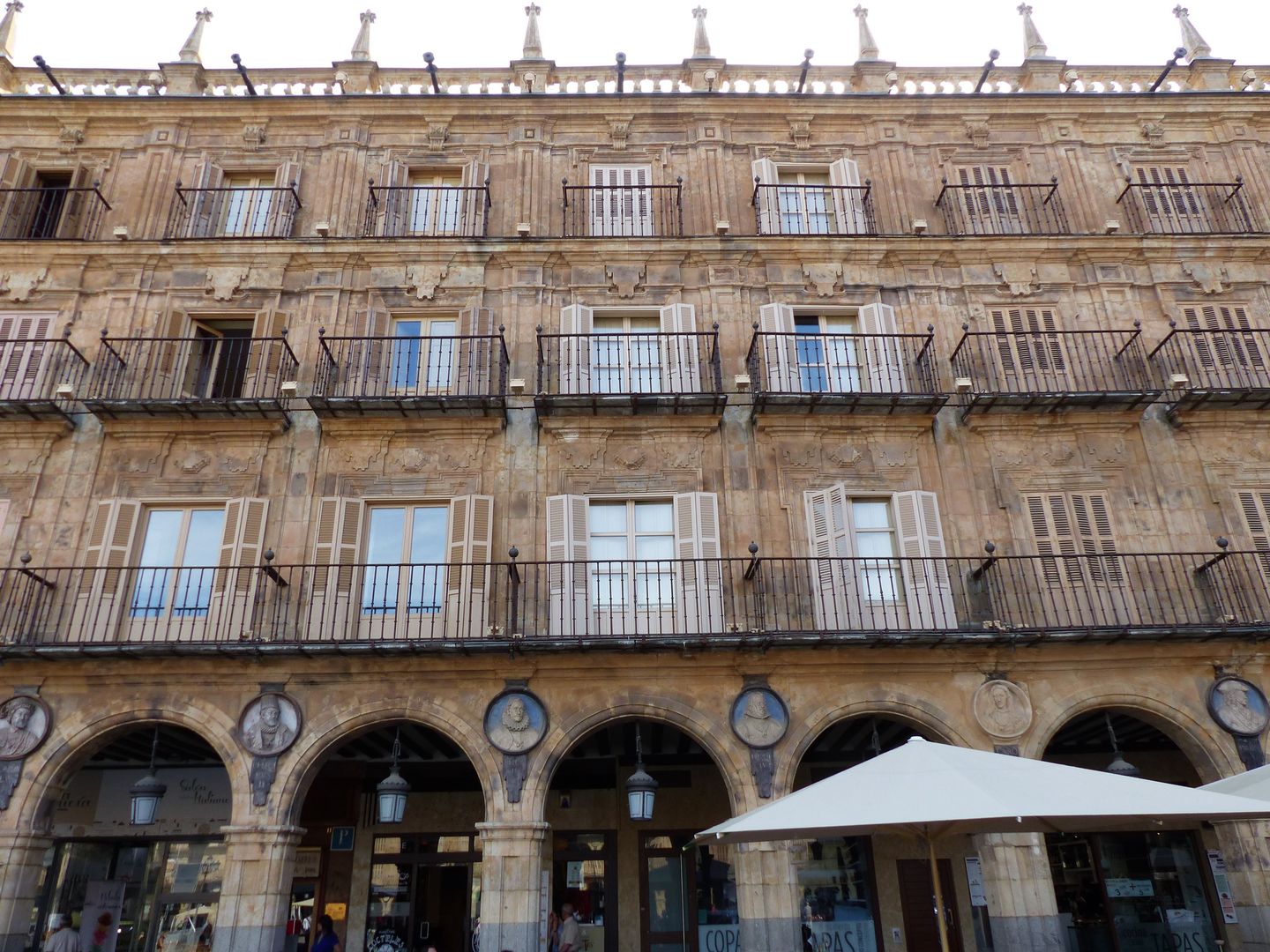
Salamanca gets filed, in a lot of itineraries, as a day trip from Madrid — two and a half hours each way on a regional train, enough time to photograph the Plaza Mayor, find the carved frog on the university facade, and leave. That schedule sees the monuments and misses the point of the place, which is that Salamanca is not a museum city pretending to be alive. It is a working university town of roughly 150,000 people where something like a quarter of the population, in term time, is a student — Spanish, Erasmus, language-school, postgraduate — and that fact shapes everything from the bar prices to the noise level in the Plaza Mayor at midnight on a Tuesday.
The University of Salamanca was founded in 1218, making it the oldest university in Spain and one of the oldest continuously operating universities in the world, and it spent several centuries as one of the handful of institutions — alongside Oxford, Paris and Bologna — that actually set the intellectual agenda for Europe. Columbus is said to have argued for his westward route to a University of Salamanca commission before his 1492 voyage; the school's jurists were central to the 16th-century debates over the legal and moral status of indigenous peoples in the Americas, an early and surprisingly serious exercise in international law. None of that is roped-off history. The lecture halls where it happened are still lecture halls, students still cut across the same courtyards between classes, and the whole old town is built from the same warm, biscuit-coloured sandstone that turns genuinely gold at sunset — the reason UNESCO's 1988 listing and the local tourism board both reach for 'La Ciudad Dorada,' the Golden City, and for once the marketing isn't oversold.
What follows isn't a rushed day-trip checklist. It's how to actually spend a day and a half or two days here: when the light is best on the Plaza Mayor's sandstone, which of the two cathedrals rewards more time, why the free-tapas culture makes this one of the best-value serious food cities in Spain, and where a student town's nightlife and a UNESCO old town's architecture end up, almost accidentally, sharing the same small streets.
The caseWhy Salamanca earns more than an afternoon
Most Spanish university towns pick a lane: heritage city or student city. Salamanca refuses to, and that friction is the whole appeal. The Plaza Mayor, widely argued to be the most beautiful main square in Spain, is simultaneously a UNESCO-cited Baroque set piece from the 1750s and the literal meeting point where students actually arrange to meet each other before a night out — the four clock faces on the ayuntamiento's tower are not decorative in the way Big Ben is decorative; people are standing underneath them checking the time for an actual appointment.
The university itself is the deeper reason to linger. Its Plateresque west facade — a riot of carved medallions, coats of arms and figures from the Catholic Monarchs' court, cut into stone with the fineness of goldsmith's work — rewards ten minutes of close looking far more than a photo and a walk-on. Inside, the Aula Fray Luis de León, a 16th-century lecture hall with its original wooden benches still bolted to the floor, is one of the few places in Europe where you can stand in the exact room where Renaissance scholarship happened and the furniture hasn't been swapped out for a gift shop. Add two cathedrals stacked on top of each other, a Roman bridge still carrying foot traffic after two thousand years, and a genuinely good, inexpensive food scene built around free tapas, and the half-day itinerary starts to look like a mistake rather than an efficiency.
The calendarWhen to go
Spring (April to June) and early autumn (September to October) are the reliable windows — mild days, the university in full term-time swing so the city feels lived-in rather than hollowed out, and light that suits the sandstone. Salamanca sits on a high, exposed plateau in Castile and León, which means a properly harsh continental climate: summer afternoons regularly clear 35°C with little shade across the Plaza Mayor's open stone, and winter brings real cold, sometimes snow, with a wind off the plateau that the tourist photos never show you.
Term-time matters more here than in most Spanish cities. September through May, the university is running, the student bars are full, and the city has an energy that empties out noticeably in July and August when students go home and the heat sets in. If live, loud, late-night Salamanca is what you're after, come in term. If you'd rather have the Plaza Mayor nearly to yourself at dawn, the hush of the university's low season — August, or the week around Christmas — delivers that instead.
LogisticsGetting around
Salamanca's old town is compact enough to walk in full — the distance from the Plaza Mayor to the Roman bridge is a flat fifteen minutes, and almost nothing of interest sits more than twenty minutes from the main square on foot. The old centre is pedestrianised or close to it in its densest core, so a car inside the walls is a liability rather than a convenience; park at one of the lots just outside the ring road and walk in.
From the train station, it's a twenty-five-minute walk into the centre, or a short hop on local bus lines 1 or 4, which both terminate near the Plaza Mayor. The high-speed and regional trains from Madrid Chamartín run several times a day, roughly 1 hour 35 minutes on the fastest services and up to 2.5 hours on slower regional trains — check which you've booked, because the gap is significant. If you're coming from Portugal, Salamanca sits on a reasonably direct road and rail corridor from the border, making it a natural stop between Madrid and Porto or Coimbra rather than a detour.
The tableHow Salamanca actually eats
Salamanca runs on Castilian meat cookery and, more unusually for a Spanish city this size, a genuinely strong free-tapas culture: order a caña or a glass of wine in most traditional bars around the old town and a small plate arrives with it, unbilled, as a matter of course rather than a gimmick aimed at tourists. That alone makes a Salamanca bar crawl a far better value proposition than the equivalent in Madrid or Barcelona, where free tapas have mostly disappeared.
The region's signature product is jamón ibérico, specifically from the Guijuelo area an hour south, and Salamanca is one of the best, least expensive places in Spain to eat genuinely top-tier ham rather than the export-grade version. Beyond ham, this is serious roast-meat country: cochinillo (suckling pig) and lechazo (milk-fed lamb, a Castilian specialty more associated with neighbouring provinces but common on Salamanca menus) both show up at traditional asadores. Hornazo, a substantial meat-and-chorizo-filled pastry traditionally eaten on Easter Monday but sold year-round from the city's bakeries, is the local specialty worth actively seeking out rather than stumbling into. For something sweeter, look for the almond-paste sweets sold by the city's cloistered convents, a tradition shared across much of old Castile.
The mapNeighbourhoods to know
The area immediately around the Plaza Mayor and the university is Salamanca's dense historic core — narrow sandstone streets, the two cathedrals, the Casa de las Conchas with its facade studded in carved scallop shells, and the highest concentration of both monuments and tourist-facing restaurants. It's compact enough to see on foot in a morning, but worth returning to at night once the day-trip crowds have gone and the square fills with locals and students instead.
The Barrio del Oeste and the streets south toward the river, around Calle Van Dyck and Calle Bordadores, trade monuments for the city's actual student nightlife — smaller bars, lower prices, and a crowd that's overwhelmingly local rather than visiting. Across the Roman bridge, the far bank of the Tormes gives the single best view back at the old town's skyline, cathedral towers and all, and is where the view-seekers go at sunset rather than the monument-seekers. For a quieter, more residential feel with the same architecture, the streets north and east of the Plaza Mayor, away from the main tourist through-routes, hold some of the best-value places to actually stay.
Field intelligencePractical intelligence
The University of Salamanca's Plateresque facade carries a tradition locals are serious about: somewhere in the carved relief is a small frog, and finding it unprompted is supposed to bring good luck, exam success for students specifically. Don't ask a local to point it out directly — half the fun is watching other visitors squint at the facade for ten minutes, and the challenge is a genuine piece of living folklore, not a tourist-board invention.
Many of the university's historic buildings, including the lecture halls and the library, are ticketed and keep their own, sometimes seasonal, opening hours separate from the cathedrals — check specific times before building a tight schedule, since several close for a midday break. The two cathedrals, Old and New, are connected and sold on a joint ticket that is worth buying as a pair rather than picking one. Term-time (roughly late September to late May) brings a livelier, louder city, particularly around exam periods when the bars stay busy until genuinely late on a weeknight; if you want quiet streets and an early night, that's also roughly when you'll get it least.
What to see & do
-
Plaza Mayor
Spain's most celebrated main square, a fully enclosed 18th-century Baroque arcade in warm sandstone, built on the proceeds of the city's wool trade and still the social heart of the city every single evening.
Tip:Come back after dark when the floodlighting turns the stone genuinely gold and the square fills with locals rather than tour groups.
-
University of Salamanca & the Plateresque facade
Spain's oldest university, founded in 1218, fronted by an extraordinarily dense carved facade of medallions, coats of arms and royal portraits — and home to the hidden frog carving every visitor ends up hunting for.
Tip:Buy the ticket that includes the Aula Fray Luis de León lecture hall; the original 16th-century wooden benches are the single most evocative interior in the city.
-
Catedral Nueva (New Cathedral)
A vast 18th-century cathedral built directly alongside, and partly over, its much older predecessor — a rare case of a city simply building a second, bigger cathedral rather than demolishing the first.
Tip:Look up at the central dome's lantern tower from directly underneath; the perspective trick used by the Churriguera family of architects is easy to miss from any other angle.
-
Catedral Vieja (Old Cathedral) & the Torre del Gallo
The smaller, 12th-century Romanesque-Gothic cathedral absorbed into the newer one's structure, with a distinctive ribbed dome known as the Torre del Gallo and a cloister holding some of the city's oldest surviving art.
Tip:The joint ticket with the New Cathedral includes a climb up the Ieronimus towers for a rooftop walk between both buildings — don't skip it for the Old Cathedral alone.
-
Casa de las Conchas
A late-Gothic merchant's house whose entire facade is studded with roughly 300 carved stone scallop shells, now home to the city's public library, open for anyone to wander into for free.
Tip:Step inside the courtyard even if you're not borrowing a book — it's one of the few grand old-town interiors in Salamanca you can see without a ticket.
-
Puente Romano (Roman Bridge)
A genuinely Roman-era bridge across the Río Tormes, still partly original after roughly two thousand years of continuous use, guarded at its near end by an Iron Age stone boar sculpture of uncertain origin.
Tip:Cross to the far bank and look back — the classic postcard view of the cathedral towers rising above the old town is from here, not from inside it.
-
Convento de San Esteban
A Dominican monastery with a Plateresque facade nearly as elaborate as the university's, and a vast gilded Churriguera altarpiece inside that most day-trippers never get to because it's a few minutes' walk off the main route.
Tip:Visit mid-morning when the light through the church's high windows actually reaches the gold of the altarpiece.
-
Convento de las Dueñas
A quietly extraordinary Dominican convent cloister with upper-gallery capitals carved into grotesque, grinning faces — skulls, demons and distorted figures that are the strangest piece of religious architecture in the city.
Tip:Go for the upper cloister gallery specifically; the ground floor is pleasant but the carved capitals upstairs are the actual reason to come.
-
Huerto de Calixto y Melibea
A small, free walled garden tucked against the old city walls, named for the star-crossed lovers of the 15th-century Spanish classic La Celestina, with one of the best quiet viewpoints over the cathedral and the river below.
Tip:Time it for late afternoon; the garden faces the cathedral's best light and it's rarely crowded even when everything else is.
On the groundWhere things are
Map data © OpenStreetMap contributors.
Where to stayBase yourself well
Around the Plaza Mayor
Best for first-timers who want everything on footThe most central possible base, inside the UNESCO core and a short walk from every monument on this page. Lively and occasionally loud at night, especially on weekends and through term time.
A boutique hotel in a restored sandstone townhouse near the square
Several old-town buildings here have been converted without losing the original stone facades and high ceilings — ask for a room off the street side if you want quiet.
€€€A simple guesthouse a few streets off the Plaza Mayor
You're paying for the five-minute walk to the square; rooms are modest but the location does the work.
€€Around the University & cathedrals
Best for architecture-focused visits and quieter nightsA short walk south of the Plaza Mayor, denser with monuments than nightlife, and generally a calmer night's sleep while staying genuinely central.
A small hotel in a converted historic building near the cathedrals
Rooms with cathedral-facing windows book out fastest in spring and early autumn — ask when reserving.
€€€Barrio del Oeste & toward the river
Best for nightlife and budget travellersStudent-town Salamanca rather than monument Salamanca — smaller bars, lower prices, and a genuinely local late-night scene a short walk from the old town's edge.
A budget-friendly guesthouse near Calle Van Dyck
Noticeably cheaper than anything inside the old-town core, and close enough to walk to the Plaza Mayor in under fifteen minutes.
€Across the Río Tormes
Best for the view, and travellers with a carOutside the old town entirely, trading a short walk or bus ride in for the single best skyline view of the cathedral towers from your own side of the river.
A modern hotel on the river's far bank
Rooms facing the Tormes get the postcard cathedral view for free, the same one everyone else crosses the Roman bridge for at sunset.
€€Affiliate notePostcardRoute is reader-supported. Some links to Booking.com (stays, flights, car hire, tickets and tours, airport transfers) are affiliate links, tracked through CJ Affiliate: if you book through them we may earn a small commission at no extra cost to you. We only recommend places we would send a friend.
Book the restEverything else for the trip
Stay sorted? These open Booking.com for the other legs of the journey.
-
Tours & tickets
Things to do in Salamanca
Skip-the-line tickets, tours and day trips.
Browse activities -
Wheels
Car hire in Salamanca
Compare pick-up points and rental companies.
Compare cars -
Air
Flights
Search fares, then come back for the neighbourhood advice.
Search flights -
Ground
Airport transfers
Book a taxi or private transfer before you land.
Book a transfer
Affiliate noteThese four links are affiliate links too: if you book through them we may earn a small commission at no extra cost to you.
Beyond the cityWorthwhile day trips
- Ávila
An hour and a half away, a completely intact medieval city wall ringing a hilltop old town — one of the best-preserved fortified perimeters in Europe and an easy pairing with a Castile-focused trip.
- Ciudad Rodrigo
An hour southwest toward the Portuguese border, a smaller walled town with its own cathedral and castle and almost none of Salamanca's crowds — a good half-day for anyone staying two nights or more.
- Sierra de Francia & La Alberca
A mountainous pocket of granite villages roughly an hour south, with La Alberca's half-timbered houses among the best-preserved traditional architecture in western Spain — worth a full day with a car.
Before you goCommon questions
- Is Salamanca worth visiting as a day trip from Madrid?
- It works as a day trip — roughly 1.5 to 2.5 hours each way by train — but it genuinely rewards an overnight stay. The Plaza Mayor and the university's lecture halls feel different once the day-trip groups have left, and the city's student-driven nightlife only shows up after dark.
- How many days do you need in Salamanca?
- A full day covers the Plaza Mayor, the university facade and lecture halls, and both cathedrals at a reasonable pace. A second day lets you add the Convento de las Dueñas, San Esteban and a proper tapas crawl without rushing, plus an evening when the square is at its best.
- What is Salamanca famous for?
- Being home to the oldest university in Spain, founded in 1218, and for the Plaza Mayor, widely considered the most beautiful main square in the country. It's also known for its free-tapas bar culture, jamón ibérico from the nearby Guijuelo region, and the hidden frog carved into the university's Plateresque facade.
- Is Salamanca expensive to visit?
- No — it's one of the better-value serious destinations in Spain. The free-tapas culture makes bar-hopping genuinely cheap, student-town pricing keeps food and lodging lower than Madrid or Barcelona, and the main monuments are covered by a handful of modestly priced joint tickets.
- What is the best time of year to visit Salamanca?
- Spring (April–June) and early autumn (September–October), for mild weather and a university still in full term-time swing. Summer regularly exceeds 35°C with little shade across the old town's open stone; winter is genuinely cold on the exposed Castilian plateau, though quiet and cheap.
- Can you find the frog on the University of Salamanca facade yourself?
- Most visitors try, and it's part of the tradition — the carving sits somewhere in the dense Plateresque relief on a stone skull motif near the top of the facade. Bring binoculars or a zoom lens if you want a real chance; locals consider pointing it out directly to be cheating.
- Is Salamanca good for nightlife?
- Very much so, in term time. With a large student population for a city this size, the streets around Calle Van Dyck and Calle Bordadores run genuinely late, and free tapas with every drink make an evening out unusually inexpensive compared with equivalent Spanish cities.