Porto, Portugal
The bookshop that became a landmark
Livraria Lello has sold books since 1906. These days most visitors come for the staircase and leave without buying one — the ticket system exists precisely because of that.
A century-old bookshop so photogenic it had to start charging admission just to keep the aisles passable
Buy tickets ↗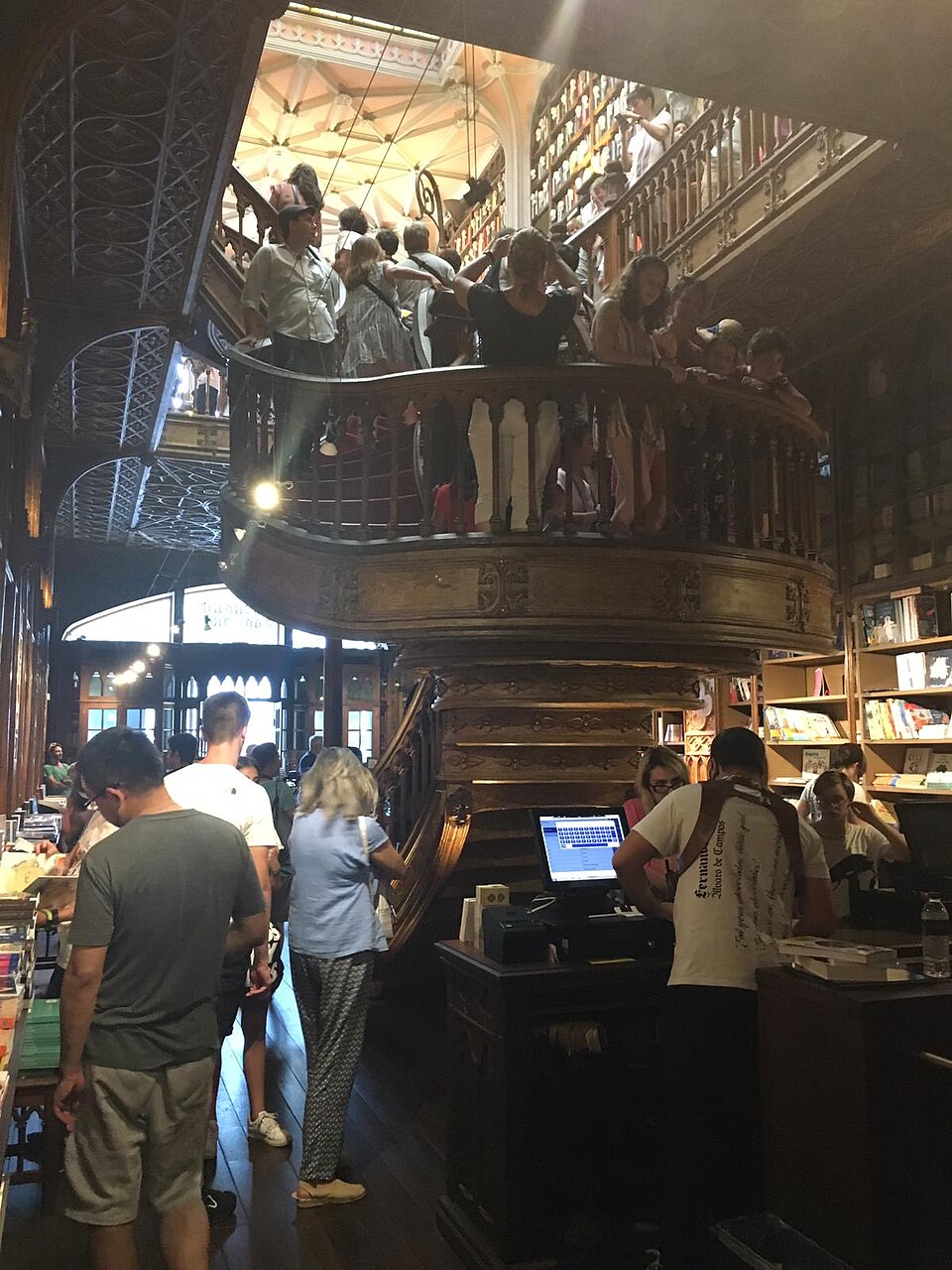
Livraria Lello sits on Rua das Carmelitas, a short walk from the Clérigos Tower in central Porto, behind a neo-Gothic facade that gives almost no warning of what's inside. It has operated as a working bookshop continuously since 1906, and on paper it still is one — new releases line the ground-floor tables, there is a dedicated children's section, and the staff can order you almost anything in print. In practice, for a very large share of the people who walk through the door, the books are furniture. They have come for the staircase.
That tension — a genuine, functioning bookshop that has become one of the most photographed interiors in Europe — is the whole story of visiting Lello today. The shop introduced a paid entry ticket in 2015 specifically because free entry had turned the space into something closer to a theme-park queue than a place anyone could browse, let alone buy a book in peace. The fee is redeemable against a purchase inside, which softens the complaint that a bookshop now charges admission, but doesn't fully answer it. Go in understanding both halves of what this place is, and the visit makes a lot more sense than if you turn up expecting either a quiet browse or a free photo op.
The backstoryA hundred years of selling books in the same room
The shop traces its roots to 1869, when a French bookseller named Ernesto Chardron opened a bookshop in Porto; the Lello brothers, José and António, later took it over, and the current building — designed by the engineer Francisco Xavier Esteves and opened in 1906 — is the one that survives today. Its facade mixes neo-Gothic details with Art Nouveau flourishes, and the interior commits far harder to that eclecticism than the street outside suggests: carved wooden shelving rises floor to ceiling, plaster columns imitate stonework, and the whole room is capped by a stained-glass skylight bearing the shop's motto, Decus in Labore — 'dignity in work.'
The building was declared a national monument of public interest decades ago, long before its current fame, on the strength of its Art Nouveau interior alone. What changed its trajectory from respected local landmark to global tourist draw was a slower, stranger process: repeated appearances on international 'most beautiful bookshops in the world' lists through the 2000s and 2010s, amplified by a persistent, partly debunked legend that J.K. Rowling drew inspiration for Hogwarts' library — or for the Harry Potter staircases generally — while she was living and teaching English in Porto in the early 1990s. Rowling herself has given inconsistent and largely noncommittal answers about how much, if any, of Lello fed into the books; the shop doesn't lean hard on the claim in its own materials, but it has never discouraged visitors who arrive believing it either.
By the early 2010s, free entry meant queues stretching down Rua das Carmelitas for over an hour, with most of that line made up of people who had no intention of buying anything — a volume of foot traffic that was genuinely damaging the stock and making the shop unworkable as, well, a shop. The ticketed-entry system introduced in 2015 was the shop's own solution, not a council mandate or a heritage-body requirement, and it remains unusual in Portugal, where paid entry to a retail bookshop has no real precedent.
InsideWhat the ticket actually gets you
The ticket price is modest and is deducted in full from any book purchase made inside on the same visit, so anyone planning to buy a book anyway effectively gets in free. Entry is timed and limited in number per slot, which caps the crowding inside even when the queue outside still looks substantial — the bottleneck is the door, not the room.
Once inside, the room is genuinely smaller than photographs suggest, which is both the appeal and the frustration: the carved shelving, the stained-glass skylight and the famous staircase are all visible from almost anywhere on the ground floor, but that also means every other visitor with a phone is working the same small space for the same angles. The staircase — a forked, curling run of wood painted a deep red, rising to the mezzanine level — is the single most photographed feature and the hardest to get a clean shot of without other visitors mid-frame; patience, or an early-morning slot, helps more than any particular technique.
The mezzanine level itself holds more of the shop's stock, including rare and antiquarian volumes in a locked case, and offers a different, looking-down angle on the stained-glass ceiling that most visitors skip because they've already taken their staircase photo and left. A small café corner operates on the upper level in some seasons, worth a stop if you want to sit with the room rather than just photograph it and move on.
PracticalBooking, timing and avoiding the worst of it
Book the entry ticket online in advance rather than relying on walk-up availability. Timed slots sell out well ahead in summer and around any Porto long weekend, and walk-up queues in peak season have been documented running over an hour even with the ticketed system in place, since the queue to buy or collect a ticket is separate from the queue to actually enter.
The single best lever for a better visit is timing: arrive at or very near opening, before the first wave of day-trippers and tour groups arrives mid-morning. Cruise-ship days, when Porto's river terminal brings in large coach groups, are reliably the worst; checking the port's arrival schedule the night before is a reasonable precaution if your dates are flexible. Weekday mornings outside school-holiday periods are the closest thing to a quiet visit this shop offers.
Bags are generally fine, but large suitcases or backpacks may be asked to go in a locker near the entrance given how tight the floor space gets. Photography is permitted, but tripods and anything that would hold up the flow of other visitors are not — this is still a working retail space, and staff do actively manage the crowd flow on busy days.
Around itWhat to pair it with
The Torre dos Clérigos is a two-minute walk and the obvious pairing — climb it either before or after Lello, since both involve a wait and both reward an early-morning visit for the same reasons. The Igreja do Carmo and the adjoining 'narrowest house in Porto,' squeezed between two churches to avoid a tax on buildings touching sacred ground, is immediately next door and worth the detour it barely requires.
Avenida dos Aliados and Porto's city hall are a short walk downhill, a useful orientation point if you're arriving from the Ribeira riverfront on foot. Treat Lello as one stop on a morning that also takes in the Clérigos Tower and a wander through the surrounding Baixa streets rather than a single-purpose detour — the whole area rewards slow walking more than any one ticketed sight does on its own.
Practical info
- Hours
- Generally open daily from mid-morning into the early evening, with reduced hours on some public holidays — confirm current hours and the booking system on the shop's own site before visiting, as both have changed over the years.
- Tickets
- A modest paid entry fee, fully redeemable against any book purchased inside on the same visit. Book a timed slot online in advance; walk-up tickets exist but queues for them regularly run long in peak season.
- Getting there
- On Rua das Carmelitas in central Porto, a two-minute walk from the Torre dos Clérigos and a short uphill walk from the Ribeira riverfront and São Bento station.
- Good to know
- Arrive at or near opening for the best chance of an uncrowded staircase photo. Large bags may need to go in a locker near the entrance. Photography is allowed; tripods generally are not.
Before you goCommon questions
- Do you need to buy a ticket to enter Livraria Lello?
- Yes. Entry has required a paid, timed ticket since 2015, introduced because free entry had made the shop unworkable for crowding. The fee is fully redeemable against any book bought inside on the same visit.
- Is Livraria Lello really connected to Harry Potter?
- The connection is a persistent, partly debunked legend rather than a confirmed fact. J.K. Rowling lived in Porto in the early 1990s and has given inconsistent, largely noncommittal answers about how much of the shop, if any, influenced the books. The shop itself does not heavily promote the claim, but has never discouraged visitors who believe it.
- How long does a visit to Livraria Lello take?
- Most visitors spend twenty to thirty minutes inside, enough to see the staircase, the stained-glass ceiling and the mezzanine level. The ticketed, timed-entry system means the visit itself is brief by design, even though the wait beforehand can run longer.
- What is the best time to visit Livraria Lello to avoid crowds?
- As close to opening as possible, on a weekday outside school holidays, and ideally not on a day when a large cruise ship is in port — Porto's river terminal brings in coach groups that reliably create the worst crowding of the day by mid-morning.
- Should I book Livraria Lello tickets in advance?
- Yes. Timed slots sell out well ahead in summer and around Porto long weekends. Walk-up tickets are available but the queue to buy them, separate from the queue to enter, has run over an hour in peak season.