
Italy · Tuscany
Pisa isn't just the tower
Forty thousand university students live here year-round, and the postcard square is maybe twenty minutes of their actual city. The other several centuries are still worth your time.
A university town that happens to have a famous tilt · 43.72° N · 10.40° E
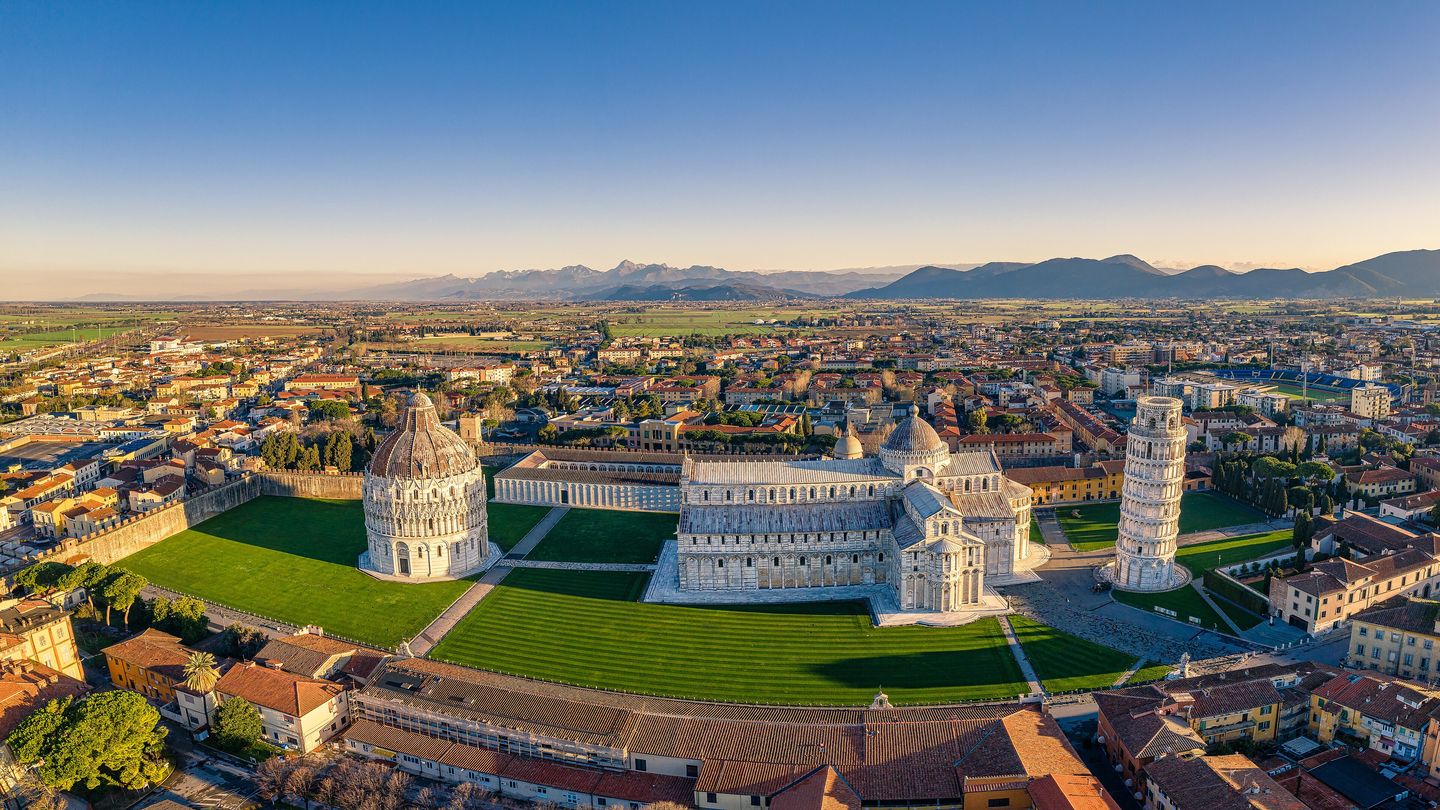
Most people who come to Pisa never actually arrive. They step off a train from Florence, walk twenty minutes to a lawn with four white buildings on it, take the obligatory photo pretending to push the tower over, buy a plastic miniature from a street vendor, and get back on a train an hour later having seen precisely one square out of a city that has dozens worth knowing. That square earns the trip on its own — nowhere else on earth crams a medieval cathedral, the single most famous architectural accident in history, and the largest baptistery in Italy onto one patch of grass — but treating Pisa as a photo stop means missing almost everything that makes the city interesting once you're actually in it.
The thing day-trippers miss is that Pisa is a living university town, not a monument with a gift shop attached. The University of Pisa was founded in 1343 and still enrols tens of thousands of students, alongside the fiercely selective Scuola Normale Superiore and Sant'Anna School of Advanced Studies — together they mean a meaningful share of the people on the street on any given afternoon are twenty-two and heading to a seminar, not a tour bus. Galileo Galilei was born here in 1564 and taught at the university before the (probably apocryphal) story of him dropping objects off the tower to test falling bodies became the city's unofficial founding myth. That academic undercurrent gives Pisa a completely different texture from the open-air museums of Florence or Siena: cheap trattorias that cater to students rather than tour groups, a genuine aperitivo scene along the river, and a pace that has nothing to do with tourism math.
There was also a time, long before any of that, when Pisa ran a navy. It was one of the four historic Maritime Republics of Italy, alongside Venice, Genoa and Amalfi, controlling trade routes across the western Mediterranean until a catastrophic naval defeat to Genoa at the Battle of Meloria in 1284 broke its power for good. The Piazza dei Miracoli was built on the proceeds of that maritime wealth, which is part of why four buildings in a provincial Tuscan town look like they belong to an imperial capital. What follows treats Pisa as the small, serious, slightly tilted city it actually is — worth a night or two, not just a photo and a train back.
The caseWhy Pisa deserves more than an afternoon
The tower alone is a legitimate reason to come, and it is genuinely more striking in person than any photograph prepares you for — the lean is not a subtle architectural quirk, it is an unmistakable, slightly vertiginous four-degree list that makes you want to tilt your own body the other way just watching it. But the real case for staying is everything within a five-minute walk of that lawn, which the day-trip crowd skips entirely: a cathedral interior with a pulpit considered one of the masterpieces of Gothic sculpture, a round baptistery with an echo so precise that guards demonstrate it for visitors on the hour, and a cemetery cloister that suffered serious bomb damage in 1944 and still carries faint scars from the restoration.
Past the Piazza dei Miracoli, Pisa has a second, completely different register: a lively medieval centre along Borgo Stretto's porticoed shopping street, a Renaissance square designed by the same architect who built the Uffizi, and a riverfront that turns into the city's social centre every evening once the heat breaks. Because most visitors never get this far, the centro storico stays genuinely local in a way that's become rare in Tuscany's bigger-name towns — restaurant menus are in Italian first, prices are a fraction of Florence's, and nobody is selling you a gondola ride or a leather jacket you don't want.
The calendarWhen to go
April, May, September and October are the strongest months — warm enough to enjoy the Arno's riverside bars without the full force of a Tuscan summer, and light enough on crowds that you can get a genuinely quiet half hour on the Piazza dei Miracoli lawn before the first coach parties arrive from Florence, which tends to be mid-morning onward. Go in early morning, before 9am, or give the square one more look in the last hour before closing, when the day-trip window has closed and the stone has gone gold.
July and August bring serious heat — regularly into the mid-thirties Celsius with little shade on the piazza itself — and the thickest crowds of the year, concentrated almost entirely around the tower and cathedral; the rest of the city empties out comparatively. June is worth building a trip around for a different reason: the Luminara di San Ranieri on the night of 16 June lines every building along the Arno with thousands of small candle-lit lanterns for the feast of the city's patron saint, followed the next evening by the Palio di San Ranieri, a traditional eight-oar boat race on the river. Winter is genuinely pleasant here by Tuscan standards — mild, quiet, and the one time you can have the Baptistery's acoustic demonstration to yourself rather than sharing it with forty other people.
LogisticsGetting around
Pisa International Airport (Galileo Galilei Airport, officially coded PSA) sits barely two kilometres from the centre and is one of Tuscany's main budget-airline gateways — many visitors to Florence and the rest of the region fly into Pisa specifically because fares undercut Florence's own airport. The PisaMover automated train connects the terminal to Pisa Centrale station in about five minutes for a few euros, and from there it's a flat twenty-minute walk or a short bus ride (the LAM Rossa line) up to the Piazza dei Miracoli.
The historic centre itself is compact and almost entirely walkable — the distance from the train station to the Leaning Tower is about 1.5 kilometres, doable on foot in well under half an hour, and most of what matters sits inside that stretch along the Arno and the medieval core north of it. Pisa Centrale also makes the city a genuinely practical touring base: direct trains to Florence take under an hour, Lucca is barely twenty-five minutes away, and the coastal line reaches Livorno and the Cinque Terre without changing trains. If you're arriving by car, note that the historic centre carries heavy restricted-traffic zones (ZTL) that are camera-enforced and easy to drive into by accident — park at one of the paid lots just outside the old walls and walk in.
The tableHow Pisans actually eat
Cecina is the dish to learn first — a thin, savoury chickpea-flour flatbread baked in huge round copper pans and sold by the slice from hole-in-the-wall bakeries, close kin to the socca you'd find across the water in Nice and a direct legacy of the old maritime trade routes that connected Tuscany's coast to Liguria and Provence. Eat it standing up, ideally still warm, from a place that's clearly been making it the same way for decades rather than a spot angling for the tower-crowd foot traffic.
Beyond that, Pisan food is Tuscan food with its own regional stubbornness: bordatino, a thick cornmeal and bean soup that was built to feed dockworkers through a long winter, and torta co' bischeri, a dense, spiced sweet tart studded with rice, chocolate and dried fruit that's genuinely unlike anything else in the region's dessert repertoire. Because this is a university city, the going-out culture leans toward aperitivo more than formal dining — cheap, generous drinks-with-snacks deals cluster around Piazza delle Vettovaglie and the riverfront in the early evening, aimed squarely at students rather than tourists, and a visitor who shows up at seven for a spritz and a plate of crostini will eat and drink for a fraction of what the same hour costs in Florence. Wine-wise, you're close enough to the Chianti hills and the DOC zones around San Miniato that a serious wine list is never far off, even in an unpretentious trattoria.
The mapNeighbourhoods to know
The area immediately around Piazza dei Miracoli is almost entirely tourist infrastructure — hotels, gelato counters, souvenir stalls selling leaning-tower snow globes — pleasant enough for a night near the monuments but not where Pisa's actual life happens. Walk south, back toward the river, and that changes fast.
Borgo Stretto and the medieval core around it form the city's real commercial heart: a covered, porticoed shopping street dating to the Middle Ages, flanked by narrow lanes opening onto small squares, with Piazza delle Vettovaglie — Pisa's old produce market square — now doing double duty as the liveliest aperitivo spot in town come evening. Piazza dei Cavalieri, a short walk northwest, is the city's other great square and a jarring change of mood from the Gothic piety of the Duomo: a Renaissance set-piece redesigned in the 1560s by Giorgio Vasari, the same architect behind Florence's Uffizi, as the ceremonial seat of the Knights of St Stephen, now the main seat of the Scuola Normale Superiore. South of the Arno, the Oltre l'Arno / San Martino district is quieter, more residential, and noticeably cheaper for accommodation, with the small Gothic riverside church of Santa Maria della Spina as its own understated landmark, best seen from across the water at sunset when the tracery along its roofline catches the light.
Field intelligencePractical intelligence
Climbing the Leaning Tower requires a booked, timed ticket, and group sizes are deliberately kept small — forty-five minutes is the usual advance-booking window to aim for in peak season, longer around Easter and midsummer. Children under eight are not permitted to climb at all, bags of any real size must be checked for free at a nearby deposit point before you're allowed up, and the climb itself is a genuinely disorienting spiral stair that tilts with the building, which is worth knowing if anyone in your group gets uneasy on stairs.
The lean itself is not static history — the tower was closed to the public entirely between 1990 and 2001 while engineers carried out a major stabilisation project, removing soil from the foundation's north side to correct the tilt by roughly half a metre without straightening it out completely, since an upright Pisa tower would rather miss the point. It has moved only millimetres since reopening and engineers consider it stable for centuries at the current angle. A combined ticket covering the Duomo, Baptistery, Camposanto and associated museums is considerably cheaper than paying for each separately and worth buying regardless of whether you climb the tower, which is ticketed on its own. Pisa runs noticeably cheaper than Florence for food and lodging a short train ride away, which is the quiet financial argument for basing yourself here and day-tripping into the bigger name towns rather than the reverse.
What to see & do
-
Leaning Tower of Pisa
The freestanding bell tower of the cathedral, begun in 1173 and leaning almost from the moment construction started thanks to unstable subsoil — now stabilised at roughly a four-degree tilt and climbable via a dizzying spiral staircase of 251 steps.
Tip:Book your climb slot online well ahead — same-day tickets routinely sell out by mid-morning in peak season, and the time-stamped entry window is strictly enforced.
-
Pisa Cathedral (Duomo)
The Romanesque cathedral at the centre of the piazza, begun in 1063 on the strength of Pisa's maritime wealth, with a bronze-doored façade, a striped marble interior, and a pulpit by Giovanni Pisano ranked among the masterworks of Gothic sculpture.
Tip:Entry is included in the combined monument ticket but still requires a separate timed slot — book it alongside the tower rather than assuming you can walk straight in.
-
Baptistery of St. John
The largest baptistery in Italy, a circular marble building begun in 1152 that took nearly two centuries to finish, with an acoustic design so precise that a single sung note reverberates for almost ten seconds.
Tip:Guards demonstrate the echo for free roughly once an hour — check the posted schedule and time your visit around it, since the effect is the whole point of the building.
-
Camposanto Monumentale
A vast walled cemetery cloister said to be built on soil shipped from the Holy Land during the Crusades, lined with Roman sarcophagi and fragments of medieval frescoes that survived a devastating 1944 bombing raid, visible in the restored galleries today.
Tip:It's the quietest of the four Piazza dei Miracoli monuments by a wide margin — a genuine break from the lawn crowds a two-minute walk away.
-
Piazza dei Cavalieri
Pisa's second great square, redesigned in the 1560s by Giorgio Vasari as the ceremonial seat of the Knights of St Stephen, now home to the elite Scuola Normale Superiore and a world away from the Piazza dei Miracoli's medieval piety.
Tip:The sgraffito-decorated façade of the Palazzo della Carovana rewards a slow look from directly across the square, where the geometric plasterwork reads most clearly.
-
Borgo Stretto
A covered, porticoed medieval shopping street running through the heart of the centro storico, lined with small shops, cafés and the lively Piazza delle Vettovaglie just off it, Pisa's real commercial and social spine.
Tip:Come at aperitivo hour — the square fills with students rather than tourists, and the drinks-and-snacks deals are some of the best value in town.
-
Santa Maria della Spina
A small, intensely decorated Gothic church perched directly on the Arno's bank, its name recalling a thorn relic once housed inside — one of the finest examples of Pisan Gothic architecture, despite its modest size.
Tip:View it from the opposite riverbank at golden hour, when the carved pinnacles along its roofline catch the light best.
-
Orto Botanico di Pisa
Founded in 1544 and the oldest university botanical garden in Europe still on part of its original site, with centuries-old specimen trees, a historic herbarium and a quiet, shaded contrast to the stone piazzas nearby.
Tip:A good midday stop between monument visits — the shade and relative emptiness make it a genuine break from the summer heat on the main piazza.
On the groundWhere things are
Map data © OpenStreetMap contributors.
Where to stayBase yourself well
Around Piazza dei Miracoli
Best for first-timers prioritising proximity to the monumentsStaying within sight of the tower and cathedral, in the quarter built almost entirely around the monuments — convenient, touristy, and the easiest base for an early look at the piazza before the day-trip crowds arrive.
A small hotel a few streets back from the piazza itself
Staying one or two streets off the lawn rather than directly on it keeps the tower a two-minute walk away while trading away the premium monument-view pricing.
€€A B&B with a tower-facing room
Worth the splurge for one night if waking up to that view matters to you — book well ahead, since rooms with a direct sightline are limited and go first.
€€€Centro storico / Borgo Stretto
Best for travellers who want restaurants and bars on the doorstepThe lived-in medieval core around the covered shopping street and the river, a ten-to-fifteen-minute walk from the monuments and squarely where Pisa's actual evening life happens.
A boutique hotel near Piazza delle Vettovaglie
Puts the city's best aperitivo square directly outside, with the Arno and Borgo Stretto's shops equally close.
€€A riverside apartment near Ponte di Mezzo
The central bridge is Pisa's social anchor in the evenings, and an apartment nearby puts both riverbanks within easy reach.
€€Near Pisa Centrale station
Best for travellers prioritising transit connections and day tripsLess atmospheric but genuinely practical — a flat walk or short bus ride from both the monuments and the regional trains to Florence, Lucca and the coast.
A straightforward mid-range hotel near the station forecourt
Useful if you're treating Pisa as a touring base for Lucca or Florence rather than the main event of the trip.
€€Oltre l'Arno / San Martino
Best for budget-conscious trips and a calmer, more local baseThe quieter southern bank of the river, residential and noticeably cheaper, with Santa Maria della Spina as its own small landmark and an easy walk back across the bridges into the centre.
A simple guesthouse south of the Arno
Costs noticeably less than an equivalent room north of the river, at the price of a ten-minute walk back to the main sights.
€Affiliate notePostcardRoute is reader-supported. Some links to Booking.com (stays, flights, car hire, tickets and tours, airport transfers) are affiliate links, tracked through CJ Affiliate: if you book through them we may earn a small commission at no extra cost to you. We only recommend places we would send a friend.
Book the restEverything else for the trip
Stay sorted? These open Booking.com for the other legs of the journey.
-
Tours & tickets
Things to do in Pisa
Skip-the-line tickets, tours and day trips.
Browse activities -
Wheels
Car hire in Pisa
Compare pick-up points and rental companies.
Compare cars -
Air
Flights
Search fares, then come back for the neighbourhood advice.
Search flights -
Ground
Airport transfers
Book a taxi or private transfer before you land.
Book a transfer
Affiliate noteThese four links are affiliate links too: if you book through them we may earn a small commission at no extra cost to you.
Beyond the cityWorthwhile day trips
- Lucca
A perfectly preserved walled Renaissance town barely twenty-five minutes away by train, where you can rent a bike and ride the full circuit of the intact city walls — a genuine contender for the best half-day out of Pisa.
- Florence
Under an hour by direct train, which is why so many visitors do Pisa backwards as a half-day stop from there — reverse the logic and base yourself in cheaper Pisa for a Florence day trip instead.
- Cinque Terre & Livorno
The five cliffside villages of the Cinque Terre are reachable via a train change at La Spezia, while the working port city of Livorno, twenty minutes away, makes an easy, far less touristy coastal alternative for a few hours by the water.
- San Gimignano & Volterra
Two hill towns deeper into Tuscany, best combined into one long day with a car or organised tour — San Gimignano for its forest of medieval towers, Volterra for Etruscan history and a quieter, less postcard-perfect version of the same hilltown formula.
Before you goCommon questions
- Is Pisa worth visiting beyond the Leaning Tower?
- Yes, and most visitors never find out why. The Baptistery's acoustics, the Camposanto's frescoes, Piazza dei Cavalieri's Renaissance architecture, and the lively student-driven Borgo Stretto neighbourhood are all within a short walk of the tower and get skipped almost entirely by the day-trip crowd rushing back to Florence.
- Can you visit Pisa as a day trip from Florence?
- Yes, and it's the single most common way people see it — direct trains run under an hour each way. But doing it the other direction, basing yourself in cheaper Pisa and day-tripping into Florence, works just as well logistically and saves money on accommodation.
- Do I need to book tickets to climb the Leaning Tower in advance?
- Strongly recommended, and often essential in peak season. Climb slots are time-stamped, group sizes are kept deliberately small, and same-day tickets routinely sell out by mid-morning between spring and early autumn.
- How many days do you need in Pisa?
- One full day covers the Piazza dei Miracoli properly, including the climb and all four monuments. Two days lets you add Borgo Stretto, Piazza dei Cavalieri and a relaxed evening on the Arno without feeling rushed, and sets you up for an easy day trip to Lucca.
- What is the best time of year to visit Pisa?
- April, May, September and October offer the best balance of mild weather and manageable crowds. Early morning, before the Florence day-trip buses arrive mid-morning, is the best window on the piazza itself at any time of year.
- How do you get from Pisa Airport into the city centre?
- The PisaMover automated train connects the airport terminal to Pisa Centrale station in about five minutes, from which the Piazza dei Miracoli is a twenty-minute walk or a short bus ride on the LAM Rossa line.
- Why is the Leaning Tower of Pisa leaning?
- The tower began tilting almost as soon as construction started in 1173 because of soft, uneven subsoil beneath its shallow foundation. A major stabilisation project between 1990 and 2001 corrected the lean by roughly half a metre without straightening it fully, and engineers consider the current angle stable for centuries.