
Panama · Panamá Province
Panama City, between two oceans and two centuries
A glass-and-steel skyline two kilometres from a 500-year-old ruin, with a rainforest in the middle and container ships queuing at the end of the street.
Dispatch from the isthmus where the shipping lanes run past downtown · 8.98° N · 79.52° W
Plan this trip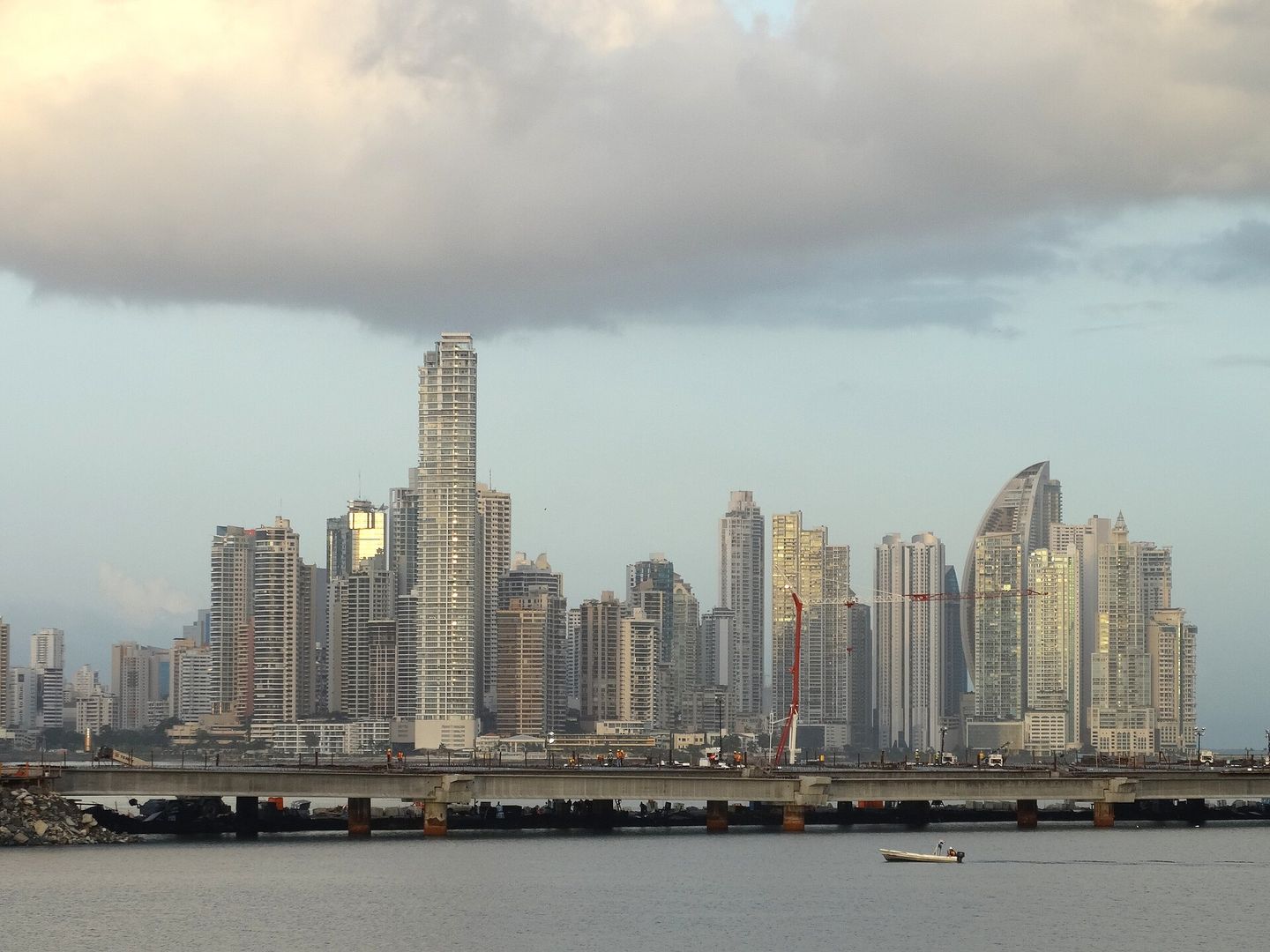
Panama City is the most physically improbable capital in the Americas, and almost nobody comes here to look at it. They come to look at the Canal, spend four hours at a lock, and fly out again from the busiest connecting airport between Bogotá and Miami. That is a shame, because the Canal is the least strange thing about this city. Stranger is the fact that a capital of roughly two million people contains a functioning patch of primary-ish tropical rainforest with three-toed sloths in it, ten minutes from a banking district that looks like Miami's ambitious younger sibling.
The city reads as three settlements stacked on the same coastline, each abandoned rather than demolished. Panamá Viejo is the 1519 original, sacked and burned in 1671 and still standing in fragments on the eastern edge of town. Casco Viejo is the walled replacement the survivors built on a defensible peninsula two years later, now a UNESCO-listed grid of Spanish, French and Caribbean facades in every state from crumbling to immaculate. And then there is the modern city, which grew explosively after the Canal Zone reverted to Panamanian control in 1999 and now stacks residential towers along the Pacific shoreline with very little in the way of restraint.
What follows is the working information: which of those layers to sleep in, when to come so the sky is not falling on you every afternoon, how to move around a city that finally built a Metro, and how to see the Canal without surrendering an entire day to a visitor centre. Panama rewards visitors who stay longer than a layover. Two or three days is enough to stop seeing it as a stopover and start seeing it as a city.
The caseWhy Panama City is stranger than its skyline suggests
The obvious pitch is the Canal, and the Canal genuinely deserves it. Standing at Miraflores while a 300-metre vessel is lowered by gravity alone, using nothing but water moved between chambers, is one of the few engineering spectacles that actually lands in person the way it does in photographs. But a Canal visit is a morning, not a trip, and the case for the city rests on everything arranged around it.
Start with the geography, which is genuinely odd. The isthmus runs east–west here rather than north–south, which is why the sun sets over the Pacific on your right and why a ship travelling from the Atlantic to the Pacific ends up further east than it started. The city sits on the Pacific side, with a tidal range of four metres or more that empties the bay twice a day into a glistening expanse of mudflat. On the Atlantic side, ninety minutes away, the tide barely moves at all. Two oceans, one narrow country, radically different behaviour.
Then there is what the Canal Zone left behind. For most of the twentieth century a strip of land either side of the waterway was American territory in all but name, administered from Balboa with its own police, schools and suburban lawns. When it reverted in 1999, Panama inherited a set of leafy, low-rise, weirdly Midwestern neighbourhoods, plus tens of thousands of hectares of watershed forest that had been protected purely because the Canal needs rain. That accident of hydrology is why Parque Natural Metropolitano exists inside the city limits and why you can watch toucans from a downtown ridge.
The honest caveat: this is not a beautiful city in the way Cartagena or Quito are beautiful. Outside Casco Viejo the built environment is uneven, traffic is genuinely bad, and the waterfront highway cuts the old town off from everything behind it. Come for the collisions rather than the prettiness, and it delivers.
The calendarWhen to go
Panama has two seasons and the difference between them is rain, not temperature. Expect a daily high somewhere around 30 to 32°C every single month of the year, high humidity, and nights that barely drop. Nothing about the thermometer will tell you what month it is.
The dry season, confusingly called verano locally, runs from roughly mid-December to mid-April. This is the reliable window: blue skies, lower humidity by local standards, breezes off the Pacific, and none of the afternoon shutdowns that the wet months bring. It is also when hotel rates peak and when Casco Viejo is at its busiest. If you want a guarantee that the causeway ride and the rainforest trails will be dry, come in January or February and accept the crowds.
The wet season, invierno, runs from around May to early December, and it is far less punishing than the word suggests. Rain here is usually a violent, theatrical downpour between about two and five in the afternoon, followed by a washed-clean evening. Mornings are frequently bright. Plan the Canal, the ruins and the trails before lunch, treat the afternoon as museum or hammock time, and the wet season becomes a perfectly good trip at noticeably lower prices with greener forest and better wildlife activity. October and November are the wettest and the ones to approach with the most flexibility.
Two dates to know. Carnaval, the four days before Ash Wednesday, empties the city as half the population heads for the Azuero peninsula, while the rest of it parties along the Cinta Costera; banks and many restaurants close, and it is either the best or worst week to be here depending on your tolerance. November is the patriotic month, with a dense run of independence holidays and marching bands, which is charming to stumble into and miserable if you need to get anything administrative done.
LogisticsGetting around
The single most useful fact: Panama City has a Metro, the first in Central America, and it is clean, air-conditioned, cheap and dramatically faster than the roads above it. Line 1 runs from the Albrook transport hub north-east through the city centre, with stops that put you within walking distance of El Cangrejo, Vía Argentina and the Calidonia markets. Line 2 serves the eastern sprawl. Neither line reaches Casco Viejo directly, which is the system's main gap for visitors, though Cinco de Mayo station leaves a short taxi hop.
You cannot pay cash at the turnstile. Buy a rechargeable Metro card at any station vending machine or booth, top it up with a few dollars, and note that a single card can usually be tapped for more than one passenger on the same trip. The same card works on the Metrobus network.
For everything else, use a ride-hailing app. Uber and its local competitors operate widely, cost very little by international standards, and remove the whole negotiation ritual of the yellow street taxis, which are unmetered and will quote you a foreigner price. If you do take a street taxi, agree the fare before you get in, and expect the driver to pick up other passengers heading the same direction, which is normal practice rather than a scam.
Walking works within neighbourhoods and almost never between them. Casco Viejo is entirely walkable and genuinely pleasant on foot. So is the Amador Causeway, which is flat, sea-flanked and lined with bike rental stands, and which is one of the few places in the city built for pedestrians on purpose. Between districts, though, the layout assumes a car: pavements vanish, overpasses appear, and crossing Avenida Balboa on foot is an act of faith. Driving yourself is possible but unnecessary unless you are heading into the interior, in which case rent at the airport rather than downtown.
Two airports. Tocumen International, about 40 minutes east of the centre in light traffic, handles everything international and is the Copa Airlines hub, hence the volume of one-stop itineraries through here. Albrook, right in town, handles domestic flights to places like Bocas del Toro and the Guna Yala islands.
The tableHow Panama actually eats
Panamanian food does not have the international profile of Peruvian or Mexican cooking, and locals will often tell you so themselves before recommending something excellent. It is a Caribbean-Pacific-Spanish-Afro-Antillean-Chinese mix built on rice, root vegetables, coconut and fried things, and it is best approached through the fonda rather than the restaurant.
A fonda is a plain, usually family-run lunch counter serving a fixed plate: rice, beans or lentils, a protein, a salad, sometimes a soup, for a few dollars. This is where the city eats on a Tuesday and it is the fastest route into the actual cuisine. Look for the ones full of office workers at half past twelve. The dishes to seek out are sancocho, a restorative chicken soup with ñame and a heavy hand of culantro that Panamanians regard as medicine; ropa vieja, shredded beef in tomato; carimañolas, deep-fried yuca fritters stuffed with seasoned meat; and patacones, twice-fried green plantain discs that accompany almost everything.
Seafood is the strong suit. Corvina, the local sea bass, turns up everywhere, most famously as ceviche. The Mercado de Mariscos on the edge of Casco Viejo sells it by the cup from a row of stalls for pocket change, which is both a genuinely good cheap lunch and the most reliable tourist ritual in the city. Go early in the day when the turnover is fastest, and note the market traditionally shuts for cleaning at the start of the week.
For breakfast, hojaldras, a fried flatbread, with fried cheese and a cup of dark coffee. For a drink, seco, the sugar-cane spirit that is the national liquor, most commonly served as seco con leche, which is exactly what it sounds like and better than it sounds. Local beers are Balboa, Atlas and Panamá, and they are cold and unremarkable and correct for the climate.
The one unambiguously world-class Panamanian product is coffee. Geisha varietals grown in the highlands around Boquete have broken world auction records repeatedly and are among the most expensive coffees on earth. Several specialist cafés in the city, particularly around Casco Viejo and El Cangrejo, pour them properly. Paying fifteen dollars for a small cup feels absurd, and it is also the one souvenir from Panama that genuinely cannot be bought better anywhere else.
The mapNeighbourhoods to know
Casco Viejo, also called Casco Antiguo or San Felipe, is the 1673 walled city on its own small peninsula, and it is where most visitors spend most of their time. Plazas, balconies, churches, rooftop bars and a restoration boom that has run for two decades. It is also the clearest illustration of the city's tensions: immaculately restored boutique hotels stand beside tenements still occupied by families who have lived there for generations, and the displacement that came with the money is a live and unresolved local argument rather than a footnote. The western edge shades into El Chorrillo, a much poorer district, and that transition is abrupt.
El Cangrejo is the older cosmopolitan quarter inland, built up in the mid-twentieth century and still the best neighbourhood in the city for eating. Vía Argentina and the surrounding streets hold Lebanese, Italian, Venezuelan, Chinese and Panamanian kitchens in close succession, plus decent coffee and a genuinely walkable street life. It has Metro access, which almost nowhere else useful does.
Bella Vista and Marbella form the banking and hotel spine, running behind the Cinta Costera waterfront. High-rise, business-oriented, functional rather than charming, with the Calle Uruguay nightlife strip attached. Obarrio and Punta Paitilla continue the same logic further east into pure residential tower territory.
Amador is the causeway district: a four-kilometre spit built from Canal excavation spoil, connecting three small islands, lined with marinas, restaurants and the Biomuseo. Breezy, low-rise and slightly out on a limb, with the best skyline views in the city looking back at the mainland.
And then there is the former Canal Zone, which is where the city becomes genuinely peculiar. Ancón, Balboa, Clayton and Albrook are green, spacious, low-density neighbourhoods of American-era housing under enormous trees, with a hill in the middle of them and administrative buildings that look like they belong in Louisiana. Nobody puts these on a first-time itinerary and they are among the most interesting places to walk in the city.
Field intelligencePractical intelligence
Money first, because it confuses people. The official currency is the balboa, pegged one to one with the US dollar. There are no balboa banknotes. US dollars circulate as the paper currency, Panama mints its own coins in matching sizes and values, and you will get a handful of mixed US and Panamanian coins in change. Carry small bills: taxis, fondas and market stalls frequently cannot break a fifty, and a hundred will be refused almost everywhere.
Tipping runs to about ten per cent in restaurants. Check the bill, because some places add propina automatically and you do not need to pay twice.
Tap water in Panama City is treated and generally safe to drink, which is unusual for the region and worth knowing before you buy three days of plastic bottles. Occasional advisories follow heavy rain or works, so ask at your hotel rather than assuming.
On safety, the useful framing is neighbourhood-specific rather than city-wide. Casco Viejo, the banking district, Amador and the Canal Zone areas are routinely fine in daylight and well policed. El Chorrillo, Curundú and parts of Santa Ana and Calidonia are best avoided after dark and not wandered into casually at any hour. Petty theft rather than confrontation is the usual risk. Standard practice applies: phone out of sight on the street, ride-hail at night rather than walking between districts, nothing in the back pocket.
Spanish is the working language. English is common in Casco Viejo, in hotels and in the business districts, and thin everywhere else, so a few phrases go a long way. Panamanians are in general genuinely friendly to visitors and considerably less formal than their neighbours.
Panama runs on Eastern Standard Time year-round with no daylight saving, which means it aligns with New York in winter and falls an hour behind it in summer. Plugs are the US two- and three-pin type at 110 volts. And if you are here on a Copa connection, the airport is far enough from the city that anything under about seven hours between flights is not worth leaving for, but a self-arranged stopover of a day or two is trivially easy to build into a ticket and is the single best-value way to see the place.
Field notesWhat to see & do
-
Casco Viejo
The walled city built in 1673 after the original was burned, now a UNESCO-listed grid of Spanish colonial, French colonial and neoclassical facades. Plaza de la Independencia, the Teatro Nacional, the golden altar of Iglesia de San José, and the bougainvillea-draped sea wall of Paseo Esteban Huertas.
On the groundWalk it early, around seven or eight, when the light is low and the streets belong to residents rather than tour groups, then come back after dark for the rooftops.
-
Miraflores Locks
The Canal's Pacific-side locks and the standard place to watch a ship transit. The visitor centre has an observation deck level with the lock walls, plus a museum covering construction, the French failure and the 2016 expansion.
On the groundCheck the posted transit schedule before you commit to a time slot — vessels come through in clustered windows, mid-morning and mid-afternoon, and an unlucky arrival means an empty chamber and a very expensive museum.
-
Panamá Viejo
The ruins of the 1519 original, the first European settlement on the Pacific coast of the Americas, sacked and abandoned after Henry Morgan's raid in 1671. The cathedral tower still stands over a field of stone footings on the eastern edge of the modern city.
On the groundThe adjoining museum is what makes the stones legible — do it first, then walk the site, and climb the tower for the view of the ruins against the skyline behind them.
-
Parque Natural Metropolitano
Two hundred-odd hectares of tropical dry forest inside the city boundary, protected because the Canal watershed needed it. Sloths, Geoffroy's tamarins, agoutis, toucans and a ridge-top viewpoint looking straight down on the skyline.
On the groundGo at opening, before seven if you can. The wildlife is active early, the trails are steep enough to punish a late start in the heat, and it empties out by mid-morning.
-
Cerro Ancón
The forested hill in the middle of the former Canal Zone, with an enormous Panamanian flag on top that was a deliberate statement of sovereignty. The summit road gives a 360-degree view over the Canal entrance, the Bridge of the Americas and Casco Viejo.
On the groundWalk up rather than driving — it takes about half an hour on a paved road through forest, and sightings of sloths and toucans on the climb are routine.
-
Biomuseo & the Amador Causeway
Frank Gehry's only building in Latin America, a riot of folded coloured metal on the causeway, telling the story of how the isthmus rose from the sea three million years ago and rerouted the planet's oceans and species.
On the groundPair it with a bike along the causeway at sunset — the ships anchored offshore waiting for a transit slot are the best free view in the city.
-
Mercado de Mariscos
The working fish market on the edge of Casco Viejo, with a row of stalls out front selling ceviche by the cup for a couple of dollars and a plain seafood restaurant upstairs.
On the groundCome before noon when turnover is highest, and check the day — the market traditionally closes for cleaning at the start of the week.
-
Cinta Costera
The reclaimed waterfront park running several kilometres along Avenida Balboa, with cycle lanes, exercise equipment, basketball courts and an unbroken view of the skyline curving around the bay.
On the groundLate afternoon is when the city actually uses it. Note the tide — at low water the bay drains to mudflat and the smell is real.
On the groundWhere things are
Map data © OpenStreetMap contributors.
Where to stayBase yourself well
Casco Viejo
Best for first-timers and short staysThe restored old town, and the only part of the city where you can genuinely live on foot. Colonial buildings converted into small design hotels, rooftop bars, plazas that fill up at dusk, and a restaurant density nowhere else in Panama matches. It is also the loudest option on a weekend night.
A restored colonial boutique hotel near Plaza Herrera
The western plazas are a block or two off the busiest bar streets, which is the difference between atmospheric and sleepless.
$$$An apartment with a balcony near Plaza Bolívar
Renting in the quieter northern half of the peninsula puts you near the Teatro Nacional and the sea wall with less late-night noise.
$$El Cangrejo
Best for eaters, longer stays and anyone using the MetroThe mid-century cosmopolitan quarter and the best-value base in the city. Walkable streets, the deepest concentration of good independent restaurants in Panama, proper coffee, and a Metro station, which no other appealing neighbourhood can claim.
A mid-range hotel off Vía Argentina
You trade colonial views for being able to walk to twenty good kitchens and ride the Metro to the old town in minutes.
$$An apartment near Vía España
The commercial spine is noisy but puts supermarkets, pharmacies and the Iglesia del Carmen Metro stop within a couple of blocks.
$Marbella & Bella Vista
Best for business trips and points redemptionsThe banking spine behind the Cinta Costera waterfront. High-rise, business-oriented and short on charm, but well stocked with reliable international hotels, easy ride-hailing in every direction, and bay views from the upper floors.
A high-floor international chain hotel on Avenida Balboa
Ask specifically for a bay-facing room above the tenth floor; the skyline-and-water view is most of what you are paying for here.
$$$A serviced apartment in Obarrio
A few blocks inland from the water, cheaper for the same square metres, and walkable to the Calle Uruguay restaurants.
$$Amador Causeway
Best for a calm final night or a family with young childrenOut on the spit built from Canal spoil, with sea on both sides, a marina, the Biomuseo and the best view back at the skyline. Quiet, breezy and low-rise, but genuinely cut off — everything beyond the causeway needs a car or a ride-hail.
A waterfront hotel near the marina
Worth it for the sunset and the ship-watching; less so if you plan to be in Casco Viejo every evening.
$$$Clayton & the former Canal Zone
Best for birders, families and repeat visitorsLeafy, spacious, low-density streets of American-era housing under huge trees, a short hop from the Metropolitan park and Miraflores. The most peaceful base in the city and the least like a city at all.
A converted Zone-era house near Clayton
Rainforest on the doorstep and Miraflores fifteen minutes away, at the cost of needing transport for absolutely everything else.
$$Affiliate notePostcardRoute is reader-supported. Some links to accommodation are affiliate links: if you book through them we may earn a small commission at no extra cost to you. We only recommend places we would send a friend.
Beyond the cityWorthwhile day trips
- Isla Taboga
A half-hour ferry from the Amador Causeway to a steep volcanic island of flowering gardens, a church claimed to be among the oldest in the hemisphere, and a beach that faces back at the shipping lanes. Go on a weekday; weekends bring the entire city.
- Gamboa & Soberanía National Park
Forty-five minutes up the Canal to where the Chagres river meets it. Pipeline Road here is one of the most famous birding trails on earth, with day counts that have set world records, and the boat trips onto Gatún Lake put you alongside transiting ships.
- El Valle de Antón
Two hours west and a thousand metres up, a small town sitting inside the crater of a dormant volcano. Cool air, waterfalls, a good Sunday handicraft market, and the only genuine relief from the coastal humidity within easy reach.
- Portobelo & the Caribbean coast
Ninety minutes across the isthmus to the ruined Spanish fortifications where the silver of Peru was once stockpiled for the treasure fleets. Congo culture, a very different Panama, and a reminder of how absurdly narrow this country is.
Before you goCommon questions
- How many days do you need in Panama City?
- Three full days is the sensible minimum: one for Casco Viejo and the old town, one for the Canal and the causeway, and one for the ruins, the rainforest and Ancón. Two days covers the headline sights if you are efficient. Add a fourth if you want a day trip to Gamboa, Taboga or El Valle, which most people who make it here end up wishing they had.
- Is Panama City safe for tourists?
- Broadly yes, with the caveat that safety here is neighbourhood-specific rather than uniform. Casco Viejo, the banking districts, Amador and the former Canal Zone areas are routinely fine and well policed. El Chorrillo, Curundú and parts of Santa Ana and Calidonia should be avoided after dark and not wandered into casually. Petty theft is the realistic risk: keep your phone out of sight on the street and use a ride-hailing app rather than walking between districts at night.
- What currency does Panama use?
- The balboa, pegged at one to one with the US dollar, but there are no balboa banknotes — US dollars are the paper currency and circulate normally. Panama mints its own coins in matching sizes, so your change will be a mix of both. Carry small bills, because taxis, fondas and market stalls often cannot break anything larger than a twenty.
- What is the best way to see the Panama Canal?
- Miraflores Locks on the Pacific side is the standard visit and the easiest from the city, with an observation deck level with the lock walls and a good museum. The critical detail is timing: check the daily transit schedule before you go, because ships come through in clustered windows rather than continuously. For something more involved, a partial transit cruise takes you through the locks aboard a vessel, and Agua Clara on the Caribbean side shows the larger 2016 expansion locks.
- When is the best time to visit Panama City?
- The dry season, from mid-December to mid-April, is the reliable window — blue skies, lower humidity and no afternoon washouts, at peak prices. The wet season from May to early December is better value and much less punishing than it sounds: rain usually arrives as a heavy downpour between two and five in the afternoon, leaving mornings clear. Plan outdoor activity before lunch and it works fine.
- Where should first-time visitors stay in Panama City?
- Casco Viejo, if the budget allows. It is the only district in the city that genuinely works on foot, and it puts the restaurants, plazas and rooftop bars on your doorstep. El Cangrejo is the better-value alternative: less picturesque, much better everyday eating, and a Metro station that connects you to the rest of the city in minutes.
- Is Panama City worth it on a layover?
- Yes, but not a short one. Tocumen airport is about forty minutes from the centre in light traffic, so anything under roughly seven hours between flights is not worth leaving the terminal for. A deliberate stopover of one or two nights, which Copa's hub schedule makes easy to build into a ticket, is a different proposition entirely and is the best-value way to see the city.