
Canada · Ontario
Ottawa runs on committee hearings and cross-country skis
A capital city built on a rock above two rivers, with a canal that turns into the world's largest skating rink the moment it freezes hard enough. This is the Canada that governs itself, then goes outside.
The capital that governs by day and skates home by winter · 45.42° N · 75.70° W
Plan this trip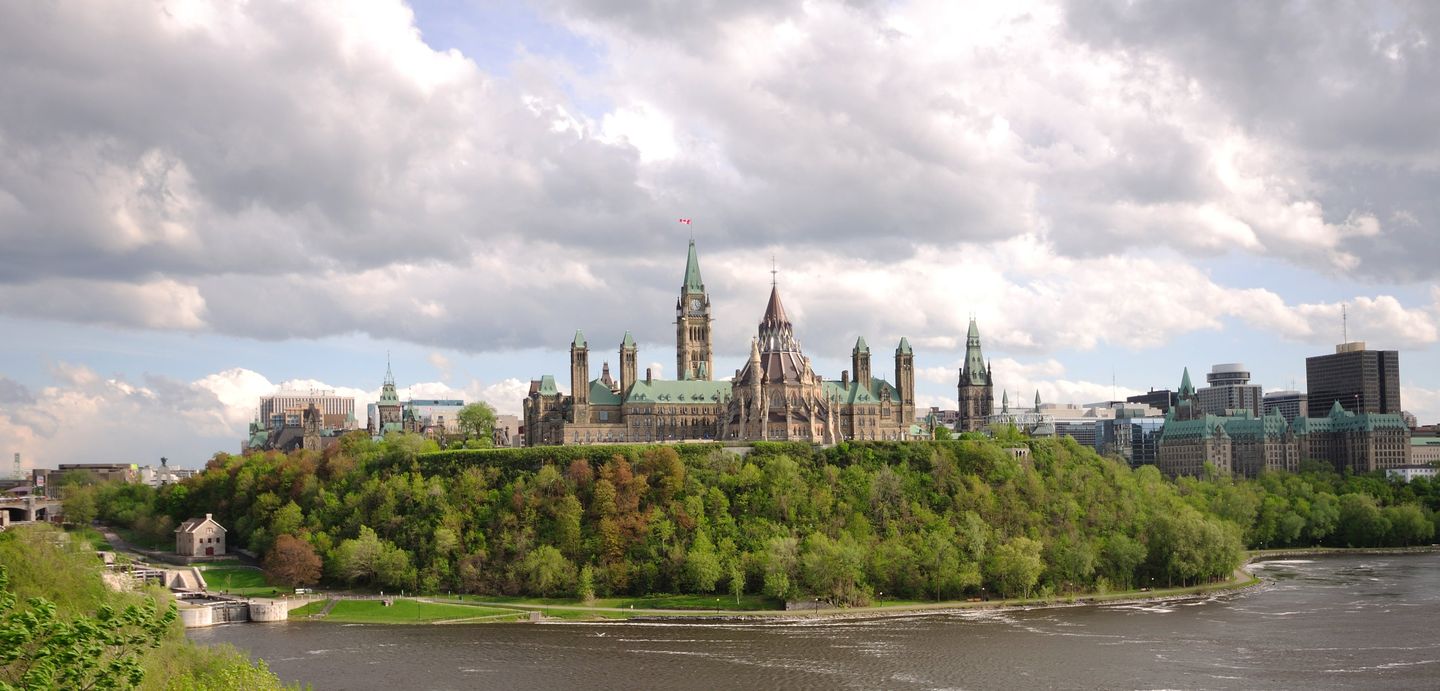
Ottawa has a branding problem it has mostly made peace with: it is the capital nobody picked for glamour. Toronto has the skyline and the money, Montreal has the nightlife and the food press, Vancouver has the mountains, and Ottawa has the Parliament Buildings, a civil service of a few hundred thousand people, and a reputation — not entirely fair, but not entirely wrong either — for being the kind of town that rolls up its sidewalks after the government offices empty out. What that reputation misses is a genuinely handsome small capital, built where the Rideau and Ottawa Rivers meet on a limestone bluff, laid out with the kind of formal civic seriousness Canada reserves for exactly one city, and wrapped by a green belt, a national park, and a canal that turns the whole downtown into a winter sport for two months a year.
The bilingual geography is part of the story. Ottawa sits on the Ontario side of the Ottawa River; Gatineau, its Quebec twin, sits on the other bank, a five-minute walk or bike ride across the Alexandra Bridge. English and French genuinely coexist here in a way they do not in most of the rest of Ontario, federal signage is bilingual by law, and the two-city metro area — officially the National Capital Region — behaves in practice like one downtown split by a river and a provincial border, which gives visitors an unusual two-for-one: a very English-Canadian government town and a francophone Quebec city, both walkable from the same hotel.
This is a city built for a specific kind of pace. The federal core — Parliament Hill, the museums, the ByWard Market — makes for an easy two or three days on foot. What extends a trip is timing it against the calendar: Ottawa in February, with the Rideau Canal Skateway open and Winterlude in full swing, is a genuinely different city from Ottawa in May, when a million tulips bloom across the capital in a festival that traces back to a wartime debt to the Dutch royal family. Arrive without checking which Ottawa you are getting and you will likely be a little underwhelmed. Arrive on purpose, in the right season, and it earns the detour.
The caseWhy Ottawa earns more than a government-tour afternoon
Most people who visit Ottawa are there for one of three reasons: a school trip that stopped at Parliament Hill, a work trip to a federal building, or a stopover on the way to somewhere else. All three tend to produce the same verdict — pleasant, tidy, a bit sleepy — because none of them budget time for the thing that actually makes Ottawa distinctive, which is its relationship with its own outdoors. This is a G7 capital where a UNESCO World Heritage waterway freezes solid enough every winter that tens of thousands of people commute to work on skates, where a national park with real wilderness trails and a herd of white-tailed deer starts fifteen minutes from Parliament, and where a formal, symmetrical government district gives way, within a few blocks, to a market neighbourhood that has been selling produce off the same square since 1826.
The museum concentration alone is unusual for a city this size. Ottawa and Gatineau together hold the National Gallery of Canada, the Canadian Museum of History, the Canadian War Museum, the Canadian Museum of Nature and the Canada Aviation and Space Museum within a compact area, most of them free or discounted on a rotating evening each week, which makes the city a legitimately serious museum weekend and not just a government-buildings detour. Add a genuinely walkable, gridded core, four distinct seasons that each rearrange what there is to do, and a capital-city budget spent on public architecture and parkland rather than private skyscrapers, and the case for Ottawa stops being an apology and starts being a pitch on its own terms.
The calendarWhen to go — and why the season decides the trip
Ottawa changes personality by season more completely than most cities its size, so the honest answer to "when should I go" is "decide what kind of Ottawa you want first." Winter, from late December through February, is when the Rideau Canal Skateway opens — ice conditions permitting, usually early-to-mid January — turning a 7.8-kilometre stretch of UNESCO-listed waterway into the world's largest naturally frozen skating rink, complete with heated changing huts and vendors selling BeaverTails pastries streetside. Winterlude, three weekends in early February, layers ice sculpture competitions, a snow playground and outdoor concerts on top of the canal itself. Come prepared for real cold — daytime highs regularly sit well below freezing, and a proper winter coat is not optional.
May is the other unmissable window, when the Canadian Tulip Festival blankets Commissioners Park and sites across the city in roughly a million tulips, a tradition that began as a diplomatic thank-you: the Dutch royal family sheltered in Ottawa during the Second World War and gifted bulbs afterward in gratitude, a gift renewed most years since. Late spring generally brings the best weather-to-crowd ratio of the year — mild, green, before the humidity of a Canadian summer sets in. Summer (June through August) is warm and reliably busy with festivals, including Canada Day on July 1st, when Parliament Hill hosts the country's single biggest birthday party and hotel rooms downtown book out months ahead. Autumn brings the Gatineau Park hills into full colour by early-to-mid October, arguably the most photogenic and least crowded of the four windows, with day-hiking weather that neither winter nor summer offers.
LogisticsGetting around
Central Ottawa rewards walking more than the government-town reputation suggests. Parliament Hill, the ByWard Market, the National Gallery, the Rideau Canal and most of downtown's hotels sit within a compact, flat, gridded core that a reasonably fit visitor can cross on foot in twenty to thirty minutes. Crossing into Gatineau adds almost nothing to that: the Alexandra Bridge is a pedestrian- and cyclist-friendly span a few minutes from Parliament Hill, and the Canadian Museum of History sits right on the other side.
For anything further out, OC Transpo runs the city's buses and the O-Train light rail, whose Confederation Line now connects downtown east-west with stops near the Rideau Centre, the University of Ottawa and points toward the eastern suburbs — useful for reaching neighbourhoods like the Glebe or Westboro without a car, though both are also a pleasant enough walk or a short cab ride from the core. In summer, the NCC's Capital Pathway network — over 200 kilometres of largely car-free multi-use paths along the canal and both rivers — makes cycling a genuinely serious way to see the city; bike-share and rental options are widely available downtown. Macdonald-Cartier International Airport (YOW) sits about twenty minutes south of downtown by taxi, rideshare or the airport's OC Transpo bus connection; there is no direct rail link. A car is worth renting only if Gatineau Park's more remote trailheads or a farther day trip are the priority — inside the core, it is closer to a liability than a convenience, given limited and metered downtown parking.
The tableHow Ottawa actually eats
Ottawa's food identity is less a single cuisine than a byproduct of being a bilingual capital with a large public-service population and a steady flow of immigration, and the resulting mix rewards wandering rather than chasing one signature dish. The ByWard Market is the obvious starting point and remains a genuinely working market by day — produce stalls, butchers, a maple candy vendor or two — that turns into the city's densest concentration of restaurants and bars by night, spanning everything from casual poutine counters to some of the capital's most ambitious tasting menus, often within the same block.
Ottawa's substantial Lebanese and broader Middle Eastern community has made shawarma something close to a local specialty, and comparing versions across a handful of long-running Byward and Somerset Street spots is a reasonable way to spend an evening. BeaverTails — flat, fried, whole-wheat pastry dough stretched into the shape of the animal's tail and topped with anything from cinnamon sugar to Nutella — actually originated here and is worth trying from a stall near the canal rather than a mall food court. For a more contemporary read on the city, Wellington West and the Preston Street "Little Italy" corridor carry a wave of chef-driven restaurants that rarely make it into the government-town stereotype, and the Glebe's stretch of Bank Street covers everything from long-standing brunch spots to natural wine bars. Ottawa also sits close enough to Quebec dairy and maple country that a genuinely good poutine or a proper maple dessert is never more than a short walk away, whichever side of the river you are on.
The mapNeighbourhoods to know
The ByWard Market, just northeast of Parliament Hill, is Ottawa's oldest and busiest quarter — a grid of nineteenth-century buildings holding the actual market stalls, the city's densest restaurant and nightlife scene, and a steady flow of both tourists and downtown workers on lunch break. It is central to nearly everything and a reasonable first choice for a first visit, if a bit loud on weekend nights.
Centretown, south of Parliament along Bank Street and Elgin Street, is where a more residential, workaday Ottawa shows up: government office towers by day, a solid run of independent restaurants and bars on Elgin by night, and easy walking access to the canal. The Glebe, a further ten to fifteen minutes south along Bank Street beside Lansdowne Park, is a leafy, upscale residential neighbourhood with a genuinely good independent shopping and dining strip and one of the city's best farmers' markets on Sunday mornings — it feels distinctly like a small town stitched into the capital.
Westboro, further west along Richmond Road, has become Ottawa's outdoor-gear and boutique-fitness hub, popular with the paddling and cycling crowd thanks to its proximity to the river and the Ottawa River Pathway, with a café and brunch culture to match. And across the water, Gatineau's Hull sector — the old town directly opposite Parliament Hill — carries its own francophone bar and restaurant scene, historically looser with its liquor licensing hours than the Ontario side, plus the Canadian Museum of History right on the waterfront.
Field intelligencePractical intelligence
Ottawa is officially bilingual at the federal level, so government buildings, museums and signage typically run in both English and French, but day-to-day service on the Ontario side defaults to English; cross into Gatineau and French becomes the practical default, though tourism-facing staff on both sides generally manage the other language without much friction. Tipping follows the standard Canadian norm of 15 to 20 percent on restaurant bills, and Ontario's harmonized sales tax (13 percent) is added at the till rather than folded into the sticker price — Quebec's combined provincial and federal tax runs slightly different again if you are paying on the Gatineau side.
Museum admission across the national museums is often free or reduced on a specific weekday evening — check each museum's own schedule, since the exact day varies and changes periodically — and several, including the Canadian Museum of Nature, waive admission for children under a certain age year-round. Winter visitors need to take the cold seriously: layered clothing, waterproof boots with real grip for icy sidewalks, and an awareness that the Rideau Canal Skateway's opening and condition depend entirely on ice thickness that season, so it is worth checking the National Capital Commission's skate report rather than assuming it will be open on any given date. Summer brings its own minor hazard in blackflies and mosquitoes near the rivers and Gatineau Park trails at dawn and dusk — repellent is worth packing between May and July. And because this is a government town first, expect hotel rates and availability to tighten sharply around Canada Day (July 1st) and during major political events, while the rest of the calendar is comparatively easy to book.
Field notesWhat to see & do
-
Parliament Hill
The Gothic Revival home of Canada's federal government, perched on a limestone bluff above the Ottawa River, with the Peace Tower's carillon audible across downtown and free guided tours of the Centre Block when it is open to the public.
On the groundCatch the Changing the Guard ceremony on the lawn in summer, or the free sound-and-light show projected onto the Centre Block most evenings from late spring through September.
-
Rideau Canal
A UNESCO World Heritage waterway completed in 1832 as a military supply route, running from downtown Ottawa to Kingston — and, once it freezes hard enough each winter, transformed into the world's largest naturally maintained skating rink.
On the groundRent skates at one of the huts along the canal in winter, or walk or cycle the towpath in summer, when it is simply a very pleasant, tree-lined waterway through the middle of the city.
-
ByWard Market
A working produce and craft market operating on the same site since 1826, surrounded by the city's densest cluster of restaurants, bars and specialty food shops, from maple candy stalls to some of the capital's most ambitious kitchens.
On the groundGo in the morning for the actual market stalls and a coffee, then come back after dark for the restaurant and bar scene — it is close to two different neighbourhoods depending on the hour.
-
National Gallery of Canada
A glass-and-granite landmark designed by Moshe Safdie, holding the country's largest art collection alongside major international works, fronted by Louise Bourgeois's towering bronze spider sculpture, Maman.
On the groundThe Indigenous and Canadian galleries are the collection's real strength — budget more time there than in the smaller European wing most visitors head to first.
-
Canadian Museum of History
Across the river in Gatineau, Canada's most-visited museum traces the country's human history from Indigenous origins to the present, anchored by the Grand Hall's towering collection of totem poles and a curved, organic building overlooking Parliament Hill.
On the groundCross the Alexandra Bridge on foot from Parliament Hill — it is a scenic ten-minute walk that also happens to cross into a different province.
-
Canadian War Museum
A deliberately austere, bunker-like building examining Canada's military history from colonial conflicts through the World Wars to modern peacekeeping, with a regeneration hall whose sloped green roof and windows are aligned to the sunrise on Remembrance Day.
On the groundBudget at least two hours; the exhibits are dense and the museum is genuinely one of the best of its kind in North America, not a quick add-on.
-
Gatineau Park
A 361-square-kilometre wilderness park just minutes from downtown, with hiking and cross-country ski trails, lookout points over the Ottawa Valley, and lakes for summer swimming — a scale of accessible nature unusual for a national capital.
On the groundChamplain Lookout is the easiest big-view payoff for the effort, especially spectacular during peak autumn colour in early-to-mid October.
-
Canada Aviation and Space Museum
One of the world's largest aviation collections housed in a hangar-like building near the airport, spanning early biplanes to Cold War jets and Canadian space program hardware.
On the groundIt is a short taxi or bus ride from downtown and easy to combine with the Canada Science and Technology Museum, which is closer to the core.
On the groundWhere things are
Map data © OpenStreetMap contributors.
Where to stayBase yourself well
ByWard Market
Best for first-timers who want everything within walking distanceThe liveliest and most central base, steps from Parliament Hill and the National Gallery, with the city's best concentration of restaurants and bars on the doorstep. Busy and a little loud on weekend nights.
A heritage hotel near the market square
Look for a property on or just off Sussex Drive for the shortest possible walk to Parliament Hill and the museums.
€€€A boutique hotel on a quieter market side street
Set back a block from the main restaurant strip trades a little buzz for a genuinely quiet night's sleep.
€€Centretown
Best for value without sacrificing walkabilityA more residential, workaday stretch along Bank and Elgin Streets, walkable to Parliament Hill and the canal, with a solid independent restaurant scene of its own and generally better rates than the Market.
A mid-range hotel near the canal on Elgin Street
Puts the Rideau Canal skateway or towpath directly outside the door, whichever season you're visiting in.
€€The Glebe
Best for longer stays and a small-town feel inside the capitalA leafy, upscale residential neighbourhood ten to fifteen minutes south of downtown by foot or light rail, with an excellent independent shopping strip and a Sunday farmers' market — a quieter, more local pace than the core.
A bed-and-breakfast in a Glebe heritage home
Several century homes along Bank Street's residential side streets operate as small inns, a genuinely local alternative to a downtown chain.
€€Westboro
Best for a more residential base near the riverThe outdoor-gear-and-brunch neighbourhood favoured by Ottawa's paddling and cycling crowd, right on the Ottawa River Pathway — further from Parliament Hill but well connected by light rail and bus.
A boutique hotel near Richmond Road
Puts the Ottawa River Pathway and Westboro Beach within easy reach, at a remove from the downtown government-district bustle.
€€Gatineau's Hull sector
Best for travellers who want a taste of Quebec without leaving the capital regionDirectly across the river in Quebec, a francophone old-town quarter with its own bar and restaurant scene and the Canadian Museum of History on the waterfront — a genuinely different-feeling base a short walk from Parliament Hill.
A hotel on the Gatineau waterfront
Trades a few minutes' extra walk to Parliament Hill for river views and a francophone neighbourhood on the doorstep.
€€Affiliate notePostcardRoute is reader-supported. Some links to Booking.com (stays, flights, car hire, tickets and tours, airport transfers) are affiliate links, tracked through CJ Affiliate: if you book through them we may earn a small commission at no extra cost to you. We only recommend places we would send a friend.
Book the restEverything else for the trip
Stay sorted? These open Booking.com for the other legs of the journey.
-
Tours & tickets
Things to do in Ottawa
Skip-the-line tickets, tours and day trips.
Browse activities -
Wheels
Car hire in Ottawa
Compare pick-up points and rental companies.
Compare cars -
Air
Flights
Search fares, then come back for the neighbourhood advice.
Search flights -
Ground
Airport transfers
Book a taxi or private transfer before you land.
Book a transfer
Affiliate noteThese four links are affiliate links too: if you book through them we may earn a small commission at no extra cost to you.
Beyond the cityWorthwhile day trips
- Gatineau Park
Wilderness hiking, lookout points and lake swimming a short drive or bus ride from downtown — easily a full day in autumn for the colour, or a half-day cross-country ski outing in winter.
- Château Montebello & the Ottawa Valley
An hour east along the Ottawa River to the historic log château at Montebello, once a private retreat for the world's wealthiest and now a resort, plus the small riverside towns strung along the same stretch of valley.
- Merrickville
A well-preserved nineteenth-century mill town on the Rideau Canal about an hour south, with stone buildings turned into boutiques, galleries and a genuinely good lock-station museum — a pleasant slower-paced counterpoint to the capital.
- Wakefield
A small arts-and-crafts village in the Gatineau Hills about half an hour north, popular for its covered bridge, riverside pubs and access to Gatineau Park's northern trailheads.
Before you goCommon questions
- How many days do you need in Ottawa?
- Two full days cover the federal core properly — Parliament Hill, the ByWard Market, and one or two major museums. Three or four days let you add Gatineau Park, a day trip, and enough slack to catch whichever seasonal event is running, from canal skating to the tulip festival.
- What is the best area to stay in Ottawa for first-timers?
- The ByWard Market. It puts Parliament Hill, the National Gallery and the city's densest restaurant scene all within a fifteen-minute walk, and it is well served by both OC Transpo and the O-Train if you want to range further afield.
- Is the Rideau Canal always open for skating?
- No — it depends entirely on ice thickness each winter, checked and maintained by the National Capital Commission, and openings typically run from early-to-mid January through February in a good year. Check the NCC's official skate report before planning a trip specifically around it, since a mild winter can delay or shorten the season.
- Is Ottawa expensive to visit?
- It is generally more affordable than Toronto or Vancouver for accommodation, with the notable exception of Canada Day (July 1st) and Winterlude weekends, when rates and availability tighten considerably. Museums are frequently free or discounted on a rotating weekday evening, which helps keep costs down for a culture-heavy itinerary.
- Do I need French to visit Ottawa?
- No — Ontario-side Ottawa runs primarily in English day-to-day, though federal buildings and museums are bilingual by law. Cross the river into Gatineau, Quebec, and French becomes the practical default, though most tourism-facing staff manage both languages without difficulty.
- What is the best time of year to visit Ottawa?
- February for Winterlude and canal skating, or May for the Canadian Tulip Festival, are the two signature windows and give the most distinctively "Ottawa" experience. Early-to-mid October offers the best weather-to-crowd ratio for anyone prioritising Gatineau Park's autumn colour over a specific festival.
- How do I get from the airport into downtown Ottawa?
- Macdonald-Cartier International Airport (YOW) is about twenty minutes from downtown by taxi or rideshare, or reachable by an OC Transpo bus connection. There is no direct rail link to the airport, so budget for a fixed-fare taxi, rideshare or the bus rather than a train.