
France · Provence-Alpes-Côte d'Azur
Nice still clocks in for work
Monaco has the mythology and Cannes has the red carpet. Nice has four hundred thousand residents, a produce market that opens before the tourists wake up, and the best base on the coast for everyone who isn't a billionaire.
The Riviera city that still has to clock in for work · 43.71° N · 7.26° E
Most of the Côte d'Azur is built around the idea of being somewhere else for a while: a yacht berth, a casino chip, a week rented at a price that makes the rest of the year worth it. Nice runs on a different clock. It is the fifth-largest city in France, with a working port, a tram system locals actually ride to their jobs, and a population that would still be here long after the last sunbed had been folded away for the season. That ordinariness, more than any single monument, is what makes it the smartest base on this stretch of coastline.
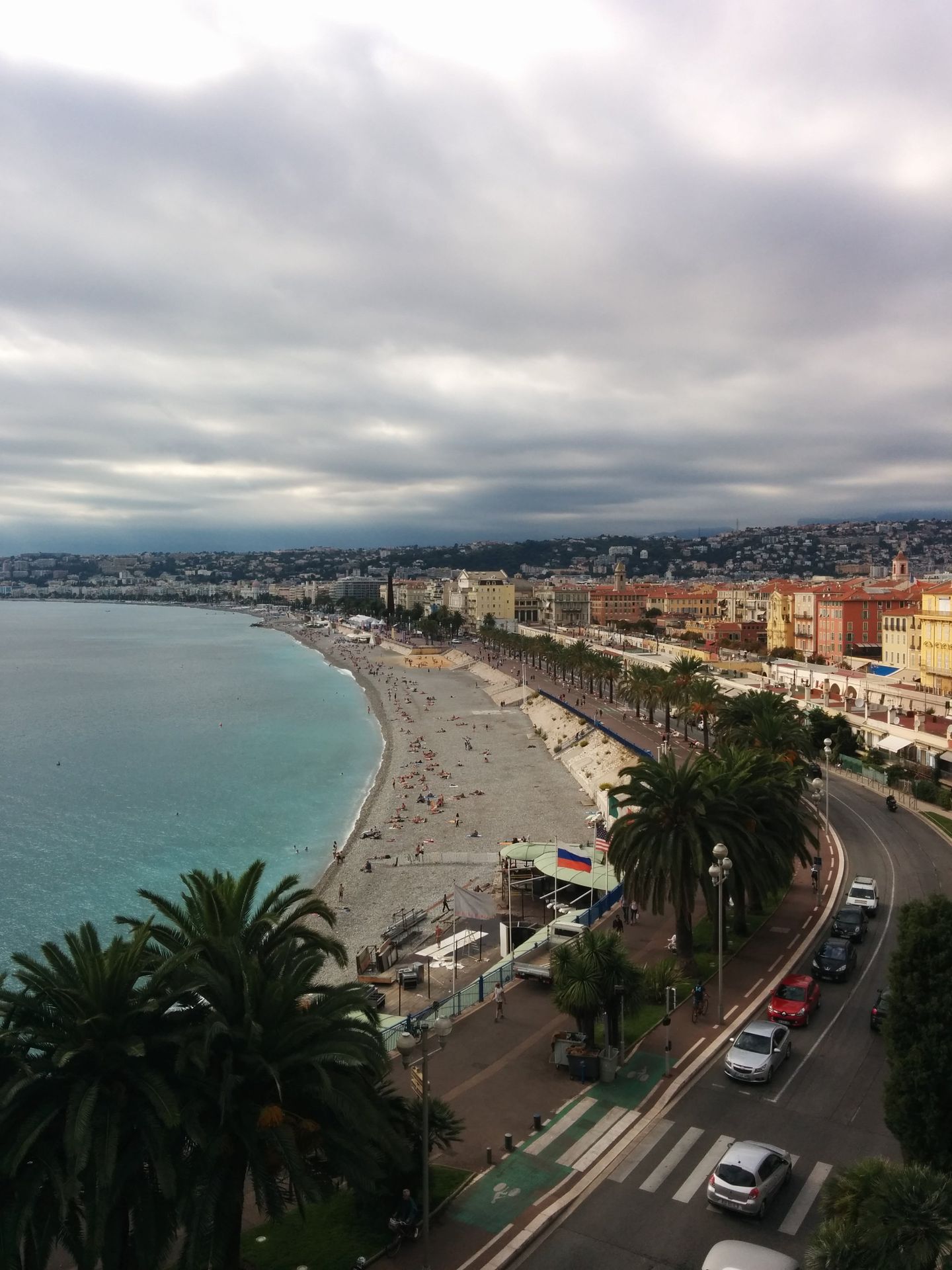
It also happens to have the setting that made the Riviera a Riviera in the first place — the long arc of the Baie des Anges, the pastel apartment blocks stacked up the hills behind, the particular quality of light that pulled a century of painters south and kept them here. Matisse lived and worked in Nice for most of his adult life and is buried in the hills above it. Chagall built his last major museum here by choice, not commission. The light is not marketing copy; it is the actual reason a very specific kind of artist wanted to be in this specific place.
What follows treats Nice as a city to understand rather than a backdrop to photograph. Where to stay so you are not spending your holiday on a bus. When to come so the beach is a pleasure rather than a logistics problem. Why the stones underfoot matter more than you'd think, and which of the famous day trips are actually worth the train fare versus which ones are better admired from a postcard rack. Nice rewards people who treat it as a place with its own life, not a jumping-off point for Monaco.
The caseWhy Nice earns the detour
Nice solves a problem that the rest of the Riviera creates. Monaco is extraordinary and absurdly small, walkable in an afternoon and priced for people who do not check the bill. Cannes exists mostly for twelve days in May and is otherwise a pleasant, slightly hollow seafront. Saint-Tropez requires a car and a tolerance for its own reputation. Nice, by contrast, is a real city at a human scale — old enough to have a genuine medieval core, big enough to have real neighbourhoods with their own characters, and cheap enough, relative to its neighbours, that a normal trip doesn't require a second mortgage.
The art alone justifies a multi-day stay that most visitors compress into a lunch stop en route to Monaco. The Musée Matisse sits in an olive grove in the hills where the painter actually lived; the Musée National Marc Chagall holds the largest public collection of his work anywhere, built around a single devotional cycle he considered his life's major statement; MAMAC tracks the postwar avant-garde, including the Nice-born New Realists, with a seriousness that punches well above the city's size. Add the old town's market, the Baroque churches hidden behind unassuming doors, and a coastline that earns its reputation honestly, and the case makes itself: Nice is not the warm-up act before the real Riviera. For most travellers, it is the real Riviera.
The calendarWhen to go
Late April through June is the strongest window — warm enough to swim by mid-May most years, the wisteria and jacaranda are out, hotel rates haven't hit their summer peak, and the light is at its clearest before the haze of high summer sets in. September into early October runs a close second: the sea has spent all summer warming up and is at its most swimmable, the crowds have thinned noticeably after the last week of August, and restaurants that packed in July have room again.
July and August are what most people picture when they picture the Riviera, and they are also when Nice is at its most crowded, its most expensive, and its hottest — regularly into the low thirties Celsius, with the beach stones radiating heat back at you by midafternoon. If you must come in peak summer, book accommodation months out and plan your beach time for early morning or after six. Winter is genuinely underrated here in a way it isn't further up the coast: Nice has one of the mildest winter climates in mainland France, rarely dropping below ten degrees by day, and February brings the Carnaval de Nice, over 150 years old and one of the largest in the world, with flower battles along the Promenade that are worth planning a trip around in their own right.
LogisticsGetting around
Nice Côte d'Azur Airport is the second-busiest in France and sits almost absurdly close to the centre — about six kilometres, a fifteen-to-twenty-minute tram ride on Line 2 straight from the terminal to Vieux Nice for a few euros, which makes the expensive airport taxis a convenience tax rather than a necessity. Keep this in mind if you're pricing Nice against cities with a long, costly airport transfer baked into every trip; here it barely registers.
Once you're in, walk. The tourist core — the old town, the Promenade, the central squares — is compact enough that a healthy adult can cross most of it in under half an hour. Nice's modern tram network, expanded considerably in the last decade, covers the rest: the airport line, a line up toward the hills and the modern art museum district, and connections to the main train station, Nice-Ville, which has frequent regional trains along the coast to Monaco, Menton, Antibes, Cannes and Èze-bord-de-mer, often cheaper and less stressful than driving a coastline road built for a fraction of today's traffic. A day or multi-day transit pass pays for itself quickly if you're using the tram more than twice. Renting a car only earns its cost if you're pushing further inland than the coastal day trips below — parking in central Nice is expensive and genuinely scarce, and the Corniche roads are spectacular but not relaxing in August traffic.
The tableHow Niçois food actually works
Niçoise cuisine is its own distinct regional tradition, not a vague stand-in for "French food by the sea," and it's worth learning the vocabulary before you order. Socca is the street food to know first: a thin, slightly charred chickpea-flour pancake cooked on huge round griddles, sold by weight, eaten standing up, and best from one of the stalls around the Cours Saleya market rather than a sit-down restaurant trying to formalise it. Pan bagnat — literally "bathed bread" — is the local sandwich: a round roll soaked in olive oil and packed with tuna, hard-boiled egg, tomato, olives and raw vegetables, invented as portable, no-cutlery food for market workers and fishermen and still exactly that today.
Salade niçoise has a real, debated, defended version here, and it does not involve cooked green beans or boiled potatoes, whatever international restaurants have decided otherwise — the traditional composition is raw vegetables, tuna (fresh or tinned, depending who you ask), anchovies, hard-boiled egg and black olives, and ordering the tourist-menu version in front of a Niçois waiter is a small, forgivable education in regional pride. Socca aside, the other dish worth seeking out is pissaladière, a thick onion tart territory shares with its Ligurian neighbours just over the Italian border, topped with anchovies and olives rather than cheese. For the full spread, the Cours Saleya morning market in Vieux Nice is where locals actually shop, and the surrounding lanes hold family-run bistros serving this exact repertoire rather than a watered-down version aimed at passing trade.
The mapNeighbourhoods to know
Vieux Nice, the old town, is the obvious centre of gravity — a dense knot of ochre and burnt-orange buildings, Baroque church façades, and lanes too narrow for cars, built on the slope below the Château hill. It is busy, loud in the evenings, and absolutely worth basing yourself in or near if you want everything within walking distance; just know that ground-floor rooms facing the lanes can be noisy well past midnight in summer.
The Promenade des Anglais and the Carré d'Or behind it form the city's grand, formal face — Belle Époque hotel façades, the curve of beach, and the kind of apartment blocks that made this stretch of coast famous before Monaco existed as a tax haven. It's pricier and quieter at night than the old town, trading atmosphere for polish. Le Port, around Port Lympia on the eastern edge, is a different register entirely: a working harbour ringed by Genoese-style ochre buildings, fewer tourists, better-value seafood, and an easy walk up to the Colline du Château for the view that opens this guide's hero image. Further out, Cimiez is where the museums live — Matisse and the Roman ruins sit in and around a residential hillside that feels like a different, quieter city, a fifteen-minute bus ride from the centre and a useful base if you want green space and lower prices over central nightlife. For value without sacrificing walkability, look toward Libération, around the covered market near the main train station — a genuinely local neighbourhood with some of the best bakeries in the city and rents that haven't caught up to the seafront yet.
Field intelligencePractical intelligence
The beaches are pebble, not sand, almost without exception along the central bay — a geological fact that surprises a lot of first-time visitors and is worth planning around. Bring water shoes or a mat, or rent a lounger and mattress from one of the private beach concessions if bare feet on stones for a full afternoon doesn't appeal; the public stretches are free but unforgiving. The water itself is clean and strikingly clear for a city this size, which is most of the trade-off's upside.
Much of central Nice, including large stretches of the Promenade, has been pedestrianised or traffic-calmed in recent years, and the tram network keeps expanding, so a car is more liability than asset if you're staying centrally. Tipping follows standard French practice: service is included by law, and rounding up for good service is a courtesy, not an obligation. Sunscreen and a hat matter more here than the temperature alone suggests, since the stone beaches and white buildings reflect a lot of glare. Finally, build in slack for the Promenade itself — it was the site of a serious terrorist attack in 2016, and the city's response has included heavier but unobtrusive security around major events like Carnaval and the summer fireworks; it has not changed the character of the place day to day, but it's worth knowing rather than being startled by the visible precautions during big public gatherings.
What to see & do
-
Promenade des Anglais
The seven-kilometre seafront walkway that gave the city its postcard image, built in the 1820s by the English expatriate community that wintered here and named, with no false modesty, after them.
Tip:Walk or cycle it at sunrise before the joggers and scooters arrive in force — the light on the bay is better than at any other hour.
See full guide -
Vieux Nice & Cours Saleya Market
The old town's daily market square, flowers and produce in the morning giving way to antiques on Mondays and a long evening of restaurant terraces — the single best orientation point for understanding how the city actually lives.
Tip:Come before 9am for the market in its working state; by noon it's as much a tourist stage as a place locals shop.
-
Colline du Château
A hilltop park where the city's original castle once stood before Louis XIV had it demolished in 1706 — now gardens, a waterfall, and the best panoramic view over the old town, the port and the bay in one frame.
Tip:Take the free lift (ascenseur) near the eastern end of the Promenade rather than climbing all the steps in midday heat, then walk down.
-
Musée Matisse
A 17th-century Genoese villa in the Cimiez olive groves holding the largest public collection of Henri Matisse's work, assembled largely from the artist's own donations during the decades he lived nearby.
Tip:Pair it with the Roman ruins and the Cimiez monastery next door for a full, uncrowded half-day in the hills above the centre.
-
Musée National Marc Chagall
Built in 1973 specifically to house Chagall's Biblical Message cycle, which the artist considered the central achievement of his career — a single purpose-built room of enormous canvases is the reason to come.
Tip:Go in the morning when the light through the stained-glass window room is at its most striking.
-
MAMAC (Musée d'Art Moderne et d'Art Contemporain)
A striking marble-clad building tracking postwar art from American Pop through to the Nice-born New Realist movement — Yves Klein, Niki de Saint Phalle and Arman all have deep roots here.
Tip:The rooftop terrace gives one of the better free city views in Nice, open whenever the museum is.
-
Port Lympia
Nice's working harbour since the 18th century, ringed by ochre and pastel Genoese-style buildings, ferries to Corsica, and a noticeably calmer, more local pace than the Promenade a few minutes' walk away.
Tip:The seafood restaurants on the quai are better value and less touristy than anything directly on the Promenade.
-
Cathédrale Orthodoxe Russe Saint-Nicolas
The largest Russian Orthodox cathedral outside Russia, built in the early 1900s for the substantial Russian aristocratic community that wintered in Nice before the Revolution — six onion domes rising incongruously over a residential street.
Tip:Modest dress is expected inside; check posted visiting hours, which are more limited than most museums and change around services.
On the groundWhere things are
Map data © OpenStreetMap contributors.
Where to stayBase yourself well
Vieux Nice (Old Town)
Best for first-timers and walkers who don't mind evening noiseDense, lively and photogenic — narrow lanes, church bells, restaurant chatter well into the night. Everything in the historic core is a short walk away.
A small guesthouse on an upper floor near Place Rossetti
Upper floors trade a few stairs for real quiet above the lane-level evening buzz, while staying steps from the cathedral square.
€€A boutique hotel near Cours Saleya
Being this close to the market means you can beat the day-trippers to breakfast and still be back in bed for a nap before the afternoon.
€€€Promenade des Anglais & Carré d'Or
Best for a classic seafront stay and beach accessThe grand, Belle Époque face of the city — sea-view balconies, polished hotel lobbies, and the beach directly across the road. Quieter at night than the old town, and priced accordingly.
A sea-view room in a Belle Époque hotel on the Promenade
Pay the premium for a genuine sea-facing room if the budget allows — the bay view at sunset is most of what you're buying here.
€€€€An apartment one street back from the Promenade
Stepping one block inland from the seafront can cut the price noticeably while keeping the beach a two-minute walk away.
€€€Le Port
Best for quieter evenings and local-feeling diningA working harbour neighbourhood with Genoese façades, better-value seafood, and a fraction of the Promenade's foot traffic — a short uphill walk from the Colline du Château and the old town.
A modest hotel near Place Île de Beauté
The port square is the neighbourhood's social hub, and staying nearby puts the Corsica ferries and the castle-hill climb equally within reach.
€€Cimiez
Best for museum-focused trips and travellers who want green space over nightlifeA green, residential hillside where the Matisse and Chagall museums live — leafy, calm, and noticeably cheaper, at the cost of a short bus or tram ride into the centre each day.
A residential apartment near the Cimiez Arènes
Being near the Roman arena puts both major museums on a comfortable walk, with the centre a short tram ride away.
€€Libération
Best for budget-conscious trips and easy train accessA genuinely local neighbourhood around the covered market near the main train station — unglamorous on paper, and quietly one of the best-value, best-bakery areas in the city.
A simple hotel near the Marché de la Libération
Being steps from the covered market means better bakeries and produce stalls than almost anywhere closer to the seafront, at a fraction of the price.
€Affiliate notePostcardRoute is reader-supported. Some links to Booking.com (stays, flights, car hire, tickets and tours, airport transfers) are affiliate links, tracked through CJ Affiliate: if you book through them we may earn a small commission at no extra cost to you. We only recommend places we would send a friend.
Book the restEverything else for the trip
Stay sorted? These open Booking.com for the other legs of the journey.
-
Tours & tickets
Things to do in Nice
Skip-the-line tickets, tours and day trips.
Browse activities -
Wheels
Car hire in Nice
Compare pick-up points and rental companies.
Compare cars -
Air
Flights
Search fares, then come back for the neighbourhood advice.
Search flights -
Ground
Airport transfers
Book a taxi or private transfer before you land.
Book a transfer
Affiliate noteThese four links are affiliate links too: if you book through them we may earn a small commission at no extra cost to you.
Beyond the cityWorthwhile day trips
- Èze
A medieval village glued to a clifftop above the sea, a short bus or train ride east. Busy by midday with coach tours, genuinely magical an hour before they arrive or after they leave.
- Monaco & Monte Carlo
Twenty minutes by train for the casino façade, the old town on the rock, and a scale of wealth worth seeing once purely as spectacle — walkable in a half-day without spending a euro inside the casino itself.
- Saint-Paul-de-Vence
A hilltop walled village turned artists' retreat a century ago, with the Fondation Maeght's serious modern-art collection just outside the walls — inland rather than coastal, and quieter for it.
- Antibes & Cap d'Antibes
A fortified old town, a lively market, and the Picasso Museum in the castle where he once worked, followed by a walk along the wilder, pine-scented coastal path of the Cap for anyone who wants a break from café terraces.
Before you goCommon questions
- How many days do you need in Nice?
- Three full days covers the old town, the museums and a beach afternoon without rushing. Add a fourth or fifth day if you want to use Nice as a genuine base for day trips to Èze, Monaco or Antibes rather than treating it as a one-night stop before moving on.
- Are the beaches in Nice sand or pebbles?
- Pebbles, almost entirely, along the central bay. Bring water shoes or rent a mattress and lounger from a private beach concession if bare feet on stones for a full afternoon doesn't appeal. The trade-off is unusually clear water for a city beach.
- Is Nice or Monaco the better base for the French Riviera?
- Nice, for almost everyone. It's larger, far cheaper, better connected by train and tram to the rest of the coast, and has enough of its own museums and neighbourhoods to fill several days — Monaco works better as a half-day trip from Nice than as a base in itself.
- How do you get from Nice Airport into the city?
- Tram Line 2 runs directly from the airport terminals into central Nice and the old town in roughly fifteen to twenty minutes for a few euros — one of the easiest, cheapest airport-to-centre connections on the Riviera. Taxis are available but cost considerably more for a trip this short.
- Is Nice expensive compared to the rest of the Côte d'Azur?
- It's noticeably cheaper than Monaco, Cannes during the festival or Saint-Tropez, though summer accommodation still climbs fast in July and August. Travelling in late spring or September, staying slightly inland of the Promenade, and eating in the old town rather than on the seafront keep costs reasonable.
- Do you need a car to visit Nice and the surrounding coast?
- No — regional trains and buses cover Monaco, Menton, Antibes, Cannes and Èze cheaply and without the Corniche traffic. A car only earns its cost for hilltop villages like Saint-Paul-de-Vence that sit further inland from the rail line.
- What is Nice famous for, beyond the beach?
- Its deep connection to modern art — Matisse lived here for decades and is buried in the hills above the city, and Chagall built his last major museum here by choice. Add the Niçoise food tradition (socca, pan bagnat, the real salade niçoise) and the February Carnaval, one of the largest in the world, and the beach is only part of the story.