
Greece · Peloponnese
Nafplio, briefly the capital of everything
A harbour town that governed a new nation for five years, then quietly went back to being one of the most beautiful small cities in Greece.
The capital Greece outgrew in five years, and never really left behind · 37.57° N · 22.80° E
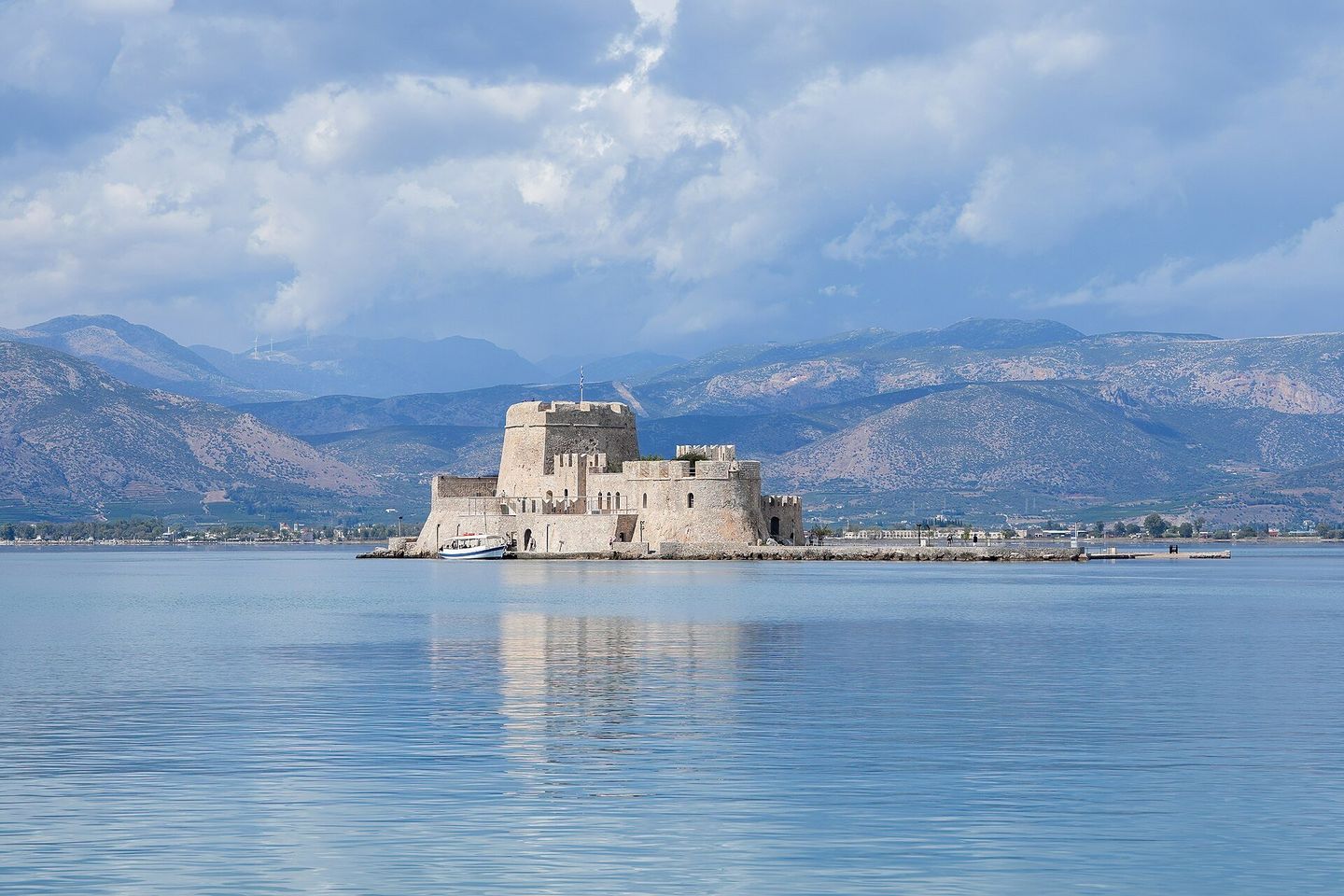
For five years in the 1830s, Nafplio was the capital of Greece — the first seat of government the newly independent nation ever had, chosen for a harbour that could be defended and a hinterland that could feed it. The country's first governor was assassinated on its church steps, its first parliament sat in a converted Ottoman mosque on the main square, and then in 1834 the capital moved to Athens and Nafplio went back to being a provincial port town, just a very well-fortified and extremely photogenic one.
That five-year accident of history is still the most useful lens for understanding the place. Three separate fortifications ring the town — a Venetian hilltop castle so large it takes the better part of a morning to see properly, a toy-sized fortress on its own islet in the harbour mouth, and a citadel on the oldest promontory that has been defended in some form since before Athens built the Parthenon. Add a dense, walkable old town of neoclassical mansions and Ottoman-era lanes, and Nafplio punches well above its size for a city most non-Greek visitors have never heard of before they start planning a Peloponnese trip.
It also happens to sit at the geographic centre of the single richest cluster of ancient sites in mainland Greece. Mycenae, Epidaurus and Tiryns are each a short drive away, which means Nafplio does double duty: a genuinely worthwhile city to spend two or three days in on its own terms, and the obvious, comfortable base for a deeper dive into Bronze Age and Classical Greece that most itineraries squeeze into a single rushed day from Athens.
The caseWhy Nafplio earns the detour from Athens
Most visitors to the Peloponnese see Nafplio, if they see it at all, as a lunch stop between Athens and Mycenae. That undersells a town that is genuinely one of the best-preserved 19th-century urban cores in Greece, built in a deliberate neoclassical style once it became the new nation's capital and largely spared the concrete redevelopment that flattened the character of so many other Greek towns in the postwar decades. Walk the old town's grid behind the harbour and you're moving through streets laid out by Bavarian and Greek planners who wanted their new capital to look like it belonged among the capitals of Europe, not like a fishing village that had stumbled into the job.
The layered fortifications do the rest of the work. Climb Palamidi and you get the clearest visual lesson in Venetian military engineering most travellers will ever see outside a textbook — bastions, dry moats, sightlines engineered centuries before anyone considered tourism. Add Bourtzi sitting almost cartoonishly pretty in the harbour, a genuinely moving assassination site on the steps of a parish church, and a half-day trip to see the Lion Gate at Mycenae or test the acoustics at Epidaurus, and Nafplio turns from a lunch stop into the single best-value base in the northeastern Peloponnese.
The calendarWhen to go
April through June is the strongest window: the Argolic plain's citrus and olive groves are at their greenest, temperatures sit comfortably in the low-to-mid twenties Celsius, and Epidaurus's ancient theatre is just coming back into use for its summer festival of drama and music, which is worth timing a trip around if a performance under the stars in a 2,300-year-old amphitheatre appeals. September and the first half of October offer the same mild comfort from the other direction, with the sea off Arvanitia and Karathona still warm enough to swim and the harsh midsummer light softened into something considerably more flattering for a town built almost entirely of pale stone.
July and August bring real heat — Nafplio's old town has little shade and the Argolic Gulf traps warmth — along with the thickest crowds at Mycenae and Epidaurus, both of which are best visited at opening time in summer to avoid both the heat and the tour-bus convoys. Winter is genuinely underrated here: the town stays open and lived-in rather than shuttering like an island resort, Palamidi and the ancient sites are nearly empty, and a crisp, clear Peloponnese winter day gives some of the best photography light of the year, even if a swim is off the table.
LogisticsGetting around
Nafplio has no airport and, since the regional rail line was suspended during the 2011 financial crisis, no working train service either, so the practical options are driving or the bus. KTEL Argolida runs frequent coaches from Athens's Kifissos terminal, a journey of roughly two to two and a half hours via Corinth and Argos, which is entirely workable for a car-free visit focused on the town itself. The frequency thins out fast for the archaeological sites around it, though — Mycenae, Epidaurus and Tiryns are each reachable by local bus or taxi, but on schedules that make a rental car considerably less stressful if you're trying to see more than one site in a day.
Within the town, you need nothing but your own feet: the old town is compact, flat near the harbour and gently rising toward Psaromahalas and Pronoia, and genuinely not built for cars in its oldest lanes regardless. The climb up to Palamidi is a separate matter — nearly a thousand stepped switchbacks from the old town, or a short drive around to the car park near the top if the knees would rather save themselves for the ramparts instead of the approach. Driving in from Athens, the modern A7 motorway via Corinth covers most of the distance quickly; the final stretch into town on the old national road is slower but scenic, running close to the Argolic Gulf's coastline.
The tableEating in the Argolis
The Argolic plain around Nafplio is some of the most fertile farmland in Greece, and the town's kitchens lean hard on what grows within a few kilometres of the harbour: citrus groves ring the plain in every direction, olive oil here is particularly fine, and the vineyards around Nemea, thirty minutes inland, produce Agiorgitiko, a deep, approachable red that is probably Greece's most exportable grape and deserves to be drunk considerably closer to where it's made than most visitors manage. Seafood follows the gulf's catch rather than a fixed menu, so ask what came in that morning instead of ordering from habit.
The old town's restaurant streets — Staikopoulou in particular — are dense with tavernas aimed squarely at visitors, serviceable but rarely memorable; the better strategy is to walk a block or two off that main strip toward Vasileos Konstantinou or into the quieter lanes near Agios Spyridon, where the same Argolic produce turns up in kitchens cooking for a local lunch crowd rather than a passing one. Look out too for the region's citrus-spoon sweets, a Peloponnese tradition of candying orange and bitter-orange peel into a syrupy preserve traditionally offered to guests with a glass of cold water — still a genuine welcome in older households and a few of the old town's more traditional cafés.
The mapThe old town's quarters
The harbour front and the grid immediately behind it is the heart of visitor Nafplio — neoclassical mansions, the main shopping streets, Syntagma Square with its former mosque and the Archaeological Museum, and the densest concentration of cafés and restaurants in town. It's compact enough to see on foot in well under an hour, which is exactly why it's worth staying a few extra days to see it properly rather than rushing through on a day trip.
Pronoia, the hillside quarter climbing east toward Palamidi, trades the harbour view for a quieter, more residential pace and noticeably better value on accommodation, with the fortress looming directly overhead as a constant, slightly surreal backdrop to ordinary apartment blocks and corner kafeneia. Psaromahalas, the old fishermen's quarter tucked along the shore below Acronauplia, has kept more of its working-town texture than the polished centre, while Akronafplia itself — the promontory the Venetians, Byzantines and a modern hotel have all in turn built on top of — is worth the climb for the layered ruins alone, even though the summit's main building is now a private resort rather than open parkland.
Field intelligencePractical intelligence
Pace the Palamidi climb honestly — the fortress sits on a hill roughly 216 metres above the old town, reached by a long, steep, largely unshaded stair with no shortcut, and it is considerably easier going up in the cool of early morning than at midday in summer. Bring water regardless of season; there is nowhere to buy any once you've started the climb.
Most of Nafplio's archaeological sites and museums close earlier in winter than their summer hours suggest, and both Mycenae and Epidaurus get meaningfully quieter at opening time or in the last two hours before closing, so build a day trip around those windows rather than the middle of the day if crowds matter to you. Cash still gets a warmer reception than cards in some of the smaller inland tavernas near the ancient sites, and a rental car's fuel and parking are both easiest to sort in Nafplio itself before heading out, since options thin out fast once you're off the main roads toward Mycenae or Nemea.
What to see & do
-
Palamidi Fortress
A sprawling Venetian hilltop fortress from the early 1700s, the last major overseas fortification Venice ever built, with sweeping views over the old town, the gulf and the Argolic plain from its bastions.
Tip:Climb before mid-morning in warmer months — there is no shade on the stepped approach and very little once you're inside the walls either.
-
Bourtzi
A small Venetian fortress on its own islet right at the harbour mouth, built in 1471 to block enemy ships from entering, later used as a residence for the town's executioners and, for a stretch in the 20th century, a hotel.
Tip:The classic photograph is from the harbour promenade at golden hour; a short boat trip out to the islet itself runs seasonally from the old town quay.
-
Acronauplia
The oldest fortified ground in Nafplio, defended in some form since antiquity and layered with Byzantine, Frankish, Venetian and Ottoman building work, now shared uneasily between open ruins and a modern hotel complex.
Tip:Access is free and unticketed from the old town side — walk up from Psaromahalas for the quietest approach and the best harbour views back down.
-
Syntagma Square & the Archaeological Museum
The old town's civic heart, ringed by the former Ottoman mosque that briefly served as Greece's first parliament building and a handsome Venetian warehouse now housing the Archaeological Museum's Mycenaean-era finds.
Tip:The museum building itself, a rare surviving example of Venetian civic architecture in the Peloponnese, is worth a slow look even if ancient pottery isn't usually your thing.
-
Church of Agios Spyridon
A small parish church on a quiet old-town corner, notable for one specific, sobering fact: Greece's first head of state, Ioannis Kapodistrias, was assassinated on its front steps in 1831, a bullet mark reportedly still visible in the stonework.
Tip:It's an easy, unticketed stop worth pairing with a read-up on Kapodistrias beforehand — the building itself is modest, but the history it carries isn't.
-
The Lion of Nafplio
A large lion carved directly into a rock face on the edge of town, commissioned by King Otto's Bavarian court to memorialise the Bavarian soldiers who died of a cholera outbreak while garrisoned here in the 1830s.
Tip:It sits along the road out toward Epidaurus, an easy five-minute stop to add onto a day trip rather than a destination requiring its own detour.
-
Arvanitia & Karathona beaches
Two swimmable stretches bookending the Acronauplia headland: Arvanitia, a small pebbled cove an easy walk from the old town, and Karathona, a longer sandy beach reached by a scenic coastal path or a short drive.
Tip:Walk the coastal footpath between the two rather than driving — it threads below Acronauplia's cliffs and is one of the nicest short walks in town.
-
Staikopoulou & the old town lanes
The dense grid of pedestrian streets behind the harbour, lined with neoclassical balconies, tavernas, and small shops selling the region's olive oil, citrus preserves and worry beads.
Tip:The side lanes just off Staikopoulou are quieter and better value than the main restaurant strip itself, and no harder to find a table on.
On the groundWhere things are
Map data © OpenStreetMap contributors.
Where to stayBase yourself well
Old Town (Palia Poli)
Best for first-timers and short stays without a carThe neoclassical heart behind the harbour — walkable to everything, dense with restaurants and shops, and the obvious first-time base even though it carries the highest prices and the most foot traffic.
A restored neoclassical townhouse near the harbour
Look for a conversion a street or two back from the waterfront restaurants for a quieter night without losing the five-minute walk to everything.
€€€A small boutique hotel near Syntagma Square
Central enough to walk to the museum, the harbour and the start of the Palamidi climb without needing a car at all.
€€Pronoia
Best for longer stays and better valueThe hillside quarter below Palamidi, a short uphill walk from the old town — quieter, more residential, and noticeably better value, with the fortress looming directly overhead.
A family-run guesthouse in Pronoia
Ten to fifteen minutes on foot from the harbour, with easier parking than anything inside the old town grid.
€€Psaromahalas & Akronafplia
Best for travellers who want atmosphere over convenienceThe old fishermen's quarter tucked along the shore below Acronauplia — fewer restaurants on the doorstep, but genuine working-town texture and the shortest approach to the headland's ruins and coastal walk.
A small apartment in the Psaromahalas lanes
A few minutes' walk from the old town proper, with the coastal path to Arvanitia practically on the doorstep.
€€Karathona & the coast road
Best for beach-focused stays with a rental carA short drive or a scenic coastal walk from the old town, facing the beach rather than the harbour — the choice for anyone prioritising swimming over being in the thick of the historic centre.
A beachfront studio near Karathona
Trades old-town atmosphere for direct beach access; a car or a willingness to walk the coastal path daily makes this work well.
€€Affiliate notePostcardRoute is reader-supported. Some links to Booking.com (stays, flights, car hire, tickets and tours, airport transfers) are affiliate links, tracked through CJ Affiliate: if you book through them we may earn a small commission at no extra cost to you. We only recommend places we would send a friend.
Book the restEverything else for the trip
Stay sorted? These open Booking.com for the other legs of the journey.
-
Tours & tickets
Things to do
Tickets, tours and activities, anywhere.
Browse activities -
Wheels
Car hire
Compare rental companies worldwide.
Compare cars -
Air
Flights
Search fares, then come back for the neighbourhood advice.
Search flights -
Ground
Airport transfers
Book a taxi or private transfer before you land.
Book a transfer
Affiliate noteThese four links are affiliate links too: if you book through them we may earn a small commission at no extra cost to you.
Beyond the cityWorthwhile day trips
- Mycenae
The Lion Gate, the beehive tombs and the citadel walls of Agamemnon's legendary capital, a roughly thirty-minute drive — among the most significant Bronze Age sites in Europe and an easy half-day from Nafplio.
- Epidaurus
The best-preserved ancient Greek theatre in existence, famous for acoustics so precise a coin dropped on the stage can reportedly be heard from the topmost of its fifty-five rows, about forty minutes east.
- Tiryns & Argos
Tiryns's massive Cyclopean walls, a near neighbour of Mycenae just ten minutes from Nafplio, pairs naturally with a stop in Argos, one of the longest continuously inhabited cities in Europe, on the way back.
- Nemea wine country
The ancient stadium and sanctuary of Zeus, plus a cluster of wineries producing Agiorgitiko, the Peloponnese's signature red grape, roughly thirty minutes inland and well worth a slower, tasting-led afternoon.
Before you goCommon questions
- How many days do you need in Nafplio?
- Two full days covers the old town, the three fortifications and a first day trip comfortably. Three or four days lets you add Epidaurus and Nemea without rushing, and is the better plan if the ancient sites are a priority rather than an afterthought.
- What is the best area to stay in Nafplio?
- The old town itself for first-timers without a car — everything is walkable from a harbour-area base. Pronoia offers better value a short uphill walk away, while Karathona suits travellers prioritising beach time with a rental car.
- Do you need a car to visit Nafplio?
- Not for the town, which is entirely walkable. You do need one, or a reliance on patchy local buses and taxis, to comfortably combine Mycenae, Epidaurus, Tiryns and Nemea in the way most visitors want to.
- How do you get from Athens to Nafplio?
- KTEL Argolida coaches run regularly from Athens's Kifissos bus terminal, taking roughly two to two and a half hours via Corinth and Argos. Driving takes a similar amount of time via the A7 motorway and gives far more flexibility for the surrounding archaeological sites.
- Is Palamidi fortress hard to climb?
- It's long rather than technical — close to a thousand steps with little shade, rising around 216 metres above the old town. Most visitors manage it comfortably in 20 to 30 minutes at an easy pace, best attempted in the morning in warmer months.
- Can you visit Mycenae and Epidaurus in one day from Nafplio?
- Yes, comfortably with a car — both sites are roughly 30 to 40 minutes from town in opposite directions, and a full day covers both without rushing either. Public transport makes the same combination considerably more time-consuming.
- What is the best time of year to visit Nafplio?
- April to June and September into early October give the most comfortable weather for both the town and the exposed ancient sites nearby. July and August bring real heat and the thickest crowds at Mycenae and Epidaurus.