
Luxembourg · Canton of Luxembourg
Luxembourg City, built into its own gorge
Europe's most overlooked capital sits on sandstone cliffs above two river valleys — a fortress that spent four centuries being besieged and now spends its ramparts on views instead.
A fortress city that spends its gorges on views, not walls · 49.61° N · 6.13° E
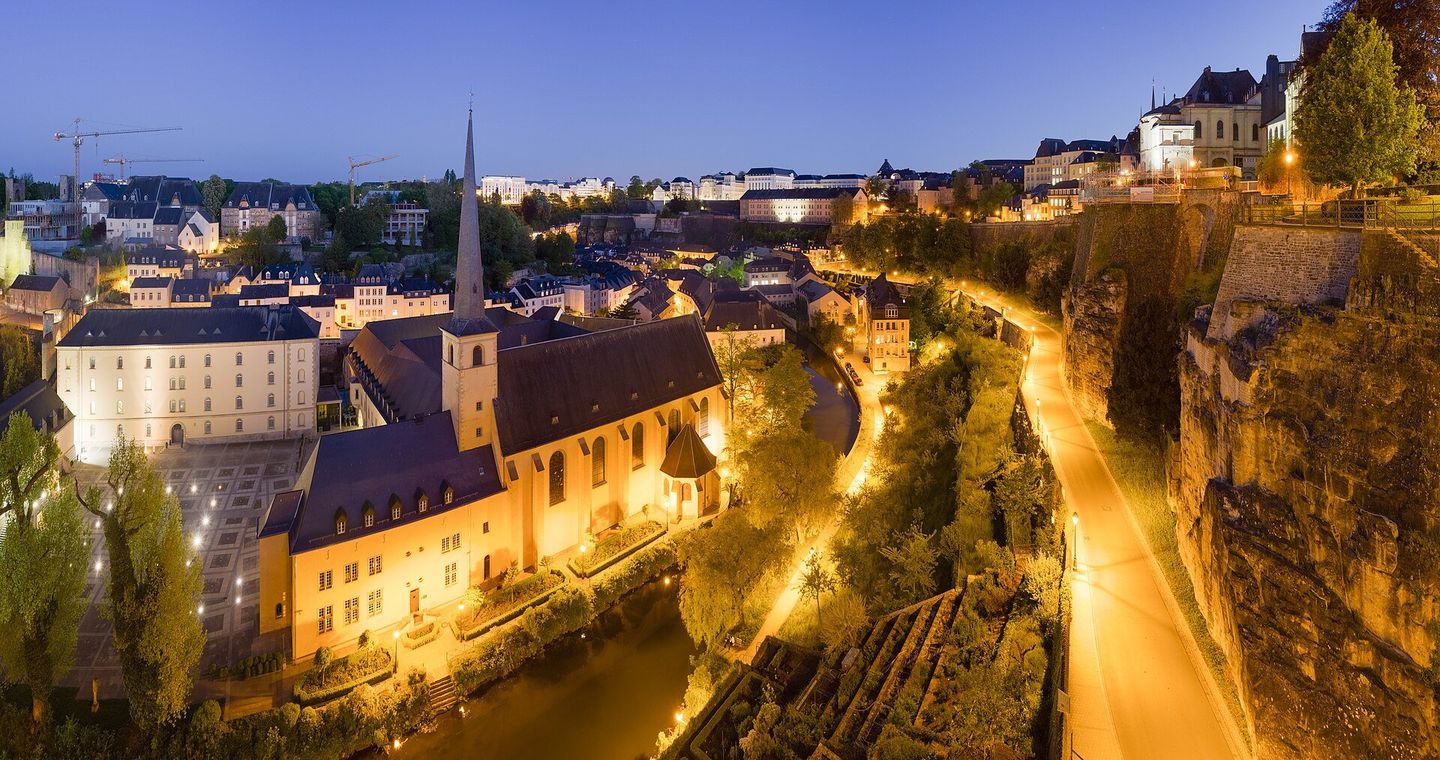
Most people who visit Luxembourg City do it by accident — a layover, a work trip to the European institutions on Kirchberg, a day diverted from a Rhine or Moselle itinerary. That's a shame, because almost nobody else in Europe has built a capital quite like this one. The old town sits on a sandstone plateau carved by two rivers, the Alzette and the Pétrusse, into gorges deep enough that you can stand at a city-centre bus stop and look down sixty metres onto rooftops, church spires and a working river valley. No other EU capital has topography doing this much of the work.
The city earned that topography the hard way. For four hundred years it was one of the most fought-over fortresses in Europe — Vauban reinforced it for the French, the Spanish and Austrians held it in turns, the Prussians garrisoned it after 1815 — and it changed hands so often that it picked up the nickname 'Gibraltar of the North.' The 1867 Treaty of London forced most of the fortifications to be dismantled as the price of neutrality, and what the engineers couldn't demolish, the city kept: tunnels, ramparts and casemates that are now free to wander rather than storm.
What you get today is a strange and pleasant collision: a medieval fortress town, a compact and genuinely walkable old centre, free public transport across the entire country, and — up on the Kirchberg plateau across the valley — glass towers housing the European Court of Justice and some of the EU's other institutions. It rewards two days properly spent far more than most people assume, and it is one of the few Western European capitals where you won't be elbowing through crowds to see any of it.
The caseWhy bother with Luxembourg City
The honest pitch is the setting, not the sights — though the sights are good too. This is a city you experience vertically: ramparts above a river valley, a public lift dropping you from the plateau to the riverside in thirty seconds, a sandstone cliff with a fourteenth-century castle on top of it. The Casemates du Bock alone, a network of fortress tunnels carved directly into the rock, pack more sheer physical drama per square metre than most capital cities manage with an entire museum quarter.
It's also refreshingly small-scale. The historic centre is walkable in well under an hour end to end, there is no queue culture because there is nothing big enough to queue for, and the whole country runs on free public transport, so getting anywhere costs nothing and takes minutes. Factor in some of the highest Michelin-star density per capita in Europe, a wine region twenty minutes away that almost nobody outside the Benelux has heard of, and you have a capital that works brilliantly as a long weekend and even better as a two- or three-night add-on to a Belgium, Germany or French Lorraine trip.
The calendarWhen to go
Late spring through early autumn — May to September — gives you the best odds of sitting outside on the Corniche or down in Grund with a glass of Luxembourgish Riesling, and it coincides with the Moselle valley's growing season, when the vineyards twenty minutes east are at their greenest. June and September are the sweet spots specifically: warm enough to enjoy the terraces, cool enough that the office-worker lunch crowds (this is a financial-services capital, and weekday lunchtimes show it) haven't fully taken over every good table.
December has its own case: Luxembourg's Christmas markets, spread across several squares in the old town including Place d'Armes and Place de la Constitution, are genuinely excellent and considerably less mobbed than Strasbourg's an hour away. Winter weekdays can feel sleepy, though, since much of the city's daytime energy comes from the roughly 200,000 cross-border commuters who work here and go home every evening — plan weekday evenings and weekends with that rhythm in mind rather than against it.
LogisticsGetting around
Luxembourg became the first country in the world to make all public transport free in 2020 — buses, trains and the modern Luxtram all cost nothing, country-wide, with no ticket to buy or validate. For a visitor this removes almost every logistical headache: tap nothing, swipe nothing, just board. The tram line runs from the Gare (train station) district through the old town's edge, across the Pont Rouge, and out to Kirchberg and the airport-adjacent Luxexpo, and it is comfortably the easiest way to cover the distance between the EU quarter and the historic centre.
The old town itself is built for walking, but the topography means 'walking' sometimes means 'descending sixty metres by lift.' The free public elevators — most usefully the one at Plateau du Saint-Esprit and the Pfaffenthal–Kirchberg lift built into the valley wall — connect the upper town directly to Grund and the Alzette valley floor in under a minute, saving a long switchback walk down the Montée de Clausen. If you're flying in, the airport (Findel) is a short, free bus or tram ride from the centre — there's rarely a reason to take a taxi anywhere in the city.
The tableHow Luxembourgers actually eat
Luxembourgish food sits at the crossroads its geography suggests: French technique, German heartiness, and a Moselle wine list running alongside it. The national dish is judd mat gaardebounen — smoked collar of pork, slow-cooked and served with broad beans and potatoes — hearty, unfussy, and on menus all over town, especially in the more traditional kitchens around Grund and Clausen. Bouneschlupp, a green bean and potato soup often finished with a smoky bit of bacon, is the everyday equivalent, the thing a Luxembourgish grandmother actually cooks on a Tuesday.
What surprises most first-time visitors is the fine-dining density: Luxembourg has more Michelin stars per capita than almost anywhere else in the world, a function of the enormous disposable income the financial sector pumps through the city and the number of ambitious French and Belgian chefs it has attracted as a result. You don't need that budget to eat well, though — the gromperekichelcher (crisp potato fritters) sold at street-food stalls and the weekly markets are a few euros and genuinely good, and the kachkéis (a soft, tangy cooked cheese spread) turns up on bread at any proper café. Wine-wise, order Luxembourgish before French: the Moselle's Rieslings, Pinot Gris and sparkling Crémant de Luxembourg are excellent and almost never make it onto export lists, so this is one of the only places you'll ever taste them.
The mapNeighbourhoods to know
Ville Haute is the upper town and historic core — pedestrianised shopping streets, Place d'Armes and Place Guillaume II, the Grand Ducal Palace, and the cliff-edge Corniche walk that locals half-jokingly call Europe's most beautiful balcony. It's compact, handsome, and where most visitors spend their daylight hours.
Drop down into Grund, the riverside quarter along the Alzette, and the mood changes entirely — cobbled lanes, converted mills, low stone bridges, and a run of restaurants and bars that feels like a different, much smaller town than the one sixty metres above it. Clausen, just upstream, was the city's old brewing district and is now its best nightlife strip, anchored by the Rives de Clausen development of converted brewery buildings. Across the valley, Kirchberg is the modern face of the city: glass-and-steel EU institutions, the Philharmonie concert hall, and MUDAM, the I. M. Pei-designed modern art museum, all built on a plateau that was farmland within living memory. The Gare district, around the main train station, is more workaday and multicultural, with the city's better-value hotels and some excellent, unpretentious Portuguese restaurants reflecting Luxembourg's large Portuguese-descended population.
Field intelligencePractical intelligence
Luxembourg has three official languages — Luxembourgish, French and German — and English is widely spoken in anything touching tourism, banking or the EU institutions, so language is rarely a real barrier. Shop and restaurant signage leans French in the old town; don't be surprised to hear a conversation move through all three languages and then English within a single transaction.
This is one of the most expensive small countries in Europe, driven by the financial-services economy, so budget accordingly for hotels and sit-down meals even though public transport is free. The whole country uses the euro, tipping is modest (rounding up, not US-style percentages), and most museums and the Casemates close one day a week — check specific hours before building a tight itinerary around any single sight, since several close on Mondays. Luxembourg's size works in your favour for day trips: nowhere in the country is more than about 45 minutes from the capital by free train or bus, which makes the Moselle valley, Vianden and the Mullerthal all realistic half-day additions without needing a car.
What to see & do
-
Chemin de la Corniche
A cliff-edge pedestrian walkway along the old fortified ramparts above Grund, nicknamed 'Europe's most beautiful balcony' — and for once the nickname undersells it rather than oversells it.
Tip:Walk it at golden hour, when the low light hits the sandstone cliffs and the Alzette valley below turns amber.
-
Casemates du Bock
The underground skeleton of the old fortress — galleries, tunnels and gun emplacements carved straight into the sandstone cliff, parts of which date back to the 10th-century origins of the city itself.
Tip:Bring a layer even in summer; the tunnels stay cool and a little damp year-round, and the footing is uneven in places.
-
Grand Ducal Palace
The working residence of the Grand Duke, a 16th-century former city hall dressed up with a Spanish-Renaissance facade that looks almost too ornate for the quiet street it sits on.
Tip:The palace is only open for guided tours in summer (roughly mid-July to early September); outside that window, admire the facade and the ceremonial guard from the street.
-
MUDAM (Musée d'Art Moderne Grand-Duc Jean)
I. M. Pei's last major European commission, a glass-and-limestone building on Kirchberg built around and into the remains of Fort Thüngen, housing Luxembourg's contemporary art collection.
Tip:The building's prow-like glass atrium, built directly over the old fort's dry moat, is worth the entry fee on its own even on a quiet art day.
-
Notre-Dame Cathedral
A late-Gothic cathedral with a Baroque western facade, home to the venerated statue of the Comforter of the Afflicted and the crypt tombs of Luxembourg's grand ducal family and the blind King John of Bohemia.
Tip:Visit during the Octave pilgrimage in spring if your dates allow — the city's biggest religious festival centres entirely on this church.
-
Grund
The riverside quarter itself is as much an attraction as anything inside it — converted mills, the Neumünster Abbey cultural centre, and low stone bridges over the Alzette, sixty metres and a world away from the plateau above.
Tip:Take the free Plateau du Saint-Esprit lift down rather than walking, then wander back up slowly through Clausen.
-
Adolphe Bridge
A soaring stone arch bridge over the Pétrusse valley, completed in 1903 and once the largest stone arch in the world — still the single most photographed structure in the city.
Tip:Walk down into the Pétrusse park below for the classic shot of the bridge's full double arch, rather than just crossing it.
-
Rives de Clausen
A former brewery complex converted into the city's main nightlife strip, all exposed brick and riverside terraces, busiest from Thursday through Saturday evenings.
Tip:Go on a weekend evening — on quieter nights, half the bars are shut and the atmosphere evaporates.
On the groundWhere things are
Map data © OpenStreetMap contributors.
Where to stayBase yourself well
Ville Haute (the old town)
Best for first-timers and walkersThe historic core, pedestrianised and postcard-pretty, with the palace, the Corniche and most sightseeing within a short walk. The obvious first-timer's base.
A boutique hotel just off Place d'Armes
Staying right on the main square buys you cafés and the Christmas market (in season) on your doorstep, with everything else in the old town five minutes away.
€€€A modern hotel near the Grand Ducal Palace
Quieter streets a few minutes from the square, still fully walkable to the Casemates and the Corniche.
€€Gare (train station district)
Best for value and transit convenienceWorkaday and multicultural rather than postcard-pretty, but well connected by free tram and bus, with better-value hotels and some excellent Portuguese restaurants.
A mid-range hotel a few minutes' walk from the Gare Centrale
Direct tram access to both the old town and Kirchberg, useful if you're combining the city with day trips by train.
€€Grund & Clausen
Best for atmosphere and evenings outThe atmospheric riverside quarter and the city's nightlife strip, down in the Alzette valley rather than up on the plateau — fewer hotels, but the ones that exist put you in the prettiest part of the city after dark.
A small riverside guesthouse in Grund
Being down in the valley means a lift or a climb back up to the old town, but you're steps from the best dinner tables in the city.
€€€Kirchberg
Best for business travel and conferencesThe modern EU and business quarter across the valley — glass towers, the Philharmonie, MUDAM, and chain business hotels built for conference and institutional travel rather than romance.
A business hotel near the European Convention Center
The practical choice if you're here for EU institution meetings or Luxexpo events; the tram puts the old town fifteen minutes away regardless.
€€Affiliate notePostcardRoute is reader-supported. Some links to Booking.com (stays, flights, car hire, tickets and tours, airport transfers) are affiliate links, tracked through CJ Affiliate: if you book through them we may earn a small commission at no extra cost to you. We only recommend places we would send a friend.
Book the restEverything else for the trip
Stay sorted? These open Booking.com for the other legs of the journey.
-
Tours & tickets
Things to do in Luxembourg City
Skip-the-line tickets, tours and day trips.
Browse activities -
Wheels
Car hire in Luxembourg City
Compare pick-up points and rental companies.
Compare cars -
Air
Flights
Search fares, then come back for the neighbourhood advice.
Search flights -
Ground
Airport transfers
Book a taxi or private transfer before you land.
Book a transfer
Affiliate noteThese four links are affiliate links too: if you book through them we may earn a small commission at no extra cost to you.
Beyond the cityWorthwhile day trips
- Vianden
A fairy-tale hilltop castle towering over a half-timbered riverside town in the Ardennes, under an hour north by bus — Victor Hugo lived here in exile and you'll understand why within minutes of arriving.
- The Moselle Valley
Luxembourg's own wine country, twenty minutes east by train to towns like Remich and Grevenmacher — terraced Riesling and Pinot vineyards along a river that most visitors to the capital never realise exists.
- Mullerthal (Little Switzerland)
A region of sandstone rock formations, mossy gorges and waymarked trails east of the city, centred on the village of Echternach — a half-day hike feels a world away from the capital's valleys of concrete and sandstone alike.
Before you goCommon questions
- How many days do you need in Luxembourg City?
- Two full days covers the old town, the Casemates, Grund and Kirchberg comfortably, with time for a leisurely lunch and the Corniche walk. Add a third day if you want to fit in a day trip to Vianden or the Moselle valley without rushing.
- Is public transport really free in Luxembourg?
- Yes — since 2020, all buses, trains and trams within Luxembourg are free for everyone, residents and visitors alike, with no ticket or app required. It's one of the easiest capitals in Europe to get around for exactly that reason.
- What language do people speak in Luxembourg City?
- Luxembourgish, French and German are all official languages, and signage and official business lean French, but English is very widely spoken, especially around tourism, banking and the EU institutions. Don't expect a language barrier.
- Is Luxembourg City expensive to visit?
- Yes, relative to most European capitals — it's one of the wealthiest small countries in the world, and hotels and restaurants price accordingly. Free public transport helps offset this, and the Gare district offers better-value accommodation than the old town.
- What is the best area to stay in Luxembourg City?
- Ville Haute, the old town, for first-time visitors who want everything walkable. If you want better value and don't mind a short free tram ride, the Gare district near the train station is the practical alternative.
- Is Luxembourg City worth visiting if I'm only passing through?
- Yes — even a single day covers the Casemates du Bock, the Corniche walk and a wander through Grund, and the free public transport from the airport or train station makes a short stopover genuinely low-effort.