
Germany · Free and Hanseatic City of Hamburg
Hamburg, water city
More bridges than Venice and Amsterdam combined, a warehouse district that became a UNESCO site, and a concert hall that turned a grain silo into the skyline's new landmark. This is Germany's least German-feeling major city.
Dispatch from the port city that built a concert hall on top of a warehouse · 53.55° N · 9.99° E
Plan this trip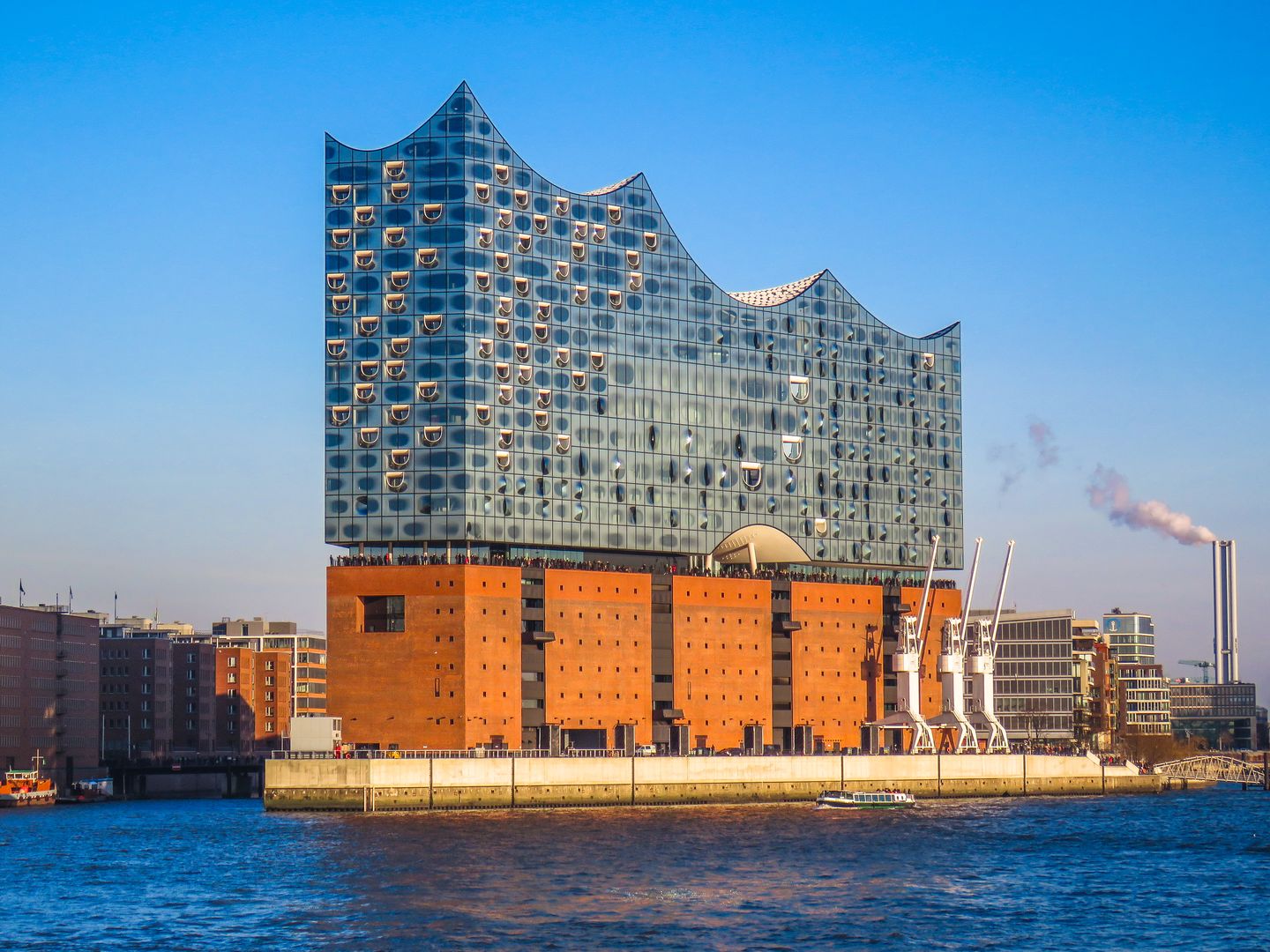
Hamburg has a branding problem it has never much cared to fix. Ask most non-Germans to picture it and you will get a shrug, or at best a vague sense of a port and the Beatles playing somewhere seedy early in their career. What that shrug misses is one of Europe's genuinely great harbour cities — a place built by merchants rather than monarchs, still legally a city-state within Germany, that has spent the last twenty years turning its working docklands into some of the most ambitious urban redevelopment on the continent without losing the grit that made it interesting in the first place.
The geography does a lot of the work. The River Elbe splits the city into a working port to the south and a dense, canal-laced centre to the north, while two connected lakes — the Binnenalster and the much larger Außenalster — sit almost in the middle of downtown, ringed by parkland and sailboats. Add in more than two thousand bridges, a UNESCO-listed warehouse district built on oak piles, and a converted cocoa warehouse that now holds a concert hall with a public viewing platform, and you have a city whose defining relationship is with water rather than with any single monument.
This dispatch is not a checklist built around the Elbphilharmonie's Instagram angle, though you will get that photo and it will be worth taking. It is aimed at someone with three or four days who wants to understand how the city actually fits together — which docklands district to base yourself in, how the Sunday fish market survived three centuries by outdrinking everyone before dawn, where the harbour ferries double as the cheapest boat tour in Europe, and why Hamburg's museum-quality warehouse district was, within living memory, just where people kept their coffee and carpets.
The caseWhy Hamburg earns a longer look
Hamburg is Germany's second-largest city and, by most measures, its wealthiest — a Hanseatic trading power for eight centuries that still runs one of Europe's biggest ports, and a city-state that has never quite thought of itself as answering to Berlin. That independence shows up everywhere: in the shipping-magnate mansions along the Elbchaussee, in a self-confidence that doesn't need to compete with the capital for cultural relevance, and in a willingness to spend enormous sums on infrastructure other cities would leave half-finished.
The Elbphilharmonie is the obvious proof of that willingness — a concert hall balanced on top of a 1960s brick warehouse, a decade late and roughly ten times over its original budget, and by most accounts worth every overrun once you actually stand on its public plaza. But the more interesting case for Hamburg is the Speicherstadt around it: the largest timber-piled warehouse district on earth, built between 1883 and the late 1920s as a free-trade zone for coffee, tea, spices and Persian carpets, converted only in the last two decades into museums, offices and, unavoidably, tourist-facing cafés, without losing the slightly forbidding scale of the original brick.
And then there is the harbour itself, still a working one, which means Hamburg is a rare major European city where you can watch a container ship the length of several football pitches slide past a 19th-century warehouse district on your way to dinner. Pair that industrial honesty with a genuinely strong live-music and nightlife scene around the Reeperbahn, a lake in the middle of downtown that locals actually sail and swim in, and a food culture built on fish sandwiches rather than fine dining pretension, and the case for Hamburg stops being about any single sight and starts being about the whole unusual mix.
The calendarWhen to go
Late May through September is the easiest window. The Alster fills with sailboats and paddleboarders, the harbour ferries run at full frequency, beer gardens along the water stay open into the evening, and the long northern daylight hours mean you can pack a genuinely full day of walking without racing the sunset. September brings the Reeperbahn Festival, a serious multi-venue music event that turns St. Pauli's clubs into a proper festival circuit for a long weekend, and Alster-Vergnügen closes the lakefront roads to traffic for a weekend of cycling and street food.
Hamburg's weather is genuinely North Sea weather — expect rain at any time of year and pack for it even in July, when a clear afternoon can turn in twenty minutes. What the city loses in guaranteed sunshine it makes up for in never feeling truly overrun: this is not a city that gets swamped the way Prague or Barcelona do in peak summer, so crowds are rarely the deciding factor in when to visit.
Winter has a specific, worthwhile case of its own. Hamburg runs several distinct Christmas markets from late November, the historic one around the Rathaus among the more atmospheric, and the Elbphilharmonie's concert programme is at its fullest through the darker months. Bring proper layers — the wind off the Elbe cuts harder than the temperature alone suggests — and expect short days, but also lower hotel rates and a city that leans into cosiness rather than apologising for the weather. The one stretch worth avoiding on a flexible schedule is late January to February, when the cold has set in without any holiday atmosphere to offset it.
LogisticsGetting around — by train, foot and ferry
The HVV network — U-Bahn, S-Bahn, buses and, crucially, the public harbour ferries — covers the city well and runs on a shared zone-based ticketing system, so one ticket type gets you everywhere. Buy a Hamburg CARD if you're sightseeing hard for a couple of days; it bundles unlimited transit with discounts at a long list of museums and attractions and pays for itself quickly once you factor in a museum or two.
The ferry lines are the detail most first-time visitors miss entirely, and they shouldn't. HVV Line 62 runs the length of the harbour on a fixed schedule for the price of an ordinary transit ticket, with stops at the Landungsbrücken piers and across to the shipyards on the Elbe's south bank — it is, functionally, a proper harbour boat tour that most tourists pay considerably more for on a dedicated cruise. Sit on the open rear deck if the weather allows it.
The city centre and Speicherstadt are compact enough to walk end to end, and a bike works well for covering the Alster's full loop or reaching Altona and the Elbchaussee mansions further west — dedicated cycle infrastructure is solid without being quite Copenhagen-level. For crossing under the river without a bridge or a ferry, the century-old Alter Elbtunnel at the Landungsbrücken is a genuine attraction in its own right (see below) as well as a functioning pedestrian and cyclist route to the harbour's south bank. Taxis and rideshares exist but are rarely faster than the train once you account for the city's bridge-heavy, canal-interrupted road layout.
The tableHow Hamburg actually eats
Start with the Fischbrötchen — a bread roll packed with pickled or fried fish, onion and a sharp remoulade-style sauce, sold from harbourside stalls and genuinely one of the better pieces of street food in Germany. Brücke 10, a row of kiosks near the Landungsbrücken piers, is the reliable tourist-facing version; locals will point you further along the harbour or to the fish market stalls themselves for a version with slightly more attitude and slightly less queue.
Franzbrötchen is the other dish worth learning before you arrive: a flattened, cinnamon-and-sugar laminated pastry, native to Hamburg specifically and rarely found with any conviction outside it, sold in every bakery and best eaten still warm with an overly strong coffee. Beyond those two, the city's food identity leans hard into its maritime trading history — herring in every conceivable preparation, Labskaus (a corned-beef, potato and beetroot hash topped with a fried egg and a herring fillet, a genuinely divisive dish worth trying once), and a strong Portuguese community around the harbour that has planted excellent, unpretentious seafood restaurants along the Elbe in Altona.
The Sunday Fischmarkt (see Attractions) is as much a food and drink institution as a shopping one — the fish auction hall behind the market stalls runs live music and beer from before dawn, and turning up straight from a St. Pauli night out to eat a Fischbrötchen and watch a band at 6am is a genuine, if punishing, local tradition. For a calmer meal, HafenCity and the streets around the Speicherstadt have absorbed a wave of good modern German and international kitchens in converted warehouse spaces over the last decade, generally at prices a notch below what the same quality would cost in Munich or Frankfurt.
The mapNeighbourhoods to know
HafenCity, built on former dockland south of the historic centre, is Europe's largest inner-city redevelopment project and the newest part of Hamburg by a wide margin — glass apartment blocks, the Elbphilharmonie, waterfront promenades, and a slightly manufactured feel that is softening as the district matures and fills in with independent shops and restaurants rather than only chains. It sits directly against the Speicherstadt, so the two are best treated as one extended walking district.
St. Pauli, immediately north-west of the harbour, holds the Reeperbahn — Hamburg's famous, occasionally lurid entertainment strip, home to music venues, clubs, and yes, a red-light district along and off the Herbertstraße. Treat the crude reputation as one layer rather than the whole story: St. Pauli is also where the Beatles served their apprenticeship playing marathon club sets in the early 1960s, and today it holds a genuinely strong independent live-music scene, plus the football stadium of FC St. Pauli, whose skull-and-crossbones fan culture is its own local institution.
Schanzenviertel and neighbouring Karolinenviertel, just north of St. Pauli, are Hamburg's alternative and student quarter — graffiti-covered facades, a dense concentration of bars, vintage shops and ethnic restaurants, and the Rote Flora, a long-occupied former theatre that remains a flashpoint for the neighbourhood's squatter-activist history. It is the district locals in their twenties and thirties actually go out in on a normal Tuesday.
Altona, further west along the Elbe, was its own independent Danish-ruled city until 1937 and still has a distinct identity — Ottensen, its liveliest sub-district, is full of good cafés and independent shops with a noticeably calmer, more residential energy than St. Pauli, and the Elbchaussee running along the riverbank west of it is lined with grand 19th-century shipping-merchant villas worth a slow walk or cycle. Around the Alster lakes, Rotherbaum, Harvestehude and Winterhude form the genteel, old-money core of the city — wide streets, consulates, and the best lakefront walking and rowing-club scene in Hamburg.
Field intelligencePractical intelligence
Currency is the euro, and Germany's cash culture, though fading, is still more persistent than in most Western European capitals — carry some cash for smaller cafés, markets and older bars that don't take cards. Tipping is modest and not obligatory: rounding up a bill by five to ten percent, handed directly to the server rather than left on the table, is the norm.
Hamburg's official language is German, but English is widely and comfortably spoken in the city centre, tourist sights and hospitality industry, less reliably so once you're deep into a residential neighbourhood café. A few basic phrases go further here than in Berlin, where visitors are simply more of a fact of life.
The Fischmarkt genuinely starts at 5am in summer and 7am in winter, running only until 9.30am — arrive on the early side if you want the full spectacle of the fish auctioneers' patter rather than a picked-over stall row. St. Pauli after dark is safe by ordinary big-city standards but keep the usual awareness around the Reeperbahn's late-night crowds and the Herbertstraße, which is officially closed to anyone under 18 and to women in general, by long-standing local custom backed by screened-off entrances.
Weather changes fast off the North Sea; pack a proper layer and a compact umbrella regardless of season, and don't plan an entire day around outdoor harbour walking without a wet-weather fallback. Public toilets and drinking water are easy to find in the city centre and Speicherstadt; the harbourside kiosks selling Fischbrötchen almost always have both nearby.
Field notesWhat to see & do
-
Elbphilharmonie & the Plaza
Herzog & de Meuron's wave-shaped concert hall, built on top of a 1960s brick cocoa warehouse at the harbour's edge, with a free public viewing platform circling the building at the join between old and new.
On the groundBook a free timed Plaza ticket online in advance — walk-up access is unpredictable and the escalator ride up through the old warehouse is part of the experience.
-
Speicherstadt & Miniatur Wunderland
The world's largest timber-piled warehouse complex, a UNESCO World Heritage site of red-brick gothic facades and narrow canals, and home to the Miniatur Wunderland model railway that draws queues on its own merit.
On the groundBook Miniatur Wunderland tickets for a specific time slot online days ahead — it regularly sells out, especially on weekends and school holidays.
-
Reeperbahn & St. Pauli
Hamburg's famous entertainment mile, equal parts red-light district, live-music circuit and genuine neighbourhood, where the Beatles played marathon club sets before anyone outside Hamburg had heard of them.
On the groundCome for a gig or a bar crawl in the streets just off the main strip rather than the Reeperbahn itself, where the crowds are thickest and the venues least interesting.
-
Sunday Fischmarkt
A dawn fish and flea market running since 1703 on the Elbe waterfront in Altona, where auctioneers' rapid-fire patter sells everything from fresh fish to houseplants to a crowd that includes plenty of people still out from Saturday night.
On the groundHead into the Fischauktionshalle behind the stalls for live music and beer — the actual social centre of the morning, not just the market itself.
-
Planten un Blomen
A large, genuinely well-designed central park with a Japanese garden, a rose garden and, on summer evenings, a free water-light-and-music show at the fountain that draws a proper local crowd with picnic blankets.
On the groundCheck the water-light concert schedule online before you go — it runs only on select summer evenings, not nightly.
-
Hamburger Kunsthalle
One of Germany's largest and best art museums, spanning medieval altarpieces through German Romanticism — including Caspar David Friedrich's most famous works — into a strong contemporary wing in a connected modern building.
On the groundPrioritise the Romanticism galleries; the Friedrich collection here rivals anything you'll find in Berlin or Dresden.
-
The Alster lakes
Two connected lakes sitting almost in the middle of downtown, ringed by parkland, grand houses and rowing clubs, with sailboats and paddleboarders on the water through the warmer months.
On the groundWalk or cycle the full Außenalster loop late in the afternoon, when the light off the water and the rowing crews are at their best.
-
Alter Elbtunnel
A beautifully tiled 1911 pedestrian and vehicle tunnel running under the Elbe from the Landungsbrücken to the shipyards on the south bank, complete with original wood-panelled lifts still in daily use.
On the groundWalk through to the far side for one of the best free views back across the harbour to the Speicherstadt and the Elbphilharmonie.
On the groundWhere things are
Map data © OpenStreetMap contributors.
Where to stayBase yourself well
HafenCity
Best for first-timers and short stays focused on the harbour sightsHamburg's newest district, waterfront and modern, with the Elbphilharmonie and Speicherstadt on the doorstep — polished rather than atmospheric, but unbeatable for first-time sightseeing logistics.
A design-led hotel near the Elbphilharmonie
Puts the concert hall, Speicherstadt and the harbour ferries within a ten-minute walk, at a price premium for the location.
€€€A modern apartment stay further into HafenCity
A slightly longer walk to the old warehouse district in exchange for calmer, more residential surroundings and better value.
€€Schanzenviertel & Sternschanze
Best for younger travellers and a livelier evening sceneThe city's alternative, café-and-bar-dense student quarter, a short walk from St. Pauli's nightlife without sitting directly on the Reeperbahn's busiest stretch.
A converted-building hotel near the Schanzenpark water tower
Central to the neighbourhood's bars and restaurants, with a straightforward train connection into the historic centre.
€€Altona & Ottensen
Best for longer stays and a quieter, more local feelA calmer, more residential district west of St. Pauli with its own strong café culture and Elbe waterfront walks — better value than the centre and only a short train ride from it.
A neighbourhood guesthouse near Ottensen's high street
Steps from good independent cafés and restaurants, with the Elbe promenade and the Fischmarkt within easy walking or cycling distance.
€€A budget-friendly hotel near Altona station
Excellent transit connections into the centre and toward the airport, at some cost to atmosphere.
€Around the Alster (Rotherbaum & Winterhude)
Best for a quieter, more upscale base close to the lakeThe genteel, old-money core of the city around the Außenalster's rowing clubs and consulate-lined streets — calm, leafy, and a pleasant walk or short train ride from the centre.
A classic hotel near the Außenalster's western shore
Puts the lake's walking and jogging loop directly outside the door, with the university district's cafés close by.
€€€Affiliate notePostcardRoute is reader-supported. Some links to accommodation are affiliate links: if you book through them we may earn a small commission at no extra cost to you. We only recommend places we would send a friend.
Beyond the cityWorthwhile day trips
- Lübeck
Forty-five minutes by train to the former capital of the Hanseatic League, a UNESCO-listed old town behind the twin-towered Holstentor gate, with marzipan, brick-Gothic churches and a genuinely different, more storybook atmosphere than Hamburg.
- Lüneburg
Around half an hour by train to a former salt-trading town whose wealth built a skyline of leaning, subsided gabled houses — a compact, easy half-day of cobbled streets, canals and gently tilting architecture.
- Sylt
Roughly three hours by direct train to Germany's most fashionable North Sea island — wide sand beaches, striking reed-thatched houses, and a wealthy, breezy holiday atmosphere worth the distance for a full day or overnight.
Before you goCommon questions
- How many days do you need in Hamburg?
- Three full days covers the Speicherstadt and Elbphilharmonie, a harbour ferry ride, and one further-out neighbourhood like Schanzenviertel or Altona at an unhurried pace. Four days gives you room for a day trip to Lübeck or Lüneburg, both genuinely worth the extra day rather than a rushed half-day squeeze.
- What is Hamburg actually known for?
- Its working port and Hanseatic trading history above all — this was, and still is, one of Europe's most important harbour cities. Add the Elbphilharmonie concert hall, the UNESCO-listed Speicherstadt warehouse district, the Reeperbahn's nightlife and live-music scene, and a general reputation among Germans as the country's most cosmopolitan, least buttoned-up major city.
- Is Hamburg expensive to visit?
- It runs somewhat above the German average but well below London, Zurich or Copenhagen. Fischbrötchen and bakery Franzbrötchen keep food costs manageable, the HVV transit system and harbour ferries are affordable, and a Hamburg CARD covering transit and museum discounts is worth it for a sightseeing-heavy couple of days.
- Is the Reeperbahn and St. Pauli safe to visit?
- Yes, by ordinary big-city standards — it is a major, well-policed entertainment district rather than a genuinely dangerous one. Keep normal awareness around late-night crowds and pickpockets, respect the Herbertstraße's long-standing local restrictions, and treat it as one neighbourhood among several rather than the whole of St. Pauli's character.
- What is the best time of year to visit Hamburg?
- Late May through September brings the longest days, the fullest use of the Alster lakes and harbour ferries, and September's Reeperbahn Festival. Winter has its own appeal around the Christmas markets and a fuller Elbphilharmonie concert programme, if you don't mind short days and North Sea wind.
- How do I get from Hamburg Airport into the city?
- The S1 suburban train runs directly from the airport terminal into the city centre in around 25 minutes, with frequent departures and a straightforward single ticket covering the whole HVV network. Taxis are available but rarely faster given Hamburg's efficient rail links.