
Switzerland · Canton of Geneva
Geneva runs the world on lunch breaks
A lakeside city barely two hundred thousand strong, where the UN, the Red Cross and half the world's diplomacy share pavement with cows' milk fondue and a free public bathhouse.
A city of two hundred thousand that quietly runs the rest of the planet's business · 46.20° N · 6.14° E
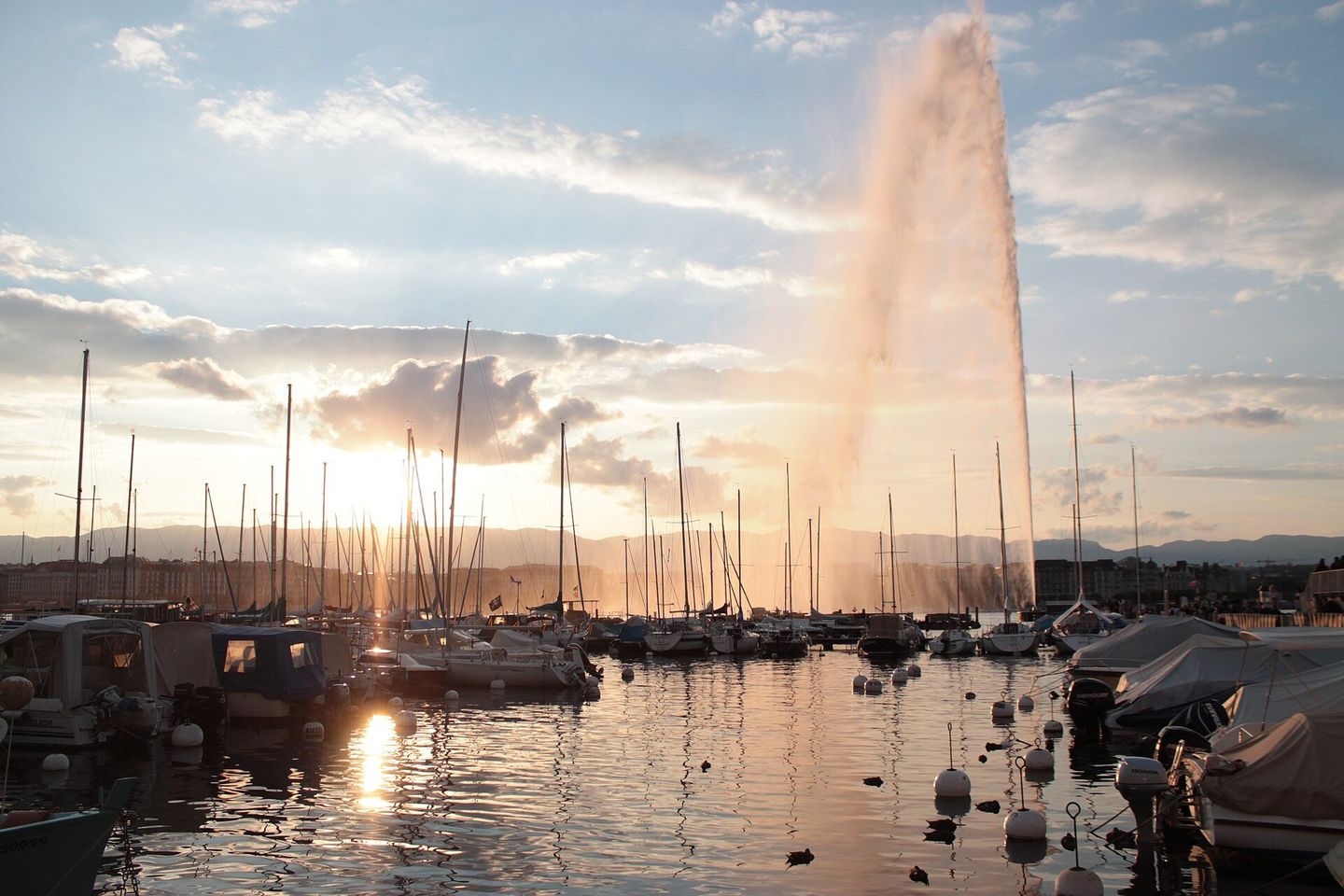
Geneva has an outsized reputation for a city you could walk across in under an hour. It is home to the European headquarters of the United Nations, the International Committee of the Red Cross, the World Health Organization and dozens of other bodies that quietly decide how much of the planet's business gets done, and yet the city proper holds barely two hundred thousand people — fewer than a mid-sized American suburb. That mismatch between global weight and physical size is the first thing to understand about Geneva: it is a company town where the company is the idea of international cooperation itself.
None of which would matter much to a visitor if the setting weren't so good. Geneva sits at the point where the Rhône exits Lake Geneva (the Swiss call it Lac Léman, and get quietly irritated when it isn't), with the Alps and the Jura both visible on a clear day and Mont Blanc occasionally showing itself on the horizon like a rumour confirmed. The Jet d'Eau, the city's 140-metre fountain, has become the obligatory photograph, but it is really just marking the spot where a genuinely beautiful stretch of water meets a genuinely old town, cathedral spire and all.
This guide treats Geneva as a place to actually spend a few days in, not a layover before the mountains. Where to base yourself depending on whether you want old stone or lake views, when the free public bathhouse is at its best, what the city's diplomatic quarter is actually like to walk through, and why the restaurant bill will sting regardless of what you order. Geneva is not cheap and it does not pretend otherwise. It is, however, unusually easy to get right.
The caseWhy Geneva earns more than a layover
Most people encounter Geneva as a connection: a flight change on the way to Chamonix, a conference that ends with one free afternoon. That is a waste of a genuinely distinctive city. Geneva's old town, the Vieille Ville, is one of the best-preserved medieval and Renaissance cores in Switzerland, built on a hill above the lake with cobbled lanes, the Reformation-era St. Pierre Cathedral where Calvin once preached, and enough quiet courtyards that it rarely feels as crowded as its reputation suggests.
The diplomatic history is also worth seeing up close rather than skipping, even for visitors with no particular interest in international relations. The Palais des Nations, the UN's second-largest site after New York, and the International Red Cross and Red Crescent Museum both offer a kind of institutional tourism that is rare and genuinely well done — the Red Cross museum especially, which treats humanitarian history with a seriousness and emotional weight that stays with most visitors long after they leave. Add CERN's free Science Gateway a tram ride away, Patek Philippe's watchmaking museum, and a lake that locals swim in all summer from free public bathing platforms, and Geneva turns out to have more to actually do than its business-trip reputation lets on.
The calendarWhen to go
June through September is Geneva at its best, when the lake is genuinely swimmable, the public bathing platforms (the bains) are in full use, and long evenings let you eat on a terrace by the water until the light finally gives out well past nine. July and August bring the heaviest tourist numbers and the highest hotel rates, so late May, June and September are the sweeter windows — warm enough to swim, with noticeably better availability and lower prices than peak summer.
Winter has its own appeal if diplomacy and museums interest you more than lake swimming: hotel rates drop, the old town's Christmas market and the lakeside ice rink add some seasonal cheer, and the ski resorts of the French and Swiss Alps are close enough for a day trip even if you're not staying in the mountains. The bise, a cold, dry wind that funnels down the lake from the north, can make winter and early spring days feel considerably colder than the thermometer suggests, so pack for wind as much as for temperature. April and October sit in between — mild, quieter, and underrated for a city break that doesn't depend on the beach.
LogisticsGetting around
Geneva Airport is remarkably close to the centre — about five kilometres, a six-minute train ride on regional trains that run every few minutes into Gare Cornavin, the main station. Every hotel and most hostels issue a free Unireso transport card at check-in, valid for the length of your stay on trams, buses and local trains, which makes the airport transfer and everything else essentially free once you've checked in. Do not skip picking this up; it is one of the best amenities in European city travel and most first-time visitors don't realise it exists until a local tells them.
Once you're settled, the city itself is compact enough to walk across in well under an hour, and the tram network (run by the TPG) covers anywhere walking doesn't reach comfortably, including the UN quarter and CERN. The other distinctly Genevan transport option is the lake itself: the yellow Mouettes shuttle boats cross between the two shores for the price of a regular transit ticket, and the historic Belle Époque paddle steamers run by the CGN offer longer, slower crossings to Lausanne, Montreux and the French shore for those with half a day to spare. A car is actively unhelpful here — parking is scarce and expensive, and nothing in the centre is more than a short tram ride away.
The tableHow Geneva actually eats
Geneva's food culture sits at a crossroads of French technique, Swiss produce and a diplomatic community that has imported cuisines from everywhere it has sent delegates. Fondue and raclette are both on nearly every traditional menu, strictly cold-weather food by local custom even if tourist restaurants will serve it to you in July — a Genevan friend ordering fondue moitié-moitié (half Gruyère, half Vacherin) in August is a minor social transgression. The dish to actually seek out as a Geneva specialty rather than a generic Swiss one is filets de perche, pan-fried perch fillets from the lake itself, served with a wedge of lemon and a small mountain of frites at almost any lakeside brasserie.
The other local habit worth knowing is longeole, a coriander-seed pork sausage specific to the canton, traditionally served with stewed leeks and potatoes, and a reliable menu fixture at neighbourhood bistros rather than tourist-facing ones. Geneva also takes chocolate seriously in the way all of Switzerland does, with Favarger a genuinely local maker worth seeking out over the international chains. Brace for the bill regardless of what you order: Geneva is consistently ranked among the most expensive cities on earth, and a casual sit-down dinner for two with wine can comfortably clear 100 Swiss francs. Lunch menus (plats du jour) at neighbourhood spots are the budget-conscious move, often half the price of the same kitchen's dinner service.
The mapNeighbourhoods to know
The Vieille Ville, the old town, sits on a hill on the lake's left bank and is Geneva's most atmospheric quarter — narrow cobbled streets, the cathedral, antique shops and quiet courtyards, with the Place du Bourg-de-Four serving as its social hub since Roman times. It is calmer at night than the areas below, which makes it a strong, if slightly removed, base for anyone prioritising atmosphere over lake views.
Pâquis, on the right bank near the main station, is the city's most mixed and liveliest district — the free Bains des Pâquis bathhouse sits right on the lake here, surrounded by cheap ethnic restaurants and a red-light fringe that has mellowed considerably without disappearing entirely. Eaux-Vives, further along the left bank past the Jet d'Eau, is quieter and more residential, with some of the best lakeside running and cycling paths in the city. Across the Arve river, Carouge feels like a different country entirely — founded by the Kingdom of Sardinia in the 18th century specifically to rival Geneva, it still has an Italianate grid of ochre townhouses, independent ateliers and a noticeably more relaxed, artsy pace. Plainpalais and La Jonction, south of the old town, hold the city's best flea market, a large park, and a growing concentration of bars and casual restaurants favoured by students and younger locals over the pricier lakefront.
Field intelligencePractical intelligence
Geneva runs on French, and while English is widely spoken in hotels, museums and anything connected to the international organisations, a bonjour on entering a shop and a merci on leaving go a long way with locals who aren't dealing with tourists for a living. The free Unireso transport card from your accommodation is the single best logistical tip in this guide — use it on trams, buses, local trains and the yellow Mouettes boats across the lake.
Switzerland isn't in the EU and still uses the Swiss franc, not the euro, though some tourist-facing businesses near the border will quote euro prices at a poor exchange rate — pay in francs where you can. Tipping is not expected the way it is in the US; service is included by law, and rounding up is a courtesy rather than an obligation. The Bains des Pâquis is free to enter but has a small fee for the sauna and towel rental, and is genuinely one of the best low-cost things to do in the city on a warm afternoon. Finally, book UN and CERN tours well ahead online — both require passport ID checks at security and limited daily slots, and walking up on the day rarely works, especially for the Palais des Nations.
What to see & do
-
Jet d'Eau
Geneva's 140-metre fountain, originally an industrial pressure-release valve in the 1880s before the city realised it made a spectacular landmark and kept it running on purpose.
Tip:Walk out along the breakwater (the Jetée des Eaux-Vives) for the closest view — on breezy days, expect to get at least a little wet.
-
Vieille Ville & St. Pierre Cathedral
Geneva's medieval hilltop old town, cobbled and quiet, centred on the cathedral where Calvin preached during the Reformation and the archaeological site beneath it, one of the largest in Switzerland.
Tip:Climb St. Pierre's north tower for the best rooftop view over the old town and the lake beyond; the archaeological crypt beneath the cathedral is a separate, easily missed ticket.
-
Palais des Nations (UN Geneva)
The United Nations' European headquarters and its second-largest site worldwide, offering guided tours through the Assembly Hall and the Human Rights and Alliance of Civilizations Room with its striking painted ceiling.
Tip:Book online well in advance and bring a passport — security is strict, walk-up slots are rare, and the broken-chair sculpture out front is worth a photo even if you skip the tour.
-
Patek Philippe Museum
A watchmaker's own collection spanning five centuries of horology, from Renaissance pocket watches to the firm's own 19th- and 20th-century masterpieces, housed in a former watchmaking workshop.
Tip:The top-floor Patek Philippe galleries are the highlight; go slowly, the detail on the enamel and miniature painting pieces rewards a magnifying glass's worth of attention.
-
Bains des Pâquis
A free public bathing pier jutting into the lake, part beach club, part sauna, part neighbourhood institution, where Genevans of every background swim, sunbathe and queue for the on-site café year-round.
Tip:Go at sunrise in summer for the quietest swim, or in winter for the sauna and a bowl of soup from the café — it stays open and busy through the cold months.
-
International Red Cross and Red Crescent Museum
A museum confronting humanitarian history directly rather than politely — war, disaster and the movement's own founding in Geneva by Henri Dunant, told through genuinely affecting exhibits rather than a dry institutional history.
Tip:Allow at least two hours; this is not a museum to rush, and several installations are emotionally heavier than a typical city-break stop.
-
CERN Science Gateway
The free public face of the world's largest particle physics laboratory, a short tram ride from the centre, with interactive exhibits on the Large Hadron Collider and the physics it's built to probe.
Tip:The Science Gateway itself needs no booking, but the deeper underground-facility tours fill up fast and must be reserved online well ahead.
-
Carouge
A self-contained 18th-century town across the Arve river, built by the Kingdom of Sardinia specifically to outshine Geneva, and still a world apart — Italianate ochre façades, independent ateliers, and a noticeably slower pace.
Tip:Visit on a Wednesday or Saturday morning for the open-air market on Place du Marché, then wander the artisan courtyards just off the main square.
On the groundWhere things are
Map data © OpenStreetMap contributors.
Where to stayBase yourself well
Vieille Ville (Old Town)
Best for first-timers who want atmosphere and don't mind a few hillsGeneva's most atmospheric quarter, cobbled and quiet above the lake, with the cathedral, antique dealers and café-lined squares. Calmer at night than the lakefront, with a short walk down to everything else.
A boutique hotel near Place du Bourg-de-Four
The old town's main square has been Geneva's social hub since Roman times, and staying beside it puts the cathedral and the best cafés on your doorstep.
€€€€A small guesthouse on a quiet lane near St. Pierre
Upper-town streets thin out noticeably after dark, trading a short uphill walk for genuine quiet.
€€€Pâquis
Best for budget-conscious trips and easy arrivals by train or airport shuttleLively, mixed and unpretentious, right by the main station and the lake, with the free Bains des Pâquis bathhouse and the city's best concentration of cheap, genuinely international restaurants.
A straightforward hotel near Gare Cornavin
Being steps from the main station makes arrivals and day trips equally painless, at some of the better rates in the city centre.
€€A lakeside apartment near the Bains des Pâquis
A morning swim before breakfast is the whole case for staying this close to the bathing pier.
€€€Eaux-Vives
Best for longer stays and travellers who want calm over nightlifeQuieter and more residential than central Pâquis, with some of the best lakeside running and cycling paths in the city and the Jet d'Eau a short walk away.
A residential apartment near the Jet d'Eau promenade
The lakefront path here is genuinely pleasant for a morning walk or run, with the fountain as your turnaround point.
€€€Carouge
Best for a quieter, more local-feeling base for a longer tripA self-contained 18th-century town across the Arve, with Italianate façades, artisan courtyards and a noticeably slower pace than central Geneva — a tram ride, not a walk, from the main sights.
A converted townhouse near Place du Marché
You trade a short tram commute into the centre for genuinely cheaper rates and Carouge's own excellent bars and markets on your doorstep.
€€Plainpalais & La Jonction
Best for value-conscious trips and travellers who want a less touristy evening sceneA student-and-local district south of the old town, built around a large park and flea market, with a growing concentration of casual bars and restaurants at lower prices than the lakefront.
A simple hotel near the Plaine de Plainpalais
The flea market runs Wednesday and Saturday mornings right outside, and the old town is a flat fifteen-minute walk away.
€€Affiliate notePostcardRoute is reader-supported. Some links to Booking.com (stays, flights, car hire, tickets and tours, airport transfers) are affiliate links, tracked through CJ Affiliate: if you book through them we may earn a small commission at no extra cost to you. We only recommend places we would send a friend.
Book the restEverything else for the trip
Stay sorted? These open Booking.com for the other legs of the journey.
-
Tours & tickets
Things to do in Geneva
Skip-the-line tickets, tours and day trips.
Browse activities -
Wheels
Car hire in Geneva
Compare pick-up points and rental companies.
Compare cars -
Air
Flights
Search fares, then come back for the neighbourhood advice.
Search flights -
Ground
Airport transfers
Book a taxi or private transfer before you land.
Book a transfer
Affiliate noteThese four links are affiliate links too: if you book through them we may earn a small commission at no extra cost to you.
Beyond the cityWorthwhile day trips
- Chamonix & Mont Blanc
An hour by bus or car across the French border to the base of Western Europe's highest peak, with cable cars up to Aiguille du Midi for a view that makes the whole détour worth it on a clear day.
- Lausanne
Forty minutes by train or a longer crossing by historic paddle steamer along the lake, for the Olympic Museum, a hillside old town, and a very different, steeper Swiss city than flat, compact Geneva.
- Yvoire
A medieval walled village on the French shore of the lake, reachable by boat in summer, with flower-draped stone lanes and a slower pace than anywhere comparable on the Swiss side.
- Annecy
An hour south into France for a turquoise canal-threaded old town and its own alpine lake — frequently compared to Geneva's, and arguably prettier at the water's edge, if smaller in ambition.
Before you goCommon questions
- How many days do you need in Geneva?
- Two full days covers the old town, the lakefront and one major museum comfortably. Three or four lets you add CERN, the Red Cross museum properly, and a day trip to Chamonix or Lausanne without rushing — Geneva rewards a relaxed pace more than a checklist sprint.
- Is Geneva expensive?
- Yes, consistently ranked among the most expensive cities in the world. Accommodation and sit-down dinners are where it bites hardest. Lunch menus, the free transport card from your hotel, and the free Bains des Pâquis bathhouse are the best ways to keep a trip affordable without missing the good parts.
- Can you actually swim in Lake Geneva?
- Yes, and locals do all summer — the water is clean and the free Bains des Pâquis bathing pier is the easiest way in, with a sauna and café attached. Swimming season runs roughly June through September; outside that window the lake is better admired from the shore.
- Do I need to book UN or CERN tours in advance?
- Yes, for both. Palais des Nations tours require passport ID and online booking well ahead, with limited daily slots and strict security. CERN's Science Gateway exhibition needs no booking, but its underground facility tours fill up fast and should be reserved online as early as possible.
- What's the best way to get around Geneva?
- Pick up the free Unireso transport card at your hotel the moment you check in — it covers trams, buses, local trains and the yellow Mouettes boats across the lake for your whole stay. The centre itself is compact enough to walk, so use the card mainly for the airport, the UN quarter, CERN and Carouge.
- Is Geneva worth visiting if I'm not interested in diplomacy or finance?
- Yes — the old town, the lake, Carouge's Italianate streets and the free bathing pier would justify a visit even without a single international organisation in the city. The diplomatic history is a genuine bonus for curious visitors, not the whole reason to come.
- What's the best time of year to visit Geneva?
- Late May through September for warm weather and swimmable lake water, with June and September offering better value and smaller crowds than peak summer. Winter suits visitors prioritising museums and nearby skiing over lake time, though the bise wind can make it feel colder than the thermometer suggests.