
Greece · Crete
Chania, layered
Venetian stone, an Ottoman minaret, a synagogue that survived deportation and ruin — all stacked around a harbour that still works for a living.
Crete's prettiest harbour, built by three empires and inherited by none of them · 35.51° N · 24.02° E
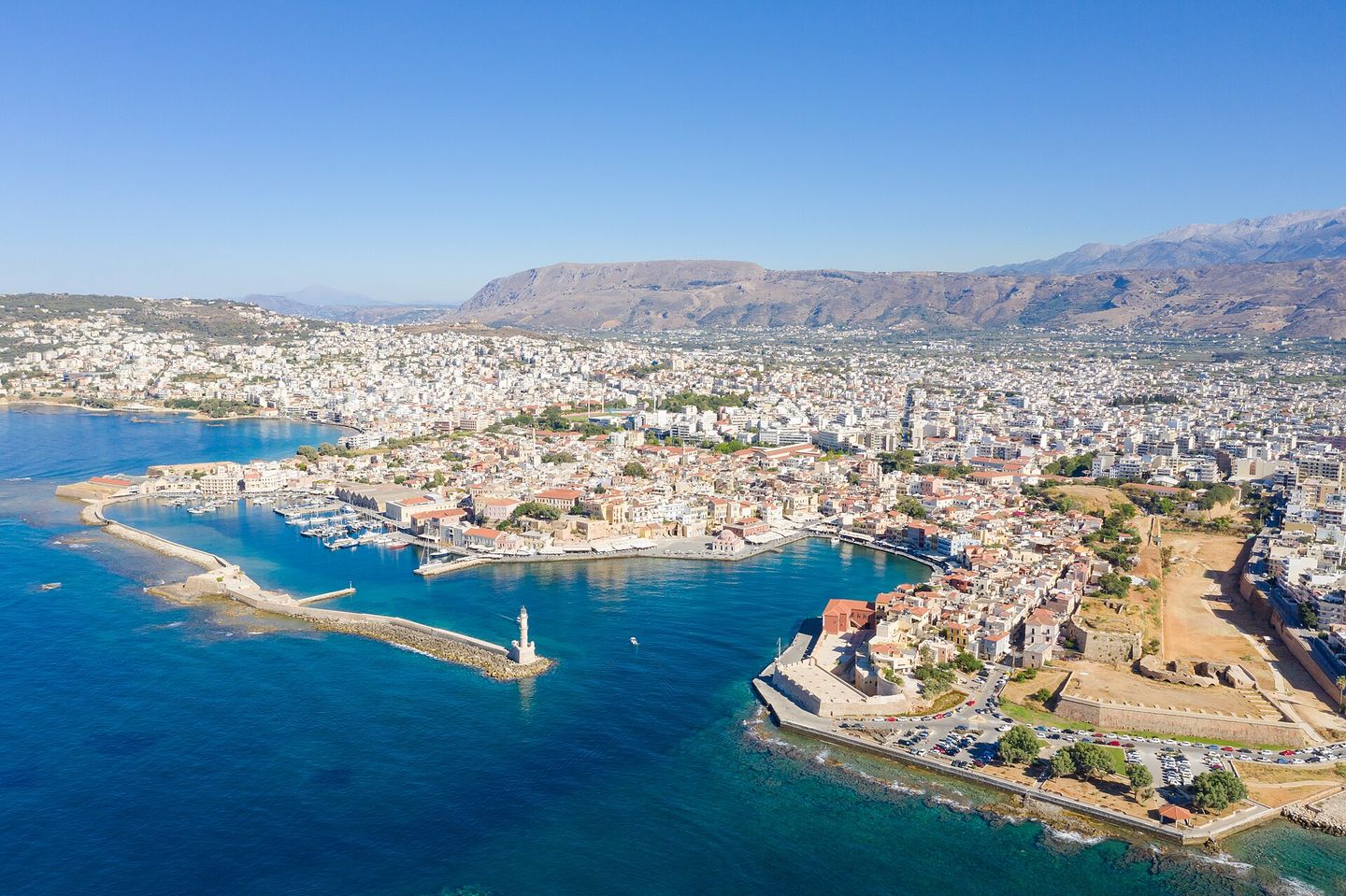
Most visitors to Crete end up in Heraklion first, because the airport and the ferry from Piraeus put them there, and most of them regret not getting to Chania sooner. Crete's second city is also its most beautiful one — a crescent of Venetian harbour buildings, an Ottoman mosque squatting on the waterfront, a hilltop where Minoans lived three and a half thousand years before either empire arrived, and a jumble of quarters behind the harbour where washing lines cross between buildings that have been rebuilt, requisitioned, bombed and restored in roughly that order.
The old town is small enough to get properly lost in within twenty minutes and interesting enough that getting lost is the plan, not the mistake. What makes Chania different from a lot of harbour towns that trade on their looks is that it never fully became a museum of itself — the market still sells fish and cheese to people who live here, the backstreets behind the tourist front still have the shuttered shops and scooter repair garages of an ordinary provincial city, and the Venetian and Ottoman layers are something residents live inside rather than preserve behind glass.
It also happens to sit within striking distance of the best reasons to come to Crete at all: the White Mountains and Samaria Gorge rising directly south, and the turquoise lagoons of Balos and Elafonisi within a long but manageable day's drive. Chania works equally well as a city break in its own right or as the base for the island's best landscapes — few places in Greece give you both so well.
The caseWhy Chania, specifically
Rethymno gets compared to Chania constantly, usually unfavourably to Rethymno's disadvantage, and the comparison is fair: Chania's harbour is bigger, better preserved, and framed by a backdrop — the snow-capped White Mountains, visible on a clear day — that no other Cretan town can match. But the real case for Chania is how many different centuries you can stand in within a single afternoon's walk. The Venetian Arsenali, the Ottoman Yali Mosque right on the water, the Byzantine-into-Ottoman church in Splantzia with both a bell tower and a minaret, the restored 15th-century synagogue in the old Jewish quarter — nowhere else on Crete stacks its conquerors quite this visibly, or this close together.
It also works at a scale that rewards walking rather than sightseeing. There is no single must-see monument demanding a half-day queue; instead there's a harbour to sit beside, a market to shop in, and streets worth wandering with no destination at all. Pair that with some of the best eating on the island and a genuinely spectacular stretch of coast and mountain within reach, and Chania earns the two or three days most visitors are tempted to compress into one.
The calendarWhen to go
Late April through June is the strongest window: wildflowers still out on the mountainsides, Samaria Gorge newly reopened for the season, warm but not punishing heat, and a harbour that hasn't yet filled with the full summer crowd. September into the first half of October is just as good and arguably better for swimming, since the sea has had all summer to warm up while the ferocious midday heat of July and August has eased.
July and August are Chania at its most crowded and hottest, with the old town's narrow lanes trapping heat and cruise-ship day-trippers filling the harbour front by mid-morning — workable, but not when the town shows its best side. Samaria Gorge closes outside roughly May to October depending on conditions (rockfall and flash-flood risk in the gorge itself make it unsafe otherwise), so anyone building a trip around the hike needs to check current dates before committing. Winter is quiet, mild by northern European standards, and genuinely pleasant for the old town and harbour, even if the gorge and the lagoon beaches are off the table.
LogisticsGetting around
The old town is entirely walkable and best treated that way — it's compact enough to cross on foot in fifteen minutes, and most cars can't fit down its narrower lanes regardless. Chania Ioannis Daskalogiannis Airport sits about fifteen kilometres east on the Akrotiri peninsula, with taxis and a limited public bus service into the centre; overnight ferries from Piraeus to the port of Souda, a short taxi ride from town, are the other main way in for anyone combining Crete with mainland Greece.
For the city itself you need nothing but your own feet. For everything around it — Samaria Gorge, Balos, Elafonisi, the beaches and monasteries of Akrotiri — you need a rental car, full stop. KTEL buses run from Chania's bus station to Rethymno, Heraklion, Kissamos and the Omalos plateau (the Samaria trailhead) on reasonably frequent schedules, and organised day-trip buses or boats cover Balos and Elafonisi too, but both lagoons are dramatically better experienced at your own pace with your own wheels, arriving before the tour buses and leaving after they've gone.
The tableEating in Chania
Cretan food is its own regional cuisine within Greek cooking, built around what the island actually produces: fierce green olive oil, wild greens (horta) gathered from the hillsides, soft mizithra cheese, and a diet that outside researchers have spent decades studying for the island's famous longevity. Start with dakos — a barley rusk topped with chopped tomato, mizithra and oregano, the island's answer to bruschetta — and look for boureki, a Chania-specific bake of courgette, potato and cheese that rarely travels beyond this corner of Crete. Kalitsounia, small pies filled with either sweet mizithra or wild greens, show up at breakfast as often as dessert.
The harbour front itself is the one place to eat with real caution: rents are high, turnover of tourists is constant, and quality correlates poorly with the view. Walk one or two streets back into Splantzia or the Evraiki quarter and the same money buys noticeably better food from kitchens cooking for regulars rather than passers-through. Finish with a glass of raki (locally, tsikoudia), the grape-skin spirit that arrives unbidden and unbilled at the end of most meals — refusing it is considered odd, finishing the bottle is considered optimistic.
The mapThe old town's quarters
Topanas, wrapping the harbour's western arc, is the postcard quarter — Venetian townhouses, the bulk of the hotels, and the densest concentration of visitors. It's worth a base here for the location, but don't mistake it for the whole town. Splantzia, just inland and up a gentle rise, is the old Ottoman neighbourhood: a plane-tree square, the double-identity church of Agios Nikolaos, and noticeably fewer souvenir shops per square metre than the harbour front.
Kasteli, the hill directly above the harbour's eastern end, is where the story actually starts — this is ancient Kydonia, inhabited since the Minoan era, with ongoing excavations visible among the Venetian-era buildings that now sit on top of it. The Evraiki, the old Jewish quarter tucked into the old town's southern edge, is the quietest of the four and home to the restored Etz Hayyim Synagogue — a sobering, essential stop that most harbour-front visitors never find their way to.
Field intelligencePractical intelligence
Pack real walking shoes if a gorge hike is anywhere on the itinerary — Samaria is sixteen kilometres of uneven mountain path, not a stroll, and needs sturdy footwear, serious water, and a full day. For Balos and Elafonisi, bring your own shade, water and supplies; facilities at both are limited, and the last stretch to Balos in particular is an unpaved, slow track that punishes a hire car's suspension and your patience in equal measure if you're expecting a quick visit.
Many smaller tavernas and shops, especially away from the harbour, still prefer cash, and some close for a few hours in the early afternoon in the old-fashioned Mediterranean pattern. Summer evenings by the harbour bring mosquitoes, so repellent earns its space in the bag. And if sightseeing opening hours matter to your plans, check them close to your travel dates rather than trusting anything printed well in advance — museum hours in particular shift with the season and have a habit of changing with little notice.
What to see & do
-
Old Venetian Harbour & Lighthouse
The crescent of waterfront buildings and the slender lighthouse at its mouth — originally Venetian, reshaped by Egyptian engineers in the 1830s into the vaguely minaret-like silhouette it has today.
Tip:Walk the full breakwater out to the lighthouse at sunset for the view back over the whole harbour and the mountains behind it.
-
Firkas Fortress & Maritime Museum of Crete
The squat Venetian fortress guarding the harbour's western entrance, now home to a small naval museum tracing Crete's seafaring and wartime history, with the best rooftop vantage point over the water below.
Tip:The admission fee is modest and the view from the ramparts alone is worth the price before you've even looked at an exhibit.
-
Municipal Market (Agora)
A cross-shaped covered market from 1911, modelled on Marseille's, still doing its original job — fishmongers, cheese counters, olive oil, knives, and a few counter-service lunch spots in the middle of the action.
Tip:Go mid-morning on a weekday for the market at full working volume, before the midday slowdown sets in.
-
Etz Hayyim Synagogue
The oldest synagogue in Crete, tucked into the quiet Evraiki quarter, destroyed in all but memory when Chania's Jewish community was deported and drowned in 1944, and painstakingly restored from ruin in the 1990s.
Tip:It's a working house of memory, not a sight to rush through — check posted visiting hours and go with the time to actually sit a while in the small courtyard.
-
Splantzia & Church of Agios Nikolaos
The old Ottoman quarter's shaded square, anchored by a church that was a mosque and a Catholic chapel before that — it still carries both a Christian bell tower and a minaret, side by side on the same roofline.
Tip:Come for an evening coffee under the plane trees; this square runs on local rhythm, not tourist footfall.
-
Kasteli hill
The rise above the harbour's eastern end where ancient Kydonia stood millennia before Venice ever arrived — an active excavation site woven in among Venetian-era houses, with harbour views at every turn.
Tip:There's no formal entry or ticket; it's simply the oldest ground in town, best covered as an extension of a harbour walk.
-
Venetian Shipyards (Neoria)
A row of barrel-vaulted stone shipyards along the harbour's eastern arm, built to haul and repair Venetian galleys, now mostly repurposed for exhibitions and events but still unmistakably built for ships.
Tip:Check what's showing while you're in town — the vaulted interiors regularly host art and photography exhibitions worth a detour inside.
-
Nea Chora beach
A proper sand beach a ten-minute walk west of the old harbour, with sunbeds, tavernas right on the sand, and none of the long drive that the island's showcase lagoons demand.
Tip:It's the easy option on a short trip — a real swim without sacrificing half a day to the car.
On the groundWhere things are
Map data © OpenStreetMap contributors.
Where to stayBase yourself well
Topanas (Old Venetian Harbour)
Best for first-timers who want the view on their doorstepThe postcard quarter, wrapping the harbour's western curve — Venetian townhouses converted into boutique hotels, the densest concentration of restaurants, and everything within a five-minute walk.
A restored Venetian townhouse near the harbour front
Look for a small conversion a street or two back from the water — you keep the walk to everything without paying for a direct harbour view.
€€€A boutique guesthouse in the Topanas backstreets
Quieter at night than anything facing the harbour directly, and still a two-minute walk to the water.
€€Splantzia
Best for travellers who want the old town without the harbour-front crushThe old Ottoman quarter, a few minutes inland and uphill from the harbour — plane-tree squares, fewer souvenir shops, and a noticeably more local pace once the day-trippers head back to the water.
A small hotel just off Splantzia square
Close enough to the harbour to walk everywhere, far enough to sleep through a quiet night.
€€Nea Chora & Chalepa
Best for longer stays, beach access, and better valueThe residential stretch just west and east of the old town — a working beach neighbourhood and a grander 19th-century quarter of consulates-turned-mansions, both a short walk or taxi from the centre.
A seafront apartment near Nea Chora beach
A ten-minute coastal walk from the old harbour, with a real beach on your doorstep instead of a view of one.
€€Agia Marina & Platanias (the resort coast)
Best for a beach-first trip with the old town as a day visitThe beach strip west of the city proper — longer stretches of sand, family resorts, and a car or regular bus ride into the old town rather than a walk.
A family-friendly beachfront hotel in Agia Marina
Trades old-town atmosphere for direct beach access and more resort amenities — worth it if swimming matters more than cobblestones.
€€€Affiliate notePostcardRoute is reader-supported. Some links to Booking.com (stays, flights, car hire, tickets and tours, airport transfers) are affiliate links, tracked through CJ Affiliate: if you book through them we may earn a small commission at no extra cost to you. We only recommend places we would send a friend.
Book the restEverything else for the trip
Stay sorted? These open Booking.com for the other legs of the journey.
-
Tours & tickets
Things to do
Tickets, tours and activities, anywhere.
Browse activities -
Wheels
Car hire
Compare rental companies worldwide.
Compare cars -
Air
Flights
Search fares, then come back for the neighbourhood advice.
Search flights -
Ground
Airport transfers
Book a taxi or private transfer before you land.
Book a transfer
Affiliate noteThese four links are affiliate links too: if you book through them we may earn a small commission at no extra cost to you.
Beyond the cityWorthwhile day trips
- Samaria Gorge
One of Europe's longest gorges, a roughly sixteen-kilometre descent through the White Mountains to the south coast at Agia Roumeli, followed by a ferry and bus back around the island — a full, demanding day, open roughly May to October.
- Balos Lagoon & Gramvousa
A startling turquoise lagoon at Crete's northwestern tip, reached by a rough dirt-road drive and a steep final walk down, or by boat trip from Kissamos that also stops at the ruined Venetian fortress on Gramvousa island.
- Elafonisi Beach
Pink-tinged sand and a shallow lagoon in the island's southwest, with a small islet you can wade out to across knee-deep water — further than Balos but easier underfoot once you arrive.
- Rethymno
Crete's third city, an hour east along the coast, with its own well-preserved Venetian-Ottoman old town and harbour — smaller and less dramatic than Chania's, but an easy half-day comparison for anyone curious.
Before you goCommon questions
- How many days do you need in Chania?
- Two full days covers the old town, harbour and market properly. Add a third day if you want to fit in Samaria Gorge or one of the lagoon beaches without rushing — both are genuinely full-day outings on their own, not add-ons to a city sightseeing day.
- Do you need a car in Chania?
- Not for the old town itself — it's entirely walkable and most of its lanes are too narrow for cars regardless. You do need one, or an organised tour, to reach Samaria Gorge, Balos Lagoon, Elafonisi or the beaches and monasteries of the Akrotiri peninsula at any reasonable pace.
- When is the best time to visit Chania?
- Late April through June, or September into early October. Both windows bring warm, swimmable weather without July and August's full heat and crowds, and both fall within Samaria Gorge's typical open season, which generally runs May to October depending on conditions.
- Is Samaria Gorge hike difficult?
- It's long rather than technical — about sixteen kilometres downhill over uneven, rocky terrain, typically taking five to seven hours depending on pace. Proper hiking shoes, real water supplies and a full day are non-negotiable; it is not a casual add-on to another activity.
- Which is better, Balos or Elafonisi?
- Balos has the more dramatic view, especially from above on the approach, but demands a rougher drive and steeper walk down. Elafonisi has calmer, shallower water and easier access once you arrive, making it the better choice with young children or anyone who finds Balos's final stretch off-putting.
- Is Chania's old town safe to walk around at night?
- Yes, generally — it's a well-trodden, well-lit tourist quarter with a constant flow of people well into the evening. Normal city-centre caution applies, but it doesn't carry any particular reputation for trouble after dark.