
Brazil · Distrito Federal
Brasilia, drawn before it was built
No other capital on earth was designed on a napkin, built in three years, and then handed to five million people to actually live in. This is the dispatch for the two days you give it.
Dispatch from the capital built from nothing in three years · 15.79° S · 47.88° W
Plan this trip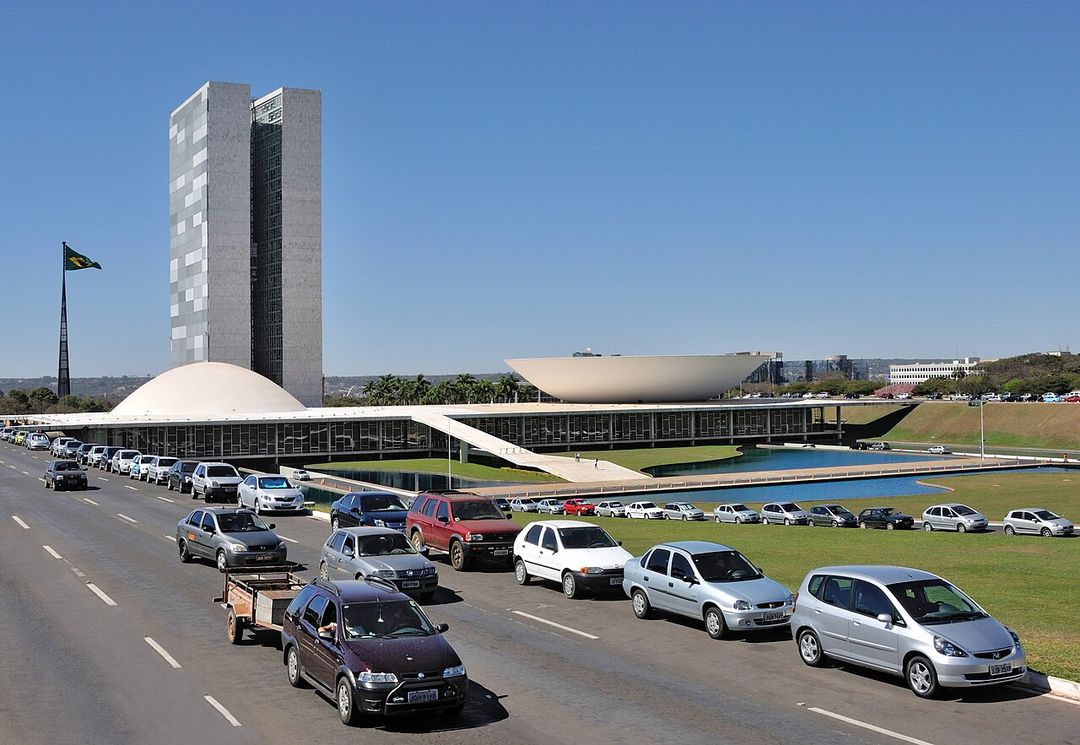
Every other capital city on this site grew the way cities grow: a river crossing, a port, a hill worth defending, centuries of accretion until the street plan stopped making sense to anyone but the people who walked it every day. Brasilia grew the way a chess move happens. In 1956, Brazil's interior held almost nothing where the capital now stands — red dirt, scrub savanna, a plateau a thousand metres up in the middle of the country, chosen specifically because it was nowhere, in a nation whose entire population and wealth clung to a coastline two thousand kilometres away. President Juscelino Kubitschek wanted a new capital built and occupied within his single term. Urban planner Lucio Costa won a blind competition with a sketch of two crossing axes, one bowed like a bird or an aeroplane depending who you ask. Oscar Niemeyer, his old friend and collaborator, took the buildings. Somewhere between 60,000 and 100,000 construction workers, the candangos, worked in shifts around the clock in a boomtown with no services and brutal heat. On April 21, 1960, the capital was inaugurated, essentially finished, three years and five months after the first stake went into the ground.
That origin story is not background trivia here — it is the entire reason to visit. Brasilia is the fullest built expression of a mid-century idea that cities could be engineered rather than grown, that good design applied at total scale would produce a better way of living. It is a UNESCO World Heritage Site less than thirty years after it was finished, the youngest place ever to receive that status at the time, awarded specifically for being a complete, coherent work of modernist urban planning rather than for any single building. Whether the experiment succeeded is a genuinely open question, and one the city itself argues with daily: the monumental core is one of the most beautiful pieces of civic architecture on the planet, and the superquadras where actual Brasilienses live were built on the then-radical premise that class shouldn't determine your apartment block. It has also produced a city so zoned and so built for the car that pedestrians are a planning afterthought, and satellite towns that grew explosively outside the plan precisely because the plan had no room for the people the city needed to build it.
This dispatch treats Brasilia as what it is: not a leisure destination with a beach or an old town to wander, but a serious architectural pilgrimage that rewards two focused days and very little more. You come here to see Niemeyer's late, confident work at the scale he intended it, to understand how a government decided a country's psychology could be redrawn on a drafting table, and to eat surprisingly well in a city nobody associates with food. Come with that framing and Brasilia delivers completely. Come expecting a normal Brazilian city with a colonial centre and cobbled lanes, and you will spend your whole visit confused about why nothing is where you expect it.
The caseWhy Brasilia earns the detour
Most people who visit Brazil never see Brasilia at all, and that is a shame specifically for anyone who cares about architecture, because nowhere else lets you walk through an entire modernist manifesto built at full civic scale and still functioning as a government. Niemeyer's late style is everywhere here, and it is a different animal from the boxy International Style his contemporaries were building elsewhere: he wanted curves, he wanted concrete to look weightless, and buildings like the National Congress, the Cathedral and the Itamaraty Palace still look genuinely radical, not dated, six decades on.
What makes it more than an architecture-nerd checklist is the scale of the ambition behind it. Brasilia was meant to physically relocate Brazil's centre of gravity away from the colonial coast and into the country's own interior, forcing development inland and symbolically declaring that the nation belonged to more than its port cities. It worked, in the sense that the interior did develop and the capital did move. It also created a city with almost no informal street life in the plan itself, because Costa's Pilot Plan zoned everything — living here, working there, shopping in a third place, all connected by roads built for cars moving at speed — which is precisely why the superquadra residential sectors and the satellite cities that exploded outside the original plan feel like a rebuttal the city wrote about itself.
And there is a real, specific pleasure in the monumental core that has nothing to do with theory: enormous, uncluttered civic space, reflecting pools that turn concrete buildings into their own mirror images, and skies over the high plateau that go a hard, saturated blue for most of the year. It photographs like nowhere else in Brazil. It is also, refreshingly, calm — this is a government town without Rio's intensity or Sao Paulo's sprawl pressing on you, and two unhurried days is enough to see the essential buildings properly and understand what the whole argument was about.
The calendarWhen to go
Brasilia sits on a high plateau at roughly 1,170 metres, which moderates the tropical heat you would expect at this latitude, and the seasons here are defined entirely by rain, not temperature. The dry season, from May to September, is the one to plan around: clear, hard-blue skies that make the monumental axis photograph at its absolute best, daytime temperatures in the comfortable mid-20s Celsius, and virtually no rain to interrupt long walks between the Praca dos Tres Poderes and the Cathedral. The trade-off is humidity, which can drop into the low double digits or even single digits by August and September, dry enough to crack lips and trigger nosebleeds for visitors unused to it — carry water and a good moisturiser, and do not underestimate how dehydrating a dry-season day here is despite the mild temperature.
The wet season runs October through April, peaking December to February, and brings the dramatic late-afternoon thunderstorms typical of Brazil's central plateau: a clear morning, a wall of cloud building through the afternoon, then a short, heavy, often spectacular downpour before the sky clears again by evening. It is not a washout season — mornings are usually fine for sightseeing, and the storms themselves, watched from under cover, are genuinely worth seeing roll in across that huge open sky. Average temperatures are slightly warmer than the dry season and everything is green rather than dust-brown, which some photographers actually prefer around the reflecting pools.
Avoid, if you can help it, the last two weeks of December through early January and the week around Carnival, when the city — being a government town built for civil servants rather than tourism — genuinely empties: ministries close, ministers and their staff go home to their states, and a meaningful share of restaurants and even some hotels reduce hours or shut. This is the flip side of Brasilia's built purpose: it depopulates when the government does. Outside of those specific weeks, any time in the dry season is the safe, easy recommendation.
LogisticsGetting around a city built for cars
Say this plainly: Brasilia was designed around the automobile in a way almost no other capital was, and pretending otherwise wastes a visitor's time. Costa's Pilot Plan is shaped like a bow (some see a bird, others a plane) with a long Monumental Axis running east-west through the government and civic core, crossed by a curving Residential Axis holding the superquadra apartment blocks. Distances between the sights that matter to a visitor are large by the standards of a walkable old European or colonial-Brazilian city, and the roads connecting them are wide, fast, multi-lane arteries with pedestrian crossings that are sometimes an inconvenient walk away from wherever you actually are.
Ride-hailing is the honest answer for most of a Brasilia visit. Uber and 99 both operate reliably and cheaply here, and given how spread out the essential sights are along the Monumental Axis, hopping between them by car is not a compromise, it is how the city itself expects to be used. Budget accordingly and do not fight the design.
That said, the absolute core is more walkable than it first appears, and doing it on foot is the right call specifically because the scale of the empty civic space is the point. The stretch from the TV Tower along the Esplanada dos Ministerios to the Praca dos Tres Poderes, taking in the Cathedral and the National Museum along the way, is a long but entirely doable walk of a couple of kilometres on flat ground with genuinely striking views opening up as you go — treat this specific corridor as a walking morning and use cars for everything else.
The city does have a public bus network and a small metro line, but both are built primarily to move commuters from the satellite cities into the Pilot Plan for work, not to link tourist sights to each other, and neither is a practical primary strategy for a two-day visit. The airport, Brasilia International (BSB), sits about 11 kilometres south of the centre and is a straightforward 20 to 30 minute taxi or ride-hail into the Hotel Sector; an airport bus exists but again optimises for commuters rather than visitors with luggage. If you plan to rent a car, note that the wide multi-lane roads and frequent use of trevos — cloverleaf-style interchanges instead of traffic-light junctions — take a short adjustment even for confident drivers, since a turn you would expect to make directly often requires committing to a full loop first.
The tableHow Brasilia actually eats
Nobody puts Brasilia on a list of Brazil's great food cities, and that reputation is out of date. As the seat of federal government and the diplomatic corps, the city has quietly built one of Brazil's most cosmopolitan and well-funded dining scenes per capita — embassies mean a genuine international restaurant range, and a concentration of well-paid civil servants and lobbyists means the kitchens get supported. The Asa Sul and Asa Norte superquadra commercial strips, and increasingly the Lago Sul and Lago Norte areas around the lake, hold serious restaurants that would not be out of place in Sao Paulo, at noticeably gentler prices.
Start with the regional cooking of Goias and the wider Centro-Oeste, since Brasilia sits in the state that used to hold this land before the Distrito Federal was carved out of it. Pequi is the ingredient to know and to be careful with: an orange fruit with a strong, resinous, faintly turpentine aroma that Brazilians from elsewhere either love instantly or need three tries to understand, traditionally cooked into arroz com pequi (rice) or galinhada (chicken and rice) — eat around the pit rather than biting into it, since it is covered in sharp internal spines. Empadao goiano is a substantial savoury double-crust pie stuffed with chicken, pork, sausage, egg, olives and hearts of palm, built to feed a table rather than one person, and pamonha, a sweet or savoury fresh-corn tamale, turns up at markets and street stalls, especially through the corn harvest.
Brasilia's own contribution to Brazilian food culture is less a dish than an institution: the churrascaria rodizio, the all-you-can-eat rotating-skewer barbecue format, is executed at a very high level here thanks to the city's proximity to the cattle country of Goias and Mato Grosso, and a Brasilia rodizio dinner is a legitimate reason to skip lunch. Beyond that, treat the city as a genuine testing ground for pan-Brazilian and international food: feijoada on a Saturday, excellent Japanese-Brazilian cooking from the country's large Nikkei community, and a serious, well-reviewed fine-dining scene that has grown up specifically to feed visiting dignitaries and the diplomatic circuit. The lakeside restaurants around Lago Paranoa, especially toward sunset, are worth booking ahead on a Friday or Saturday, when half of official Brasilia seems to have the same idea.
The mapSectors to know
Brasilia does not have neighbourhoods in the organic sense; it has sectors, each zoned for a single function under Costa's plan, and understanding the zoning is the fastest way to stop being confused by the map. The Monumental Axis (Eixo Monumental) is the civic spine running east from the Praca dos Tres Poderes through the Esplanada dos Ministerios — a two-kilometre avenue of near-identical ministry buildings framing the view — past the National Museum, the Cathedral and the TV Tower, to the Rodoviaria bus station at the crossing point with the Residential Axis. This is where you spend most of your sightseeing time and it holds almost no hotels or restaurants of its own; you visit it, you do not stay in it.
The Hotel Sectors, North and South (Setor Hoteleiro Norte and Sul), sit at that crossing point exactly where the two axes intersect, and this is the practical base for almost every visitor: a short walk or drive to the Monumental Axis on one side and to the residential Asa Norte and Asa Sul wings on the other. It is convenient rather than charming — a strip of hotel towers with limited street life of its own after dark.
Asa Sul and Asa Norte, the South and North Wings, are where the superquadra housing blocks fan out along the curved Residential Axis, and they are the closest thing Brasilia has to a lived-in, walkable neighbourhood. Each superquadra was built to a shared standard — identical building heights, a shared internal green space, a local commercial strip for daily errands — on the deliberately egalitarian premise that a senator's block should look the same as a schoolteacher's. Asa Sul in particular has developed into the city's best area for a genuine evening out, with commercial strips like the 400s holding a dense run of restaurants and bars.
Lago Sul and Lago Norte, the wealthier low-density districts wrapped around the shores of the artificial Lago Paranoa, hold the city's grandest private houses, several embassies, and the lakeside restaurant scene worth a sunset visit even if you are not staying there. And well beyond the Pilot Plan boundary, the satellite cities — Taguatinga, Ceilandia, Samambaia and others — hold the majority of the Distrito Federal's population, grew explosively and largely informally precisely because Costa's plan made no provision for the workers who built and served the capital, and are not part of a typical two-day visitor itinerary, though they are the honest demographic reality behind the postcard core.
Field intelligencePractical intelligence
Brasilia runs on the Brazilian real, and as the federal capital it is a comparatively expensive Brazilian city for hotels and fine dining, though everyday food and transport remain reasonable by international standards. Cards are widely accepted in the Hotel Sectors, restaurants and shops; carry some cash for smaller vendors, market stalls and tips, which are not obligatory but a rounded-up 10% is customary at a sit-down restaurant if service isn't already included.
Safety in the areas a visitor actually spends time — the Monumental Axis, the Hotel Sectors, Asa Sul and Asa Norte, Lago Sul — is good by the standards of a major Brazilian city; this is a government town with a heavy security presence around the ministries and the Praca dos Tres Poderes. Ordinary urban caution still applies after dark and around the Rodoviaria bus station, and, as everywhere in Brazil, keep valuables discreet and avoid flashing phones or cameras carelessly on public transport.
The practical fact that shapes everything else: this is a car-built city, so budget more than you would elsewhere for ride-hailing between sights, and do not assume walkability between areas that look close together on a map — the scale of the Monumental Axis is genuinely deceptive in photographs. Sun protection matters more than visitors expect; the plateau altitude and the near-total lack of shade along the civic core mean sunburn arrives faster than the mild temperature suggests, especially in the dry season's harsh, clear light.
Most federal buildings including the National Congress and Itamaraty Palace offer free guided tours, typically weekday mornings and afternoons with more limited weekend hours — check current schedules before planning your day around a specific building, since access can tighten with little notice around political events. Portuguese is the only language you can rely on outside international hotels and upscale restaurants, though English is more common here than in most of Brazil given the diplomatic and government presence; a few basic phrases go a long way everywhere else.
Field notesWhat to see & do
-
Praca dos Tres Poderes
The ceremonial heart of Brazilian government, where the National Congress, the Planalto presidential palace and the Supreme Federal Court frame a vast open plaza — the three powers of the republic, deliberately positioned to face one another as equals.
On the groundCome in the late afternoon when the low sun rakes across the white concrete and the flag, one of the largest in the world, catches the wind properly. Free guided tours of the Congress run on weekdays.
-
Cathedral of Brasilia
Niemeyer's hyperboloid crown of sixteen curved concrete columns, half-sunk below plaza level so you descend into it, with a ceiling of stained glass by Marianne Peretti that floods the interior in blue and green light.
On the groundThe descent through the dark entrance tunnel into the sudden light-flooded nave is the whole effect — do not photograph it from outside first, walk in cold if you can.
-
Itamaraty Palace
The Foreign Ministry headquarters, arguably Niemeyer's most elegant civic building: a rectangular block of soaring white arches seeming to float over a reflecting pool, with an interior garden by Roberto Burle Marx.
On the groundFree tours run on a limited weekday schedule and often require booking a day or two ahead through the Itamaraty website — worth the small effort for the interior garden alone.
-
National Museum and the Digital TV Tower
Niemeyer's half-dome National Museum sits beside the National Library along the Monumental Axis, while the 224-metre TV Tower a short distance away offers a free public viewing deck putting the entire Pilot Plan's bird shape into visible perspective.
On the groundGo up the tower first, early, to orient yourself before walking the axis at ground level — seeing the plan's shape from above makes the rest of the day's walking make sense.
-
Juscelino Kubitschek Memorial (JK Memorial)
A stark black-and-white mausoleum and museum honouring the president who forced Brasilia into existence in three years, holding his tomb, his personal archive, and a genuinely moving account of the city's frantic construction.
On the groundThe exhibits on the candangos, the construction workers who built the city in round-the-clock shifts, are the most human part of the whole monumental core — do not skip the museum for the tomb alone.
-
Palacio da Alvorada
The official presidential residence on the shore of Lago Paranoa, an early and much-copied Niemeyer design whose slender, curving external columns appear to touch the ground on tiptoe.
On the groundThe residence itself is not generally open to the public, but the exterior and gardens are visible and worth the short detour from the Praca dos Tres Poderes, especially at sunset over the lake.
-
Ponte JK (Juscelino Kubitschek Bridge)
A 1,200-metre bridge across Lago Paranoa supported by three asymmetrically crossing steel arches, completed in 2002 and now as photographed at night, lit in changing colours, as any building from the original 1960 plan.
On the groundWalk or cycle the pedestrian and bike path along the bridge deck near sunset for the best light on both the arches and the lake.
-
Feira da Torre (TV Tower craft fair)
A long-running weekend and holiday craft market at the base of the TV Tower selling Brazilian handicrafts, gemstones, hammocks and street food, and the most reliable dose of informal street life anywhere in the Pilot Plan.
On the groundWeekends only, and it winds down by early evening — pair it with the tower viewing deck and a late lunch rather than planning a whole afternoon around it alone.
On the groundWhere things are
Map data © OpenStreetMap contributors.
Where to stayBase yourself well
Setor Hoteleiro Sul (South Hotel Sector)
Best for first-timers focused on the monumental coreThe main hotel strip sitting exactly where the Monumental and Residential axes cross, putting the civic core on one side and the Asa Sul restaurant streets on the other. Convenient rather than charming, and the default base for most visitors.
A business-class tower in the South Hotel Sector
Look for a room on a higher floor facing the Monumental Axis for a view over the government buildings toward the Praca dos Tres Poderes.
$$$A mid-range chain hotel near the Rodoviaria
A short walk from the central bus station connections and an easy ride-hail to either axis, at a gentler rate than the lakefront properties.
$$Asa Sul
Best for travellers who want an evening scene rather than a hotel-sector stripThe South Wing's superquadra blocks and their commercial strips, the closest thing Brasilia has to a walkable residential neighbourhood with restaurants, bars and daily life at street level after the ministries empty out.
A serviced apartment in a superquadra block
Living inside an actual superquadra for a night or two is itself part of understanding the plan — ask for one near the 400s commercial strip for restaurants on foot.
$$Lago Sul
Best for longer stays and lakeside diningLow-density, leafy and wealthy, wrapped around the southern shore of Lago Paranoa near several embassies and the presidential residence. Quiet and residential, best for travellers with a car or a generous ride-hailing budget.
A lakeside boutique hotel in Lago Sul
Trades proximity to the Monumental Axis for lake views and quiet, with the sunset restaurant scene on your doorstep instead of a taxi ride away.
$$$Setor Hoteleiro Norte (North Hotel Sector)
Best for value without sacrificing the central crossing-point locationThe quieter counterpart to the South Hotel Sector across the Monumental Axis, slightly less dense and a touch better value for essentially the same central location.
A value hotel in the North Hotel Sector
The same crossing-point convenience as the South sector at a generally softer rate, with Asa Norte's restaurants a short ride away.
$$Affiliate notePostcardRoute is reader-supported. Some links to accommodation are affiliate links: if you book through them we may earn a small commission at no extra cost to you. We only recommend places we would send a friend.
Beyond the cityWorthwhile day trips
- Chapada dos Veadeiros National Park
A high-altitude plateau of waterfalls, canyons and crystal-clear natural pools about three and a half hours north by car, centred on the small hippie-pilgrimage town of Alto Paraiso and the village of Sao Jorge at the park gate. Needs at least an overnight to do properly.
- Pirenopolis
A well-preserved 18th-century colonial gold-mining town in the hills of Goias, about two hours by road, with cobbled streets, baroque churches and a cluster of waterfalls nearby — the closest thing to the historic Brazil that Brasilia itself deliberately does not offer.
- Cristalina
A small town roughly an hour and a half southeast, known for its crystal and gemstone shops and workshops set among the striking rock formations of the surrounding countryside — an easy half-day if you want a break from concrete and modernism.
Before you goCommon questions
- How many days do you need in Brasilia?
- Two full days covers the essential monumental core properly: the Praca dos Tres Poderes, the Cathedral, Itamaraty Palace, the National Museum and TV Tower, and an evening in Asa Sul. A single day is possible if you are disciplined and use ride-hailing between sights, but it will feel rushed. Beyond two days, add a Chapada dos Veadeiros overnight or a Pirenopolis day trip rather than lingering longer in the Pilot Plan itself.
- Is Brasilia worth visiting if I am not an architecture person?
- It is a more specialised trip than Rio or Sao Paulo, and it rewards genuine curiosity about how the city came to exist more than casual sightseeing. If the idea of an entire capital designed on a napkin and built in three years interests you at all, two days here delivers on that completely. If you are looking for beaches, historic old towns or nightlife, put your time elsewhere in Brazil instead.
- Can you walk around Brasilia, or do you need a car?
- The core stretch along the Monumental Axis — from the TV Tower past the Cathedral and National Museum to the Praca dos Tres Poderes — is a walkable couple of kilometres on flat ground and the best way to see it. Almost everything else, including getting to and from your hotel and to Asa Sul for dinner, is realistically done by Uber or 99 rather than on foot; the city's scale and road design were built for cars, not pedestrians.
- What is the best time of year to visit Brasilia?
- The dry season, May through September, brings clear skies, comfortable daytime temperatures and the best light for photographing the monumental architecture, though the air gets very dry by August and September. The wet season, October to April, brings dramatic afternoon thunderstorms but usually clear mornings, and everything turns green. Avoid late December through early January and the week of Carnival, when the government town genuinely empties out.
- Why was Brasilia built in the middle of nowhere?
- President Juscelino Kubitschek wanted to physically shift Brazil's centre of gravity away from the crowded, wealthy coastline and force development into the country's underused interior, fulfilling a goal written into Brazil's constitution decades earlier. The plateau site had almost no existing population, which let Lucio Costa and Oscar Niemeyer build the entire city from a single coherent plan rather than adapting to what already existed — the whole point was a clean slate.
- Is Brasilia safe for tourists?
- Yes, particularly in the areas a visitor spends time — the Monumental Axis, the Hotel Sectors, Asa Sul and Asa Norte, and Lago Sul — which benefit from a heavy government security presence. Ordinary Brazilian urban caution still applies: keep valuables discreet, use ride-hailing rather than hailing taxis on the street at night, and take normal care around the Rodoviaria bus station after dark.