
Italy · Emilia-Romagna
Bologna earned its nicknames the hard way
The learned, the fat, the red — a working university city that happens to also be where Italy's best-known pasta sauce actually comes from, under 36 kilometres of arcaded porches built so nobody gets wet.
Italy's food capital, and nobody had to tell it so · 44.49° N · 11.34° E
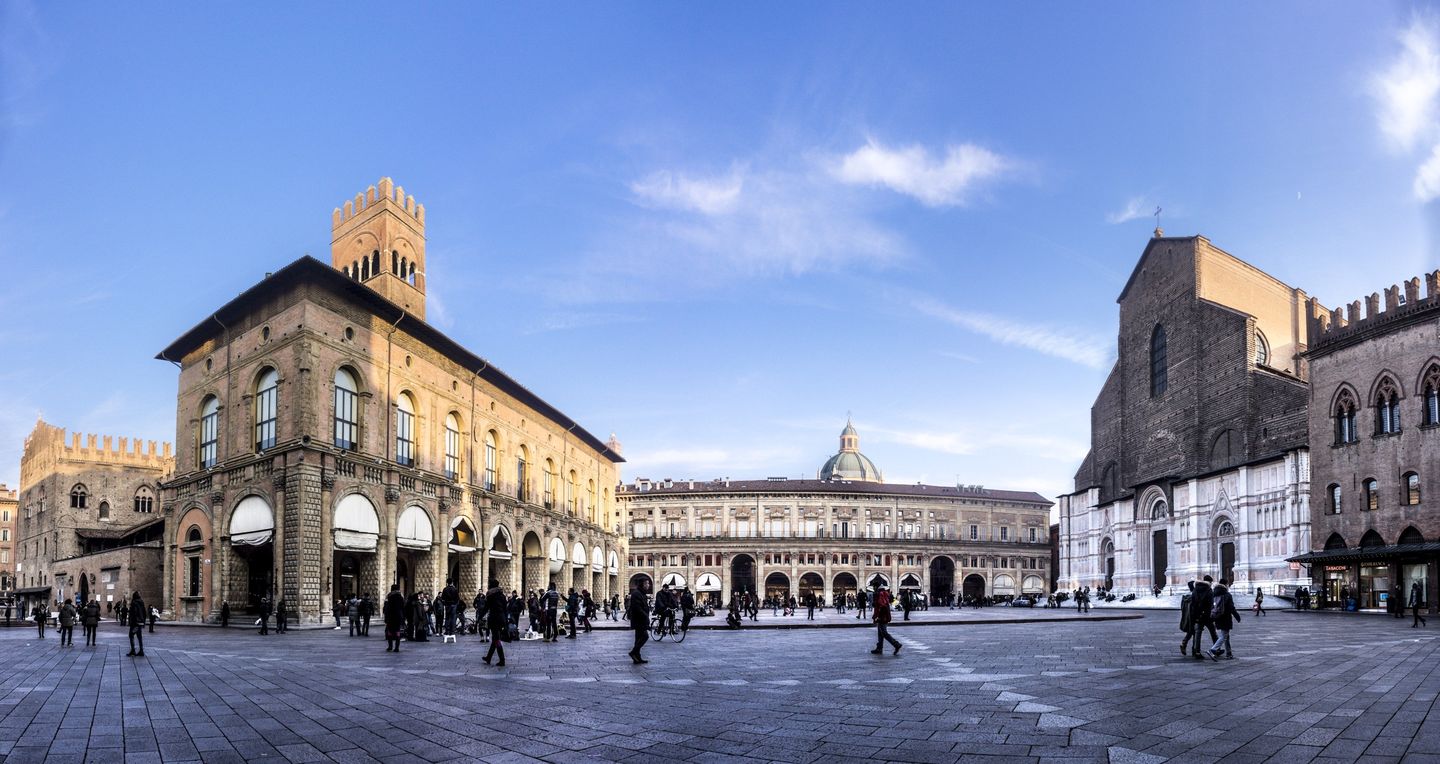
Italians have three nicknames for Bologna and all three are earned. La dotta — the learned — for a university founded in 1088, the oldest in the Western world still teaching students today, and for the medieval law scholars whose lecture halls still ring the old centre. La grassa — the fat — for a kitchen that gave the world tagliatelle al ragù, tortellini, and mortadella, and that still treats a trattoria lunch as a civic institution rather than a tourist transaction. And la rossa — the red — for the terracotta rooftops seen from any of the surrounding hills, and for a political history as one of Italy's most durably left-leaning cities.
What those three nicknames don't quite convey is how unbothered the city is about being noticed. Bologna has no single, single-ticket monument the way Rome has the Colosseum or Pisa has its tower. It has instead a genuinely lived-in historic centre — one of the largest and best-preserved in Europe — stitched together by nearly 40 kilometres of covered porticoes, a 900-year-old university still running classes in the same quarter, and a food culture so strong that several of its signature dishes are better eaten here than anywhere they've since travelled to, including the places that put 'Bolognese' on an export menu.
That makes it an unusually good antidote to Italy fatigue. There is no queue to the Sistine Chapel here, no gondola touts, no selfie bottleneck at a single viewpoint. There is a market quarter that still functions as a market, a university quarter still full of actual students, and a central square that Bolognesi walk through on the way to work rather than photograph. Give it two or three days and it rearranges your sense of what an Italian city visit is supposed to feel like.
The caseWhy Bologna, and why now
Bologna spent decades as the city Italians raved about and foreigners skipped on the way between Florence and Venice, which is exactly why it has kept its nerve. The historic centre is enormous by Italian standards — one of the best-preserved medieval and Renaissance cores in Europe — and almost none of it has been hollowed out into souvenir shops the way parts of Florence and Venice have. Shops sell things Bolognesi actually buy. Restaurants cook for regulars first.
The porticoes are the detail that converts people fastest. Roughly 38 kilometres of arcaded walkway line the streets of the centre, a mix of medieval timber overhangs and later stone and brick colonnades, built originally so the university's growing student population had somewhere to live and somewhere dry to walk. UNESCO added them to the World Heritage list in 2021 as a connected urban system, not a single building — walk the centre in a downpour and you understand immediately why. Add a food culture that invented half the dishes people think of as generic 'Italian', a lively university energy that keeps the city young and cheap after dark, and an hour-by-train radius that reaches Florence, Venice, Modena and Ferrara, and the case makes itself.
The calendarWhen to go
April, May, late September and October are the sweet spots — warm enough to eat outside, cool enough to walk the centre at midday without wilting, and ahead of or behind the thickest crowds. Bologna is less seasonally extreme than Rome or Florence because it has never depended on tourism the way they have, so 'high season' here is a gentler curve than elsewhere in Italy.
July and August bring real heat, and like much of Italy, a chunk of the city's family-run trattorias close for a week or two around the Ferragosto holiday in mid-August — check ahead if a specific restaurant is the whole reason for the trip. Winter is underrated: the porticoes mean a surprising amount of the centre stays walkable in the rain, Christmas markets fill Piazza Maggiore in December, and hotel prices drop noticeably outside the university's exam periods. Avoid trying to see Bologna as a single rushed day-trip from Florence — it rewards an overnight stay far more than its size on a map suggests.
LogisticsGetting around
Walk. The historic centre is compact enough to cross on foot in well under an hour, and the porticoes mean you can do it in a thunderstorm without an umbrella. Most of what matters — Piazza Maggiore, the Two Towers, the university quarter, the Quadrilatero market streets — sits within a 15-minute walk of the centre, and a bicycle is the only upgrade worth making if you want to range further, with bike lanes and a city bike-share system that's genuinely usable.
Bologna Centrale, the train station, is one of Italy's great rail hubs — high-speed lines put Florence around 35 minutes away, Milan about an hour, Venice around 90 minutes, and Rome under two hours, which makes Bologna a serious base for day trips as well as a destination in its own right. From Bologna Guglielmo Marconi Airport, the Marconi Express monorail covers the short hop to Centrale station in about seven minutes, running every few minutes — skip the taxi queue and take it. Buses (the ATC network) fill in anywhere walking won't reach, useful mainly for the hill-top Basilica of San Luca if you don't fancy the walk up.
The tableWhy Bologna eats like this
Tagliatelle al ragù is the dish most visitors came for, and it is worth saying plainly: the thing called 'spaghetti bolognese' abroad does not exist here. The real ragù — a slow-cooked sauce of minced meat, soffritto, tomato and often milk or wine — is paired with fresh egg tagliatelle because the ribboned, slightly rough surface holds the sauce the way smooth spaghetti can't. Order tagliatelle al ragù, not 'spaghetti bolognese', and a Bolognese waiter will relax slightly.
Tortellini in brodo — tiny meat-filled pasta parcels served in a clear broth, traditionally for Christmas but available year-round — is the other dish to seek out, along with tortelloni (the larger, usually ricotta-and-spinach-filled cousin), lasagne alla bolognese, and mortadella, the smooth pork cold cut that 'baloney' is a corrupted echo of and that tastes nothing like it once you've had the real thing sliced thin off the bone at a deli counter. This is also Parmigiano-Reggiano and balsamic-vinegar territory by extension — the real versions come from nearby Parma and Modena, both an easy train ride away, and Bolognese kitchens use them accordingly.
Eat where the lunch crowd is Italian. The university quarter and the streets around the Quadrilatero market hold the city's best density of trattorias, osterie and old-school delis, many with a hand-written daily menu and no interest in translating it. A tagliere of cured meats and cheeses with a glass of Lambrusco — the real, dry, slightly sparkling red, not the sweet export version — is a perfectly respectable light lunch. Reserve ahead for anywhere with a reputation; this is a city that eats out seriously and tables for the well-known kitchens go fast.
The mapNeighbourhoods to know
The centro storico inside the old walls is where most visits happen, built around Piazza Maggiore and radiating out along the two main spine streets, Via dell'Indipendenza and Via Rizzoli. It splits usefully into smaller districts: the Quadrilatero, the tight medieval grid of market streets immediately east of Piazza Maggiore, is the best few blocks in the city for food shopping, delis and quick lunches, loudest and most alive in the late morning.
The university quarter, centred on Via Zamboni and spreading toward Via delle Belle Arti, is younger, scrappier and the best place after dark — student bars, cheap wine, and a genuinely mixed-age crowd rather than a tourist one. Santo Stefano, south-east of Piazza Maggiore, is quieter and more elegant, built around the extraordinary Basilica of Santo Stefano. San Donato–San Vitale, just outside the old walls to the east, is where rising rents have pushed students and young Bolognesi, and it has the loosest, least-polished energy of the lot. Keep the walled centre as your base for a first visit — everything that matters for a short trip sits inside or just beyond it.
Field intelligencePractical intelligence
Validate public transport tickets before boarding — Bologna's bus inspectors do check, and an unvalidated ticket is treated the same as no ticket at all. Buy tickets from a tobacconist (look for the black-and-white 'T' sign) or a ticket machine rather than trying to find a conductor on board.
Many of the smaller museums and the Archiginnasio's anatomical theatre keep limited hours and close for a midday stretch or an extra day midweek — check specific opening times before building a tight schedule around any one sight. The climb up the Asinelli Tower is genuinely strenuous (nearly 500 steps with no lift) and visitor numbers are capped per slot, so book ahead in high season rather than turning up and hoping.
Like much of Italy, many shops and some restaurants still close for a few hours in the early afternoon, and a meaningful share of the city's eating and drinking slows down around the August Ferragosto holiday. Tipping is not the custom the way it is in the US; a cover charge (coperto) or service charge is often already on the bill, and rounding up is generous rather than obligatory. And do learn to love the portico — on a hot afternoon or in the rain, it is the single best piece of urban design in the city, and it is free.
What to see & do
-
Piazza Maggiore & Basilica di San Petronio
The civic heart of Bologna since the 13th century, ringed by the unfinished brick facade of San Petronio — intended to be the largest church in Christendom before the Church redirected the funds elsewhere — and the arcaded Palazzo dei Banchi.
Tip:The basilica's facade is deliberately half-clad in marble and half bare brick; ask why at the small ticket desk inside and you get a genuinely good story about Rome running out of patience with Bolognese ambition.
-
The Two Towers (Due Torri)
Asinelli and Garisenda, the last two survivors of what was once a forest of nearly 100 noble family towers — Asinelli climbs to 97 metres and 498 steps, Garisenda leans more sharply than Pisa's famous tower ever did.
Tip:Check current access before planning around it — Garisenda has been closed to the public in recent years over structural concerns, and Asinelli visitor slots are capped and worth booking in advance in summer.
-
Portico di San Luca & the hilltop sanctuary
The world's longest portico — roughly 3.5 kilometres and 666 arches — climbs from Porta Saragozza to the Santuario della Madonna di San Luca on the hill above the city, built so processions and pilgrims never had to walk in the open.
Tip:Walk up in the late afternoon; the view back over Bologna's red rooftops from the sanctuary steps is best with the light low and behind you.
-
The Quadrilatero market streets
A tight medieval grid of lanes just east of Piazza Maggiore, lined with butchers, fishmongers, cheese counters and delis that have traded here for centuries — the single best place in the city to understand why it's nicknamed 'the fat'.
Tip:Come between 10am and noon on a weekday, when the stalls are busiest and freshest and the weekend crowds haven't arrived.
-
Basilica di Santo Stefano (the Seven Churches)
A strange, atmospheric complex of interlinked medieval churches and courtyards built up over centuries on the site of an older pagan temple, once genuinely seven buildings and still popularly known by that count.
Tip:Don't rush it — the real pleasure is wandering between the linked cloisters and chapels rather than ticking off a single nave.
-
Archiginnasio & the Anatomical Theatre
The university's original 16th-century home, its walls and ceilings covered in painted coats of arms of generations of students, leading to a small wood-panelled anatomical theatre where public dissections were once performed.
Tip:It keeps limited and sometimes irregular opening hours — check the day's schedule before making it the centrepiece of a plan.
-
MAMbo (Museo d'Arte Moderna di Bologna)
Bologna's contemporary art museum, housed in a converted former bakery and market hall in the up-and-coming area beyond the old walls, with a collection and rotating exhibitions that punch well above the city's size.
Tip:Pair it with a walk through the surrounding former industrial district, which has filled in with galleries and studios over the last decade.
-
Finestrella di Via Piella
A tiny unmarked window set into a wall on Via Piella that frames one of the last visible stretches of Bologna's largely hidden medieval canal network — most of the city's waterways were covered over in the 20th century.
Tip:It's easy to miss; look for a small crowd with phones raised to a gap in the wall, roughly where Via Piella meets Via Oberdan.
On the groundWhere things are
Map data © OpenStreetMap contributors.
Where to stayBase yourself well
Around Piazza Maggiore
Best for first-timers and short staysThe old civic heart, with the Two Towers, the basilica and the Quadrilatero all within a few minutes' walk. Central, lively, and the easiest base for a first visit who wants everything on foot.
A boutique hotel on a quiet lane just off the piazza
Look just a block or two back from the square itself — the noise drops fast and the walk stays under five minutes.
€€€A small apartment above the Quadrilatero market streets
Waking up above the market means fresh bread and espresso before the day-trippers arrive.
€€The university quarter (Via Zamboni)
Best for nightlife and valueYounger, looser and noticeably cheaper after dark — student bars, long wine-bar tables, and the best casual nightlife density in the city, a short walk from the centre.
A simple guesthouse near Via delle Belle Arti
Expect noise on weekend nights in exchange for the lowest rates close to the centre.
€€Santo Stefano
Best for a quieter, still-central baseQuieter, more residential and a touch more elegant, built around the Basilica of Santo Stefano — still a five-to-ten-minute walk from Piazza Maggiore but a noticeably calmer night's sleep.
A restored townhouse hotel near the Seven Churches
A good middle ground for anyone who wants Piazza Maggiore walkable but doesn't want to hear it from bed.
€€€Near Bologna Centrale (the train station)
Best for day-trippers and early departuresLess picturesque, but unbeatable if Bologna is a base for day trips to Florence, Modena, Ferrara or Venice — the historic centre is still a 15-to-20-minute walk or a short bus ride away.
A modern hotel a few minutes from Centrale station
Worth the trade-off in charm if an early train is the priority on any given morning.
€€San Donato–San Vitale
Best for repeat visitors on a budgetOutside the old walls to the east, cheaper and scruffier, with a growing scene of its own as rents push students and young Bolognesi out of the centre.
A budget apartment stay just beyond Porta San Donato
A 10-to-15-minute walk or a short bike ride into the centre, with noticeably lower rates for it.
€Affiliate notePostcardRoute is reader-supported. Some links to Booking.com (stays, flights, car hire, tickets and tours, airport transfers) are affiliate links, tracked through CJ Affiliate: if you book through them we may earn a small commission at no extra cost to you. We only recommend places we would send a friend.
Book the restEverything else for the trip
Stay sorted? These open Booking.com for the other legs of the journey.
-
Tours & tickets
Things to do
Tickets, tours and activities, anywhere.
Browse activities -
Wheels
Car hire
Compare rental companies worldwide.
Compare cars -
Air
Flights
Search fares, then come back for the neighbourhood advice.
Search flights -
Ground
Airport transfers
Book a taxi or private transfer before you land.
Book a transfer
Affiliate noteThese four links are affiliate links too: if you book through them we may earn a small commission at no extra cost to you.
Beyond the cityWorthwhile day trips
- Modena
Twenty-five minutes by train: a gorgeous Romanesque Duomo, the real source of balsamic vinegar (visit a traditional acetaia for a tasting), and the Ferrari and Maserati museums for anyone who cares about Emilia-Romagna's other famous export.
- Parma
Under an hour away, and the source of Parmigiano-Reggiano and Prosciutto di Parma — tour a cheese dairy if the timing allows, then wander a gracious small city built around an elegant Duomo and Baptistery.
- Ferrara
About half an hour north: a flat, bike-friendly Renaissance city built by the Este dukes, centred on a genuine moated castle, with a historic Jewish quarter and one of the best cycling cultures in Italy for a day of unhurried pedalling.
- Ravenna
Roughly an hour away and worth the trip for the Byzantine mosaics alone — several UNESCO-listed churches and mausoleums hold some of the best-preserved early Christian mosaic work anywhere in the world.
Before you goCommon questions
- How many days do you need in Bologna?
- Two full days covers the historic centre properly — Piazza Maggiore, the Two Towers, the Quadrilatero market streets, and a climb to San Luca. Add a third day if you want to use Bologna as a base for a day trip to Modena, Ferrara or Parma, all of which sit within an hour by train.
- Is Bologna better than Florence for a first trip to Italy?
- They do different jobs. Florence has the single greatest concentration of Renaissance art anywhere, and that's worth the crowds at least once. Bologna offers a calmer, more lived-in Italian city experience with arguably better everyday food and far fewer queues — a strong pairing with Florence rather than a straight replacement for it.
- What is 'spaghetti bolognese' actually called in Bologna?
- It isn't served under that name at all. The real dish is tagliatelle al ragù — fresh egg ribbon pasta with a slow-cooked meat sauce — and ordering 'spaghetti bolognese' in Bologna itself will mark you out as a tourist. Ask for tagliatelle al ragù and the kitchen will take you more seriously.
- Why does Bologna have so many covered porticoes?
- They grew out of medieval rules letting property owners extend upper floors over the street to house the university's expanding student population, on condition the extensions stayed open underneath for public passage. The result, roughly 38 kilometres of connected arcades across the city, was added to UNESCO's World Heritage list in 2021 as a single urban system.
- Is Bologna walkable, or do I need public transport?
- The historic centre is genuinely compact and walkable — most sights sit within 15 minutes of Piazza Maggiore, and the porticoes mean you can do it in bad weather without an umbrella. Buses or a bike are useful mainly for reaching the hilltop Basilica of San Luca or the areas just outside the old walls.
- What is the best time of year to visit Bologna?
- April–May and late September–October offer the best balance of good weather and manageable crowds. Bologna's tourism is less seasonally extreme than Rome's or Florence's, and winter is genuinely underrated thanks to the porticoes keeping much of the centre walkable in the rain, plus lower hotel rates outside university exam periods.
- How do I get from Bologna's airport into the city centre?
- Take the Marconi Express monorail directly from the airport to Bologna Centrale train station — it runs every few minutes and the ride takes about seven minutes, considerably faster and more reliable than a taxi in traffic.