Palermo, Italy
Cappella Palatina
A room barely the size of a village church, decorated by three civilisations at once, and still the clearest single argument for visiting Palermo.
A Norman king's private chapel where Byzantine gold, Arabic woodwork and Latin stonework share one small room without once fighting each other
Buy tickets ↗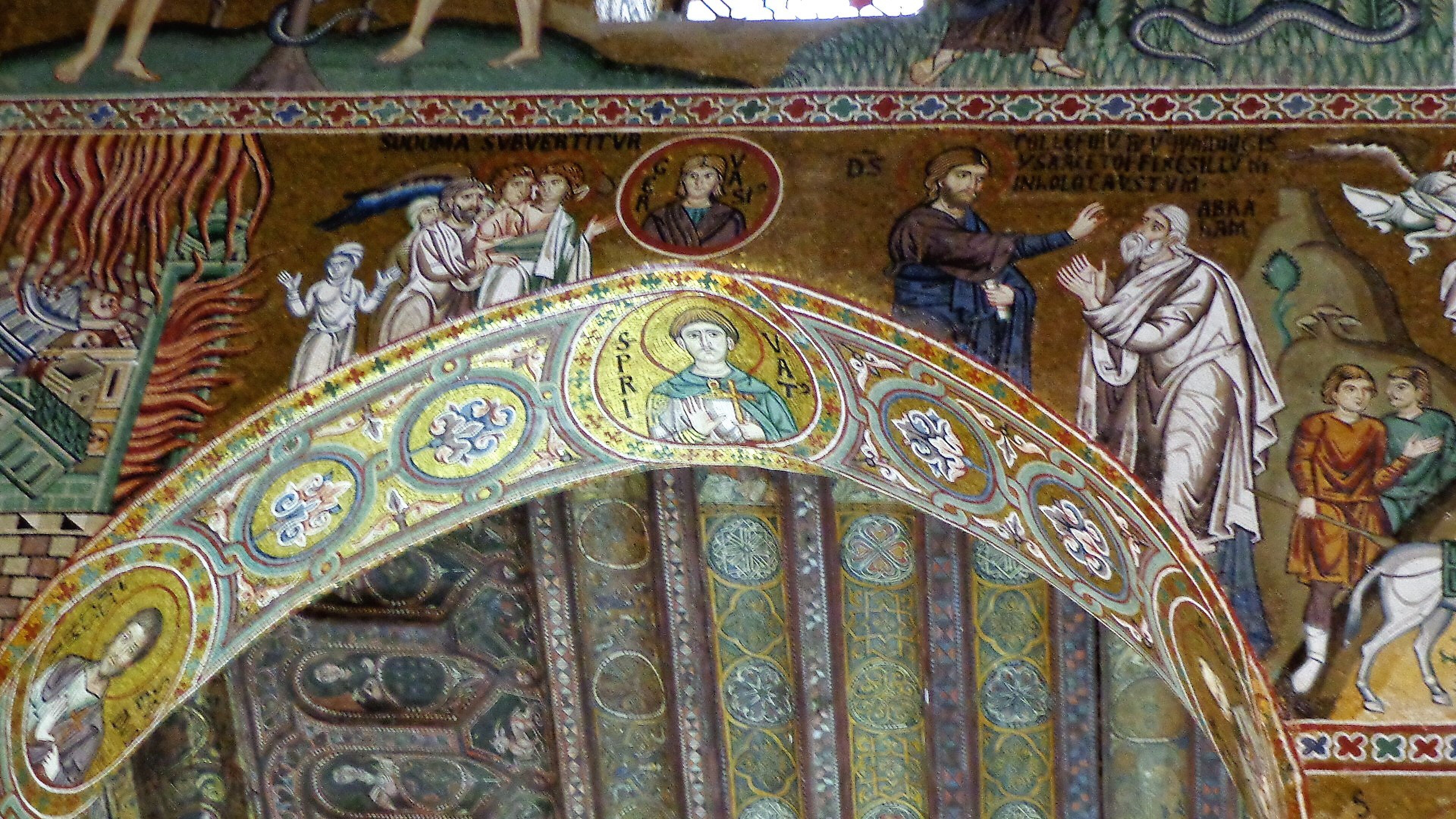
The Cappella Palatina is easy to walk past without noticing, because from the courtyard of the Palazzo dei Normanni it is just another doorway off a working government building — the Sicilian Regional Assembly still sits upstairs. Step through that doorway and the scale problem becomes obvious immediately: this tiny private chapel, built for a 12th-century king and his household rather than a congregation, is covered floor to ceiling, apse to aisle, in some of the finest Byzantine mosaic work anywhere outside Constantinople or Ravenna, under a carved and painted wooden ceiling that has nothing to do with Christian Europe at all.
What makes the chapel genuinely singular, rather than merely beautiful, is that those two traditions — Greek Byzantine mosaic and Islamic muqarnas woodwork — sit directly on top of a third, a conventional Latin basilica floor plan with a cosmatesque marble pavement, and none of the three were treated as decoration applied to someone else's building. Roger II, the Norman king who commissioned it, ruled a multicultural, multi-faith Sicily and appears to have simply hired the best craftsmen available regardless of where they came from: Greek mosaicists, probably trained in the Byzantine tradition, and woodworkers working in a style associated with Fatimid Egypt, building side by side for a Latin Christian king in a palace at the edge of the Arab world and the edge of Byzantium both.
The result is the single clearest physical expression of what historians call Arab-Norman Sicily, and it is why the chapel sits at the centre of the UNESCO World Heritage listing that also covers Palermo's cathedral and the cathedrals of Monreale and Cefalù. Nothing else in the group packs quite as much of that fusion into quite so small a space.
The backstoryA king who hired across three civilisations
Roger II began the chapel in 1132, within a decade of consolidating Sicily into a single Norman kingdom out of territory that had previously been fought over by Byzantine Greeks, Arab emirs and various Latin Christian claimants. Rather than erase that layered inheritance, Roger's court seems to have actively drawn on all of it — the kingdom's administration ran in Greek, Arabic and Latin simultaneously, and the chapel he built for his own private worship reflects exactly that trilingual, tri-cultural governing style in physical form. It was consecrated in 1140, with the mosaic programme continuing under his successors for some years afterward.
The mosaics are generally attributed to workshops trained in the Byzantine tradition, quite possibly including craftsmen who had worked on churches in Constantinople itself, brought to Palermo specifically for royal commissions like this one. The wooden ceiling is harder to pin down precisely, but its muqarnas structure — a honeycomb of small, projecting niches — and painted figurative scenes point toward craftsmen working in a style associated with Fatimid Egypt, making it one of the only surviving examples of that specific decorative tradition inside a Christian building anywhere in the world.
On the groundWhat you're actually looking at
The chapel follows a standard three-aisled basilica plan, which means the architecture itself is almost deliberately unremarkable — all the impact comes from what covers it. Look up first: the nave ceiling is the Fatimid-style wooden muqarnas work, painted with hunting scenes, musicians, animals and courtly figures that have nothing devotional about them at all, a striking contrast with the explicitly religious mosaic programme surrounding it on every wall.
The mosaics themselves run in a clear narrative order if you know where to look. The nave walls carry an Old Testament cycle — Creation, Adam and Eve, Noah's ark — read left to right along the upper registers. The aisles carry scenes from the lives of Saints Peter and Paul. And the sanctuary, the most important space in the building, culminates in a dome and apse mosaic of Christ Pantocrator presiding over the whole room, the same iconographic formula used in the greatest Byzantine churches, transplanted whole into a Norman king's private chapel. The cosmatesque marble floor, geometric inlaid stonework in the Roman tradition, is worth looking down for too — it is easy to miss entirely with so much happening overhead.
Doing it wellGetting in, and getting the most from a small room
Access is the chapel's one real logistical hurdle. It sits inside the Palazzo dei Normanni, a functioning seat of government, and entry is metered to protect the mosaics and manage the limited floor space — walk-up queues at busy times can run well past the time most visitors expect to spend in what is, physically, a small room. A timed online ticket for the Palazzo dei Normanni and chapel combined removes nearly all of that uncertainty and is worth arranging before arriving in Palermo rather than on the day.
Once inside, resist the urge to rush. The temptation with any heavily decorated interior is to do one slow circuit and leave, but the chapel rewards stopping in one spot and simply looking up for a few minutes at a time — the gold mosaic surface was designed to shift and catch available light, and different viewing angles and times of day change how the Pantocrator dome and the upper registers read considerably. As with other religious sites in Sicily, modest dress covering shoulders and knees is the sensible default, even though the chapel's primary identity today is as a historic monument rather than an active parish church.
In the areaWhat to pair it with
The Palazzo dei Normanni sits at the western edge of Palermo's historic centre, an easy walk from the Quattro Canti crossroads and the Baroque fountain of Piazza Pretoria, both covered on the main Palermo dispatch. Palermo Cathedral, a short walk north, forms the other half of the city's own entry in the Arab-Norman UNESCO listing and makes a natural next stop on the same morning, with its own blend of Norman, Arab and later Baroque layers visible in a single building.
For visitors willing to go a little further, the Benedictine abbey church of Monreale, roughly 20 minutes outside the city by bus, completes the Arab-Norman trilogy with an even larger mosaic programme in a more conventionally sized church — worth the half-day trip for anyone who finds the Cappella Palatina's small scale leaves them wanting more of the same tradition at full size.
Practical info
- Tickets
- Admission is via a single combined ticket for the Palazzo dei Normanni and the Cappella Palatina. Booking a timed slot online in advance is strongly recommended — walk-up access is metered to protect the mosaics and queues at the entrance can be long, especially mid-morning in high season.
- Getting there
- The Palazzo dei Normanni sits at Piazza Indipendenza, a roughly 15-minute walk from the Quattro Canti in the historic centre; several city bus routes also stop directly outside.
- Good to know
- The chapel can occasionally close to visitors, or open on a restricted schedule, when the Sicilian Regional Assembly is in session in the same palace — check the official booking site for the current day's access before planning your visit around it.
Before you goCommon questions
- What makes the Cappella Palatina different from other mosaic churches in Sicily?
- It's the smallest and most concentrated example of the Arab-Norman style that also produced Monreale and Palermo Cathedral — Byzantine gold mosaics, a Fatimid-style carved wooden ceiling and a Latin basilica floor plan all occupying one compact royal chapel rather than a full-sized church.
- How long should I spend at the Cappella Palatina?
- Thirty to forty-five minutes is enough to take in the main mosaic cycles and the ceiling properly, though the room is small enough that even a longer, more leisurely visit rarely feels like it needs more than an hour.
- Do I need a separate ticket for the Cappella Palatina and the Palazzo dei Normanni?
- No — a single combined ticket covers both, since the chapel is inside the palace. Booking a timed entry online ahead of your visit is the main thing worth doing in advance.
- Is the Cappella Palatina usually crowded?
- Yes, especially mid-morning in high season, because access is deliberately metered to protect the mosaics and the room itself is small. Arriving right at opening, or booking one of the first available timed slots, is the most reliable way to avoid the worst of it.
- Is the Cappella Palatina worth visiting if I'm also going to Monreale?
- Yes — they complement rather than duplicate each other. The Cappella Palatina compresses the same Arab-Norman mosaic tradition into a small, intimate royal chapel, while Monreale's abbey church shows the same style at a much larger, more conventional church scale.